Individual Economists

"Economic D-Day": Trump Announces "Most Crushing Economic Operation Ever" Against Iran

Zero Hedge -

"Economic D-Day": Trump Announces "Most Crushing Economic Operation Ever" Against Iran

Summary:

  • Trump's Economic War against Iran Begins 
  • Trump says "severe economic consequences" for any country that does businesses with Tehran
  • Trump says "ECONOMIC D-DAY" begins against Iran
  • UAE Cuts Ties As Iran Warns Gulf States Against Helping Washington; Kpler Says US Navy Gaining Ground In Hormuz
​​​​​​​"ECONOMIC D-DAY"

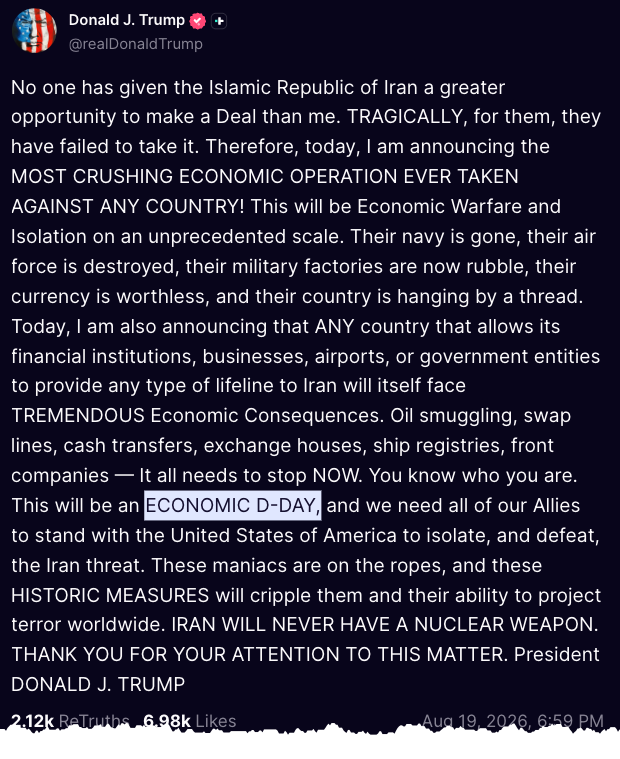
President Trump is out with a Truth Social post describing today as "ECONOMIC D-DAY" against Iran, declaring that his total economic war against Tehran will be the "MOST CRUSHING ECONOMIC OPERATION EVER TAKEN AGAINST ANY COUNTRY."

Trump said that with Tehran's military and military-industrial base reduced to "now rubble" and its "currency worthless," he will unleash severe economic consequences against "ANY country that allows its financial institutions, businesses, airports, or government entities to provide any type of lifeline to Iran."

Here's the full Truth Social post:
Last week, Derek Holt, head of Capital Markets Economics at Scotiabank in Toronto, offered clients a preview of what the campaign to economically isolate Iran could look like (view here), including the potential targeting of China. Notably, much of Iran's crude exports flow to Chinese buyers.

UAE Cuts Ties As Iran Warns Gulf States Against Helping Washington; Kpler Says US Navy Gaining Ground In Hormuz

Iran's parliament speaker Mohammad Bagher Ghalibaf is visiting Baghdad while at the same time US Secretary of State Marco Rubio has spoken UAE National Security Adviser Sheikh Tahnoon bin Zayed Al Nahyan to discuss the Hormuz situation and security. Except of course the two sides aren't talking with each other.

President Trump has made clear that no talks are on, and that none are scheduled, as he's been floating a 'new' strategy to 'strangle' the Iranian economy over the long term. CNN reported Tuesday that White House officials have recently communicated that they are shifting their strategy — going from "hammer Iran ASAP" to "strangle them" over time.

US Navy file image/Reuters

As for Ghalibaf, he blasted War Secretary Pete Hegseth and Treasury Secretary Scott Bessent on Tuesday, mocking this new disengagement strategy, given the US has already failed to bring Tehran to its knees.

"Americans think squeezing Iran harder will win concessions that were never part of the agreement," Ghalibaf wrote in a post on X. "Bessent and Hegseth are way out of their league," Ghalibaf added while referring to them as the "clown crew." He stated:

Stop waiting for the clown crew to pull a rabbit out of their hat and clean up the mess you made.

After declaring a new 'offensive' military posture in response to the crisis, Iran is showing no signs of backing off the confrontation with the US in the region. On Wednesday its armed forces warned Gulf countries against hosting or assisting American forces, saying it would be tantamount to joining the war on the US side.

"We wish to warn that any assistance or facilitation provided to the aggressor U.S. military amounts to participation in the U.S. military operation," armed forces chief of staff Ali Abdollahi said.

"It seems unlikely that such a large number of military aircraft, particularly refueling aircraft could be present at regional bases without knowledge of host countries," the official continued as cited in Mehr news agency.

It's not known how many refueling tankers or else large warplanes are still positioned in the Gulf, but certainly the bulk of regional refueling aircraft operated by the US Air Force are currently concentrated at Tel Aviv's Ben Gurion international airport - and has been subject of a lot of media attention.

And in another significant escalation that effectively torpedoes any remaining illusions of hoped-for cross-Gulf detente, the United Arab Emirates has announced Wednesday a complete and immediate severance of all economic ties with Tehran. The move comes on the heels of what UAE officials claim was a barrage of Iranian ballistic missiles targeted directly at Emirati territory.

Tehran had quickly denied it had fired missiles on its territory, but UAE authorities later clarified that the military observed two missiles inbound from Iran, which caused no damage or casualties - which triggered an urgent missile alert for the population on Tuesday.

Meanwhile, below are some of the latest major developments and reports related to the Iran conflict:

Iran has weighed attacking US military targets in Europe should Donald Trump escalate the war, according to people close to the regime, as Tehran considers its options to increase the stakes of the conflict. FT

Even as Iran projects resilience in the war with the United States, its leaders are worried that a threat of more economic punishment by Donald Trump could increase hardships, reignite unrest and further erode the Islamic Republic’s legitimacy. RTRS

Iranian attacks on shipping in the Strait of Hormuz are piling up without an American military response, raising the risks of crossing the strategic waterway and frustrating some Arab allies who worry the U.S. doesn’t have a strategy to wind down the conflict. WSJ

However, shipping analytics firm Kpler has suggested that the US Navy is gaining ground in the Strait of Hormuz, and that Iran is ceding some control, amid a war of words between President Trump and Iranian leadership over who has actual 'control'.

previewing new sanctions still to be announced...

"At the moment, however, the evidence is clear: The United States, patrolling the strait with its navy, is gaining ground – and Iran is losing much of its control of the critical waterway," writes CNN. "More than 80% of liquids transits through the Strait of Hormuz over the past two weeks have taken the Omani route – a UN-authorized shipping channel that Iran vehemently opposes – or have been 'dark' transits that likely took the Omani route, according to Kpler, which tracks ships using transponders and satellite data."

But there's as yet no rush for international shipping to return to the waterway, given the risk of attack and all of the serious unknowns which could result in total losses as well as threaten the safety of crew.

Tyler Durden Wed, 08/19/2026 - 21:04

Trump Indicates Plans To Meet North Korea's Kim Jong-Un Later This Year

Zero Hedge -

Trump Indicates Plans To Meet North Korea's Kim Jong-Un Later This Year

President Trump on Wednesday issued some surprisingly positive statements regarding North Korea and its expanded nuclear modernization ambitions, while fielding questions from reporters.

The comments come days after the Commander-in-Chief ordered scaled back US-South Korean joint military drills, which are happening this week and are now expected to end early.

Getty Images

Trump has indicated he plans to meet with North Korean leader Kim Jong-Un later this year, after breakthrough face-to-face diplomacy with the autocrat during his first term at the White House. According to reports:

Donald Trump said he would meet Kim Jong-un later this year. The US president has privately discussed setting up a face-to-face discussion with the North Korean leader during his next trip to Asia, which could happen in November, according to reports.

He confirmed on Wednesday that the pair had plans to meet later this year.

He stated that the relationship was an asset to the US and the world, before saying: "I get along with him well. And you know what? The fact that I get along with him, that’s a very good thing, not a bad thing."

According to more:

“As long as we have a smart president, he’s going to be fine,” Trump said.

Trump’s statement that North Korea has 57 nuclear warheads was within the range of widely reported estimates but was more specific than past U.S. government statements.

“They should have ​never allowed it. If I were president, I wouldn’t ​have allowed ⁠it. But he’s got them,” Trump said of the North Korean leader.

Trump didn't provide any further details on a potential meeting, and all of this interestingly comes at a time where the White House probably needs a distraction away from the Iran war and Hormuz Strait energy crisis.

The president had earlier in the week described North Korea as a "Country that, as long as Donald J. Trump has been President, has been unthreatening and respectful" - in a post on Truth Social.

Before that, Pyongyang had slammed the drills as a "rehearsal for aggressive war". North Korea's Foreign Ministry had described last Friday that these planned drills look different, and will be more dangerous, compared to all prior ones of the past-half decade, in that they appear offensive in nature as the exercise will focus on modern warfare tactics.

North Korea had further stated: "It is our consistent principle of ensuring security to respond to a new level of a threat with a new level of a deterrent," and so the country "will more clearly express its stance on the enemies to cope with any threats and challenges through the responsible and decisive exercise of the right to legitimate self-defense."

Tyler Durden Wed, 08/19/2026 - 20:30

Trump Indicates Plans To Meet North Korea's Kim Jong-Un Later This Year

Zero Hedge -

Trump Indicates Plans To Meet North Korea's Kim Jong-Un Later This Year

President Trump on Wednesday issued some surprisingly positive statements regarding North Korea and its expanded nuclear modernization ambitions, while fielding questions from reporters.

The comments come days after the Commander-in-Chief ordered scaled back US-South Korean joint military drills, which are happening this week and are now expected to end early.

Getty Images

Trump has indicated he plans to meet with North Korean leader Kim Jong-Un later this year, after breakthrough face-to-face diplomacy with the autocrat during his first term at the White House. According to reports:

Donald Trump said he would meet Kim Jong-un later this year. The US president has privately discussed setting up a face-to-face discussion with the North Korean leader during his next trip to Asia, which could happen in November, according to reports.

He confirmed on Wednesday that the pair had plans to meet later this year.

He stated that the relationship was an asset to the US and the world, before saying: "I get along with him well. And you know what? The fact that I get along with him, that’s a very good thing, not a bad thing."

According to more:

“As long as we have a smart president, he’s going to be fine,” Trump said.

Trump’s statement that North Korea has 57 nuclear warheads was within the range of widely reported estimates but was more specific than past U.S. government statements.

“They should have ​never allowed it. If I were president, I wouldn’t ​have allowed ⁠it. But he’s got them,” Trump said of the North Korean leader.

Trump didn't provide any further details on a potential meeting, and all of this interestingly comes at a time where the White House probably needs a distraction away from the Iran war and Hormuz Strait energy crisis.

The president had earlier in the week described North Korea as a "Country that, as long as Donald J. Trump has been President, has been unthreatening and respectful" - in a post on Truth Social.

Before that, Pyongyang had slammed the drills as a "rehearsal for aggressive war". North Korea's Foreign Ministry had described last Friday that these planned drills look different, and will be more dangerous, compared to all prior ones of the past-half decade, in that they appear offensive in nature as the exercise will focus on modern warfare tactics.

North Korea had further stated: "It is our consistent principle of ensuring security to respond to a new level of a threat with a new level of a deterrent," and so the country "will more clearly express its stance on the enemies to cope with any threats and challenges through the responsible and decisive exercise of the right to legitimate self-defense."

Tyler Durden Wed, 08/19/2026 - 20:30

8 Examples That Demonstrate That The Islamization Of America Is Steadily Progressing

Zero Hedge -

8 Examples That Demonstrate That The Islamization Of America Is Steadily Progressing

Authored by Michael Snyder via The End of The American Dream,

In Islam, there is no separation between mosque and state. The goal is to use the state to make everyone submit to Islam. If you want to see what this looks like, just check out almost any country in the Middle East that has a Muslim majority. They don’t believe in freedom of speech or freedom of religion. Do you want to know how many churches there are in Saudi Arabia? The answer is zero, because churches are banned in Saudi Arabia. Now this same ideology is spreading in America, and that should deeply alarm all of us.

Today, Islam is the fastest growing religion in America.

It used to be witchcraft, but now Islam has taken the top spot.

There are now more than 2,700 mosques in the United States.

In 1970, there were about 100.

But it isn’t just mosques that are going up everywhere.

Enormous Islamic “mini-cities” are being constructed in states such as California and Texas.

And rapidly growing Islamic populations are taking over entire sections of the states of Minnesota and Michigan.

What we have been witnessing all over Europe is now happening here.

The following are 8 examples that demonstrate that the Islamization of America is steadily progressing…

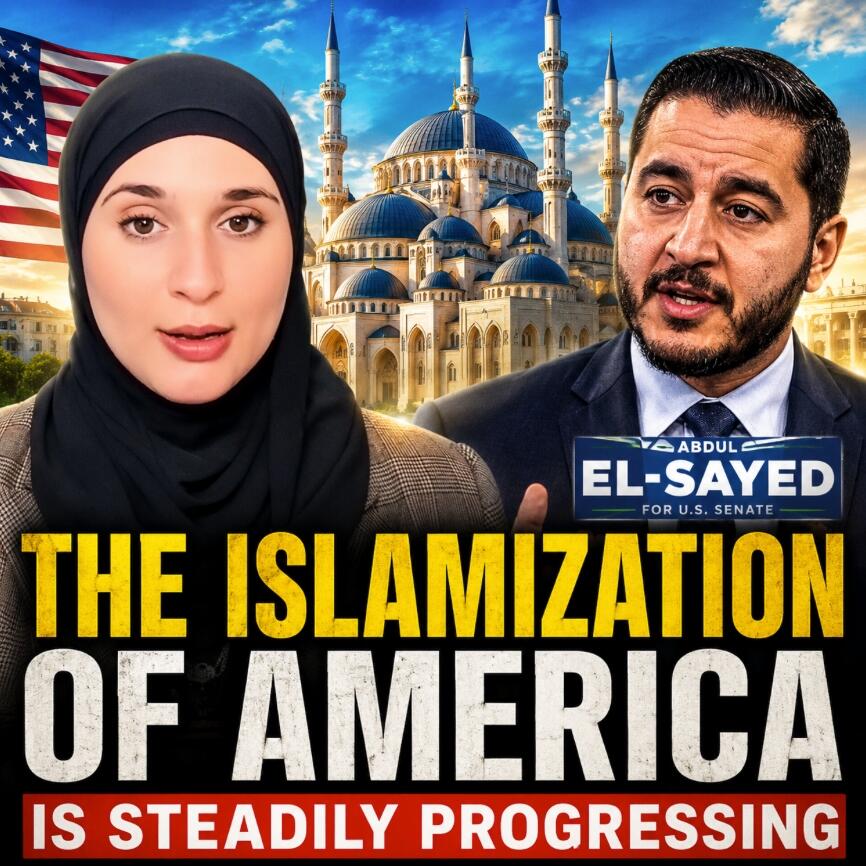
#1 Michigan Democratic Senate nominee Abdul El-Sayed has a really good chance of winning in November, and he has publicly stated that he has a sacred “obligation” to obey Islamic law in every area of his life until he dies…

Muslim Democrat Michigan Senatorial candidate Abdul El-Sayed has previously declared his sacred “obligation” to follow Islamic law in every aspect of his life until he dies and stands before Allah. He has claimed he does not want to subvert the Constitution and mandate Islamic law but that is part of his religion.

Michigan Democratic Senate nominee Abdul El-Sayed is having his words, vows, and religion come back to haunt him. According to The Washington Free Beacon, years ago he declared his sacred “obligation” to follow Islamic law in every aspect of his life until he dies and stands before Allah. This comes from remarks he made to the New York Times back in 2009, when he was younger and buying his first home.

#2 In the supposedly “deep red” state of Mississippi, a hijab-wearing Muslim woman has been sworn in as a municipal judge

Assma Ali has made history. The daughter of Yemeni immigrants to the United States, Ali is now municipal judge for the City of Benoit, a small town in southwest Bolivar County in the Mississippi Delta.

Ali was sworn in as municipal judge on Aug. 5. She has spent nearly a decade serving as an attorney in Mississippi after graduating with her law degree from Mississippi Christian University (formerly Mississippi College) in 2017 and interned in both Rankin and Madison counties while attending law school.

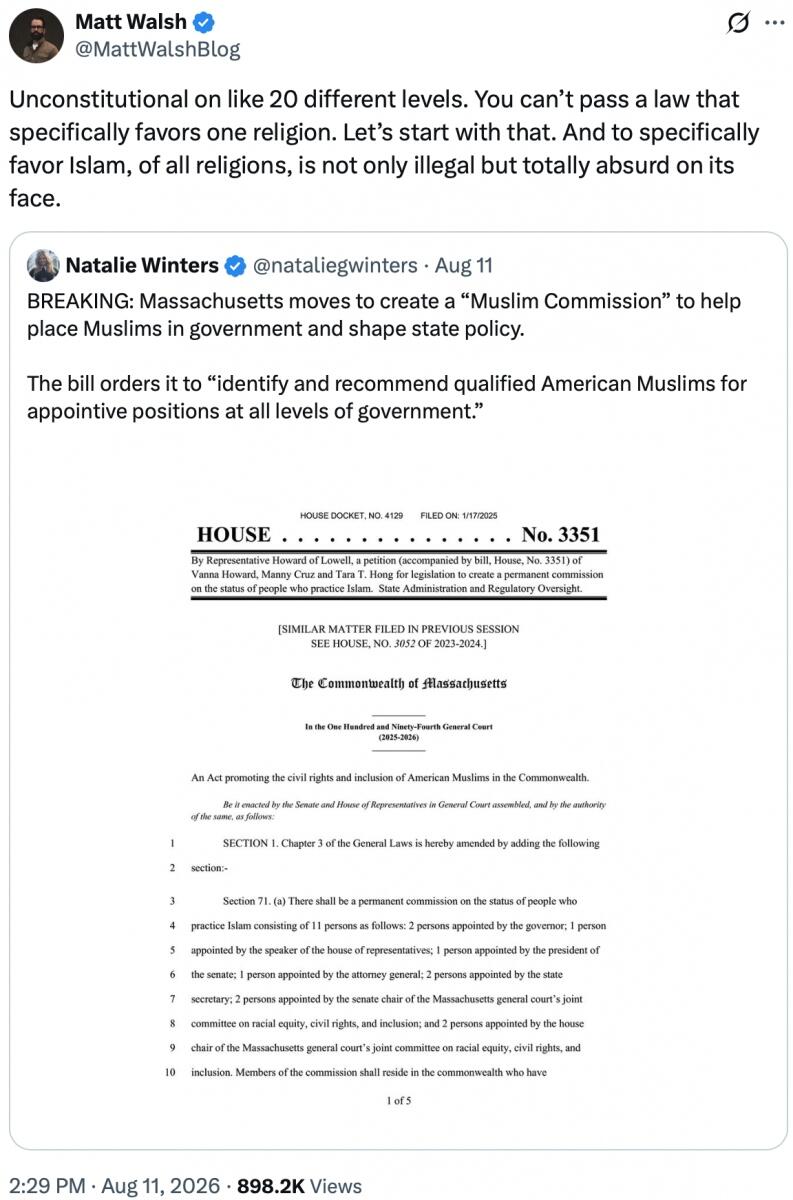
#3 I know that this is hard to believe, but a bill in the state of Massachusetts would “identify and recommend qualified American Muslims for appointive positions at all levels of government”. Needless to say, this is very unconstitutional

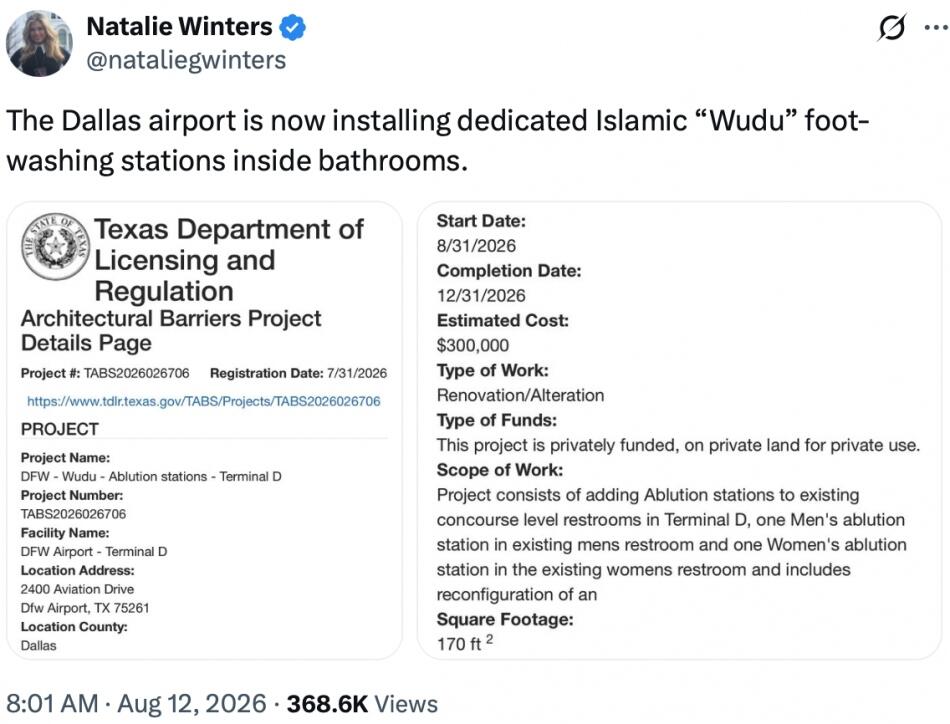
#4 What in the world has happened to the state of Texas? At DFW Airport, they are going to be putting in Islamic foot-washing stations

#5 The city of Hamtramck, Michigan is one of the first cities in the nation where Muslims make up the majority of the population, and the all-Muslim city council decided that it would be a good idea to legalize the sacrifice of animals on residential property…

After several months of contentious debate and pressure from Muslim residents, Hamtramck City Council voted Tuesday night to allow the religious sacrifice of animals on residential property.

Muslims often slaughter animals during the holiday of Eid al-Adha and Hamtramck has one of the highest percentage of Muslim residents among cities in the U.S.

#6 An entire Islamic “mini-city” is going up right in the heart of Orange County, California

#7 A survivor of Sharia law in Iran recently pleaded with the city council of McKinney, Texas not to approve a new Islamic center that was being planned…

An Iranian Christian who describes himself as a “Sharia law survivor” warned Americans during a McKinney City Council meeting that the United States is currently facing a “level one” invasion of Islam. The meeting involved discussions of a proposed Islamic Center.

“I’m a Sharia law survivor from Iran,” he began. “I’m telling you, this is a bad idea and you’re going to regret not listening to people like us who lived under Sharia law.”

“I’m here to tell you this is a dangerous ideology you’re allowing in your country. Every country that is Islamic now, it used to be a Christian country and we were soft Christians. And we allowed these people to come in, bring their Sharia law into our countries and slowly kill us off left and right.”

But after listening to him and countless others that objected to the project, the city council unanimously approved it anyway

According to Texas Scorecard, McKinney City Council members have since voted 7-0 to approve plans for the Islamic Center.

#8 This summer, giant Islamic marches are being held in major cities all over the nation. Sean Feucht just stumbled into one in downtown Chicago

US Christian worship leader Sean Feucht has issued a warning about the growth of Islam in America after his “Jesus march” encountered a Muslim procession in Chicago.

Feucht shared footage from the city showing participants in the annual Arbaeen Procession, which was taking place around an hour before his Christian event was due to begin.

“This is insane. What I’m witnessing is crazy,” Feucht said in a video posted on social media.

According to Feucht, those that were participating in the Islamic march were “shouting anti Christian and anti Israel verses from the Quran”

“An hour before we start, there’s a massive Muslim march. We didn’t even know this was happening guys…where they are declaring their allegiance to Allah. And that the entire city of Chicago will bow to Allah.”

Feucht also claimed participants were “shouting anti Christian and anti Israel verses from the Quran”.

“Have you woken up yet? Do you understand what is at stake in our nation?” he asked.

They aren’t here to assimilate.

They are here to take over.

So why aren’t more Americans standing up?

Well, perhaps the fact that average testosterone levels have fallen dramatically over the past 50 years might have something to do with it…

A recent review of studies involving more than a million men all over the world found that average testosterone levels in blood have dropped by about 20 percent over the past half century. A new, unpublished study put the decrease during that basic time period at closer to 50 percent. Some scientists are skeptical of these numbers because testosterone has been measured in different ways over time. But Michael Eisenberg, a urologist at Stanford Medicine who specializes in male fertility, told me that the findings of a decline are “pretty solid.” The testosterone slump, he said, has “manifested across many different study designs.”

We are seeing entire communities being radically transformed all over this county.

We are going down the exact same road that Europe has been going for the past 30 years, and that should deeply trouble all of us.

There are approximately 2 billion Muslims in the world today, and they make up the majority of the population in more than 50 different nations.

But this is just the beginning.

It is being projected that by 2050 Muslims will make up nearly a third of the entire global population.

This is a story that is not going away, and now is the time to take a stand.

Michael’s new book entitled “10 Prophetic Events That Are Coming Next” is available in paperback and for the Kindle on Amazon.com, and you can subscribe to his Substack newsletter at michaeltsnyder.substack.com.

Views expressed in this article are opinions of the author and do not necessarily reflect the views of ZeroHedge.

Tyler Durden Wed, 08/19/2026 - 20:05

8 Examples That Demonstrate That The Islamization Of America Is Steadily Progressing

Zero Hedge -

8 Examples That Demonstrate That The Islamization Of America Is Steadily Progressing

Authored by Michael Snyder via The End of The American Dream,

In Islam, there is no separation between mosque and state. The goal is to use the state to make everyone submit to Islam. If you want to see what this looks like, just check out almost any country in the Middle East that has a Muslim majority. They don’t believe in freedom of speech or freedom of religion. Do you want to know how many churches there are in Saudi Arabia? The answer is zero, because churches are banned in Saudi Arabia. Now this same ideology is spreading in America, and that should deeply alarm all of us.

Today, Islam is the fastest growing religion in America.

It used to be witchcraft, but now Islam has taken the top spot.

There are now more than 2,700 mosques in the United States.

In 1970, there were about 100.

But it isn’t just mosques that are going up everywhere.

Enormous Islamic “mini-cities” are being constructed in states such as California and Texas.

And rapidly growing Islamic populations are taking over entire sections of the states of Minnesota and Michigan.

What we have been witnessing all over Europe is now happening here.

The following are 8 examples that demonstrate that the Islamization of America is steadily progressing…

#1 Michigan Democratic Senate nominee Abdul El-Sayed has a really good chance of winning in November, and he has publicly stated that he has a sacred “obligation” to obey Islamic law in every area of his life until he dies…

Muslim Democrat Michigan Senatorial candidate Abdul El-Sayed has previously declared his sacred “obligation” to follow Islamic law in every aspect of his life until he dies and stands before Allah. He has claimed he does not want to subvert the Constitution and mandate Islamic law but that is part of his religion.

Michigan Democratic Senate nominee Abdul El-Sayed is having his words, vows, and religion come back to haunt him. According to The Washington Free Beacon, years ago he declared his sacred “obligation” to follow Islamic law in every aspect of his life until he dies and stands before Allah. This comes from remarks he made to the New York Times back in 2009, when he was younger and buying his first home.

#2 In the supposedly “deep red” state of Mississippi, a hijab-wearing Muslim woman has been sworn in as a municipal judge

Assma Ali has made history. The daughter of Yemeni immigrants to the United States, Ali is now municipal judge for the City of Benoit, a small town in southwest Bolivar County in the Mississippi Delta.

Ali was sworn in as municipal judge on Aug. 5. She has spent nearly a decade serving as an attorney in Mississippi after graduating with her law degree from Mississippi Christian University (formerly Mississippi College) in 2017 and interned in both Rankin and Madison counties while attending law school.

#3 I know that this is hard to believe, but a bill in the state of Massachusetts would “identify and recommend qualified American Muslims for appointive positions at all levels of government”. Needless to say, this is very unconstitutional

#4 What in the world has happened to the state of Texas? At DFW Airport, they are going to be putting in Islamic foot-washing stations

#5 The city of Hamtramck, Michigan is one of the first cities in the nation where Muslims make up the majority of the population, and the all-Muslim city council decided that it would be a good idea to legalize the sacrifice of animals on residential property…

After several months of contentious debate and pressure from Muslim residents, Hamtramck City Council voted Tuesday night to allow the religious sacrifice of animals on residential property.

Muslims often slaughter animals during the holiday of Eid al-Adha and Hamtramck has one of the highest percentage of Muslim residents among cities in the U.S.

#6 An entire Islamic “mini-city” is going up right in the heart of Orange County, California

#7 A survivor of Sharia law in Iran recently pleaded with the city council of McKinney, Texas not to approve a new Islamic center that was being planned…

An Iranian Christian who describes himself as a “Sharia law survivor” warned Americans during a McKinney City Council meeting that the United States is currently facing a “level one” invasion of Islam. The meeting involved discussions of a proposed Islamic Center.

“I’m a Sharia law survivor from Iran,” he began. “I’m telling you, this is a bad idea and you’re going to regret not listening to people like us who lived under Sharia law.”

“I’m here to tell you this is a dangerous ideology you’re allowing in your country. Every country that is Islamic now, it used to be a Christian country and we were soft Christians. And we allowed these people to come in, bring their Sharia law into our countries and slowly kill us off left and right.”

But after listening to him and countless others that objected to the project, the city council unanimously approved it anyway

According to Texas Scorecard, McKinney City Council members have since voted 7-0 to approve plans for the Islamic Center.

#8 This summer, giant Islamic marches are being held in major cities all over the nation. Sean Feucht just stumbled into one in downtown Chicago

US Christian worship leader Sean Feucht has issued a warning about the growth of Islam in America after his “Jesus march” encountered a Muslim procession in Chicago.

Feucht shared footage from the city showing participants in the annual Arbaeen Procession, which was taking place around an hour before his Christian event was due to begin.

“This is insane. What I’m witnessing is crazy,” Feucht said in a video posted on social media.

According to Feucht, those that were participating in the Islamic march were “shouting anti Christian and anti Israel verses from the Quran”

“An hour before we start, there’s a massive Muslim march. We didn’t even know this was happening guys…where they are declaring their allegiance to Allah. And that the entire city of Chicago will bow to Allah.”

Feucht also claimed participants were “shouting anti Christian and anti Israel verses from the Quran”.

“Have you woken up yet? Do you understand what is at stake in our nation?” he asked.

They aren’t here to assimilate.

They are here to take over.

So why aren’t more Americans standing up?

Well, perhaps the fact that average testosterone levels have fallen dramatically over the past 50 years might have something to do with it…

A recent review of studies involving more than a million men all over the world found that average testosterone levels in blood have dropped by about 20 percent over the past half century. A new, unpublished study put the decrease during that basic time period at closer to 50 percent. Some scientists are skeptical of these numbers because testosterone has been measured in different ways over time. But Michael Eisenberg, a urologist at Stanford Medicine who specializes in male fertility, told me that the findings of a decline are “pretty solid.” The testosterone slump, he said, has “manifested across many different study designs.”

We are seeing entire communities being radically transformed all over this county.

We are going down the exact same road that Europe has been going for the past 30 years, and that should deeply trouble all of us.

There are approximately 2 billion Muslims in the world today, and they make up the majority of the population in more than 50 different nations.

But this is just the beginning.

It is being projected that by 2050 Muslims will make up nearly a third of the entire global population.

This is a story that is not going away, and now is the time to take a stand.

Michael’s new book entitled “10 Prophetic Events That Are Coming Next” is available in paperback and for the Kindle on Amazon.com, and you can subscribe to his Substack newsletter at michaeltsnyder.substack.com.

Views expressed in this article are opinions of the author and do not necessarily reflect the views of ZeroHedge.

Tyler Durden Wed, 08/19/2026 - 20:05

Judge Ordered Off Karmelo Anthony Murder Case As Defense Pushes For New Trial

Zero Hedge -

Judge Ordered Off Karmelo Anthony Murder Case As Defense Pushes For New Trial

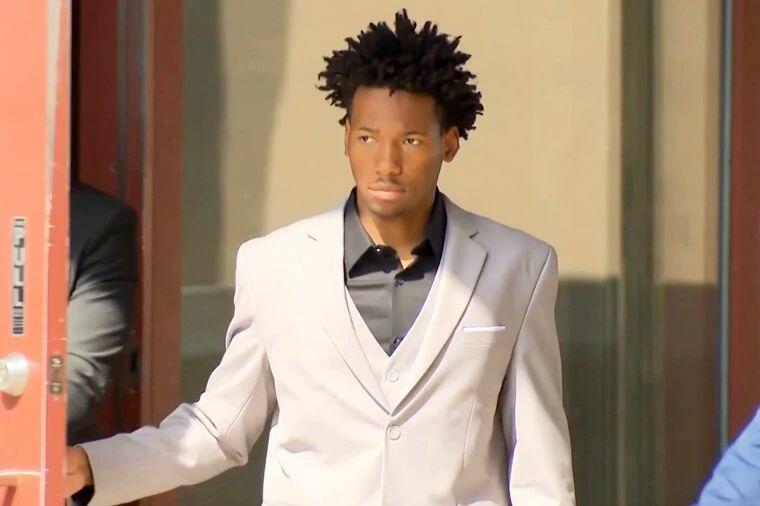
Judge John Roach has been ordered to recuse himself from further proceedings in the Karmelo Anthony murder case, as the defendant seeks a new trial.

On August 19, 2026, Visiting Judge Sid Harle ruled that Roach must step aside. Retired District Judge Michael Chitty has been appointed to handle a hearing scheduled for August 20 on whether Anthony should receive a retrial.

Anthony, now 19, was convicted of first-degree murder and sentenced to 35 years in prison after fatally stabbing 17-year-old Austin Metcalf during an altercation at a high school track meet in Frisco, Texas, in April 2025. A Collin County jury returned the verdict in June 2026 following a trial in McKinney. Jurors deliberated for about three hours and rejected the option of a lesser manslaughter conviction.

Anthony's new defense team is pursuing the new-trial motion. His attorneys argued that Roach's strict courtroom rules - including restrictions on live media coverage - and public statements he made after the verdict demonstrated bias that would prevent him from fairly considering the request.

In a statement, the legal team said the ruling addressed "whether a reasonable fully informed observer would see Judge Roach's conduct and believe that he could fairly and impartially consider a motion for new trial," adding that they believed the judge correctly granted the recusal motion.

"Today’s ruling answers a fundamental question: whether a reasonable fully informed observer would see Judge Roach’s conduct and believe that he could fairly and impartially consider a motion for new trial," the legal team told the Epoch Times

Critics of the original trial, including Anthony's former attorneys and groups such as the Collin County NAACP, had raised concerns about the absence of Black jurors in what they described as a racially charged case involving a Black defendant. Prosecutors struck several potential Black jurors, stating the decisions were race-neutral because the individuals were educators in a case involving young students. Roach rejected a challenge to the jury's composition during the trial.

The incident occurred on April 2, 2025. Students from Memorial High School's track team returned to their designated tent area and found Anthony, a Centennial High School student, sitting there. Metcalf asked him to leave. An argument ensued. Multiple witnesses testified that Anthony was the aggressor. One quoted Metcalf saying he would not fight at a track meet. Witnesses said Anthony responded, "Touch me and see what happens," while reaching into his bag. After Metcalf shoved him, Anthony stabbed Metcalf in the chest with a knife and fled. He was arrested shortly afterward.

The case drew significant public attention amid competing narratives about the confrontation and broader issues of race and self-defense. Both sides maintained at trial that race was not a factor in the events under the tent.

Judge Chitty will now oversee the upcoming hearing on the motion for a new trial.

Tyler Durden Wed, 08/19/2026 - 19:40

Judge Ordered Off Karmelo Anthony Murder Case As Defense Pushes For New Trial

Zero Hedge -

Judge Ordered Off Karmelo Anthony Murder Case As Defense Pushes For New Trial

Judge John Roach has been ordered to recuse himself from further proceedings in the Karmelo Anthony murder case, as the defendant seeks a new trial.

On August 19, 2026, Visiting Judge Sid Harle ruled that Roach must step aside. Retired District Judge Michael Chitty has been appointed to handle a hearing scheduled for August 20 on whether Anthony should receive a retrial.

Anthony, now 19, was convicted of first-degree murder and sentenced to 35 years in prison after fatally stabbing 17-year-old Austin Metcalf during an altercation at a high school track meet in Frisco, Texas, in April 2025. A Collin County jury returned the verdict in June 2026 following a trial in McKinney. Jurors deliberated for about three hours and rejected the option of a lesser manslaughter conviction.

Anthony's new defense team is pursuing the new-trial motion. His attorneys argued that Roach's strict courtroom rules - including restrictions on live media coverage - and public statements he made after the verdict demonstrated bias that would prevent him from fairly considering the request.

In a statement, the legal team said the ruling addressed "whether a reasonable fully informed observer would see Judge Roach's conduct and believe that he could fairly and impartially consider a motion for new trial," adding that they believed the judge correctly granted the recusal motion.

"Today’s ruling answers a fundamental question: whether a reasonable fully informed observer would see Judge Roach’s conduct and believe that he could fairly and impartially consider a motion for new trial," the legal team told the Epoch Times

Critics of the original trial, including Anthony's former attorneys and groups such as the Collin County NAACP, had raised concerns about the absence of Black jurors in what they described as a racially charged case involving a Black defendant. Prosecutors struck several potential Black jurors, stating the decisions were race-neutral because the individuals were educators in a case involving young students. Roach rejected a challenge to the jury's composition during the trial.

The incident occurred on April 2, 2025. Students from Memorial High School's track team returned to their designated tent area and found Anthony, a Centennial High School student, sitting there. Metcalf asked him to leave. An argument ensued. Multiple witnesses testified that Anthony was the aggressor. One quoted Metcalf saying he would not fight at a track meet. Witnesses said Anthony responded, "Touch me and see what happens," while reaching into his bag. After Metcalf shoved him, Anthony stabbed Metcalf in the chest with a knife and fled. He was arrested shortly afterward.

The case drew significant public attention amid competing narratives about the confrontation and broader issues of race and self-defense. Both sides maintained at trial that race was not a factor in the events under the tent.

Judge Chitty will now oversee the upcoming hearing on the motion for a new trial.

Tyler Durden Wed, 08/19/2026 - 19:40

Your Bank Data Could Become A Profit Center - And You'll Pay the Price

Zero Hedge -

Your Bank Data Could Become A Profit Center - And You'll Pay the Price

Authored by Morgan Sweeney via The Center Square,

A forthcoming federal rule on open banking may allow banks to charge new fees for access to consumer data, a move critics say would harm consumers and runs counter to other parts of President Donald Trump's agenda.

Open banking allows consumers to authorize banks and other financial institutions to securely share their financial data electronically with third-party providers.

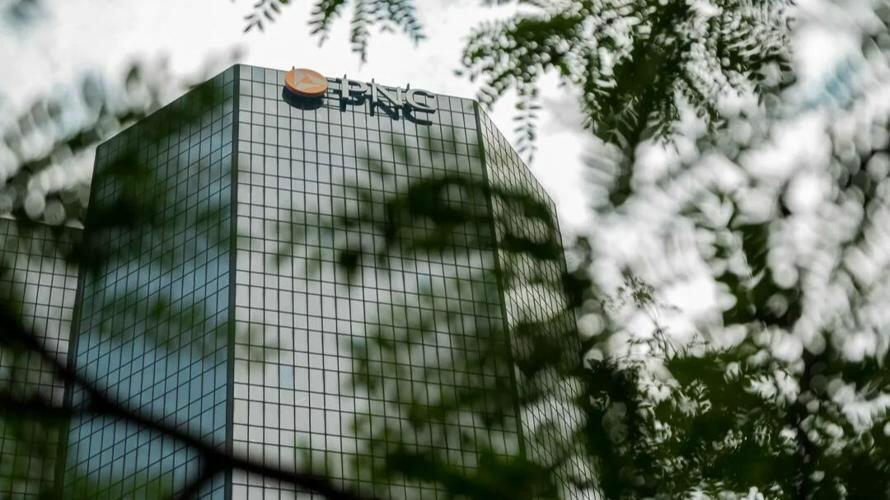
PNC Bank building in Pittsburgh, PA (Photo: Grace David / The Center Square) Why now?


The White House was reviewing the anticipated rule from the Consumer Financial Protection Bureau as of last week, according to reporting by Bloomberg Law. The rule would help shape the federal framework for open banking in the U.S., building on a broad provision contained within the Dodd-Frank Wall Street Reform and Consumer Protection Act of 2010.

Dodd-Frank was passed to enhance transparency and accountability and strengthen consumer protections in the financial industry after the economic crisis of 2008. The law is just under 850 pages long, and Section 1033 - which provides the legal basis for the open banking ecosystem that has evolved in the U.S. - was not one of its central provisions. Section 1033 is about one page long and it ensures that Americans have the legal right to access their own financial data upon request. Financial institutions must provide consumers' financial data relevant to the sought-after financial product or service in "an electronic form usable by consumers."

The law gives the Consumer Financial Protection Bureau broad authority to define and standardize this process, which is partly why affected industries have anticipated federal rulemaking on open banking for more than a decade.

The Biden administration issued the long-awaited rule in late 2024, which required banks to provide data directly to third parties authorized by consumers and prohibited banks from charging third parties fees for accessing the data, among other provisions. Banks pushed back, suing the bureau claiming it was exceeding the authority it was granted under Section 1033 and challenging those provisions in court.

Banks have said the rule would require them to build and maintain costly interfaces for third-party access while preventing them from being able to recoup those costs.

Last summer, JPMorgan Chase & Co. submitted proposed fees to data aggregators like Plaid for accessing Chase customers' financial data.

The Trump administration has said the Biden administration's rule was unlawful, "arbitrary and capricious" and began working on a rewrite of the rule last August. The lawsuit is essentially paused until the new rule is released, and the court ordered that enforcement of the Biden rule be stayed.

The Trump administration's version reportedly includes a provision that would allow banks to charge volume-based fees to fintech companies to access consumer financial data, meaning banks could begin charging fintech companies once they make more than a certain number of requests for customer data.

Who pays the price?

News that the Trump administration's rule would include a data-rationing provision prompted numerous objections from fintech companies and consumer advocacy groups, who argued that if banks didn't pay for the data sharing, consumers ultimately will.

"Inevitably, if [the cost] is on the third party, it's going to go back to the consumer," said Todd Zywicki, a George Mason University law professor who formerly led a CFPB task force on federal consumer financial law and served in a leadership role at the Federal Trade Commission.

A third party is really a false choice, according to Zywicki, and between consumers and banks, he thinks banks are the much better option.

"The bank already has built-in incentives to collect the data, keep the data safely, use the data, and under law would already be required to share the data with consumers for them to be able to use it to shop for themselves," Zywicki told The Center Square, "To then say, OK, now you have to also let Plaid access my data or Mint access my data, so they can go find me a better savings account than recommended to me or suggests this product instead of that product just strikes me as the only way to really make sense on this."

The five largest banks in the U.S. reported a record-worthy second quarter. JPMorgan reported its highest quarterly profit in history, Goldman Sachs had its best second quarter ever, and Citigroup enjoyed its best quarter in a decade. Bank of America also posted strong results, while Wells Fargo beat Wall Street expectations. Collectively, they brought in $49 billion in profits.

Zywicki and other sources who spoke to The Center Square also maintained that banks have already done much of the work to build an open banking ecosystem and any costs they might incur to share data with more third parties would be relatively small.

"Banks already are collecting and holding information securely... They've already got to share the information for free with the consumer. It's just a matter of whether a third party can get the information on behalf of the consumer," Zywicki added.

But there's another cost to consumers that could be even greater than any immediate impact on their wallets, advocates warn, and that's the cost of continued fervent fintech innovation.

"We have already seen the nation's biggest banks take advantage of regulatory ambiguity to impose fees and throttle access. Further uncertainty could stop the next great startup from forming and prevent consumers from accessing affordable financial products," said Miranda Margowsky, head of communications for the Financial Technology Association.

Fintech innovation can do more than help consumers manage their finances. Startups like Carefull, a fintech company that analyzes customers' financial activity for unusual patterns, can help detect warning signs of dementia or cognitive decline, potentially years before a clinical diagnosis.

"The goal here is to create a competitive framework where... small banks, for example, or fintech providers, or whoever can compete against the big banks that are currently holding the data," Zywicki said. "It's not really much of a fair playing field if banks can continue to use this information to market their [own] products."

At odds with Trump's agenda

Critics of a data tolling system have also said that allowing banks to charge for access to consumer data undermines several of the administration's other priorities and initiatives.

Several advocacy groups submitted a joint letter to the administration in July saying that the proposal would violate the spirit of one of Trump's May executive orders that specifically calls for government regulation that promotes financial innovation.

"The United States is a global leader in financial innovation, driven in part by the rapid growth of financial technology (fintech) firms," the order reads. "To foster this financial innovation, the Federal Government must update regulations.... and remove overly burdensome and fragmented regulations and supervisory practices that form barriers to entry and primarily benefit incumbent financial services firms."

The president has also heavily promoted Trump Accounts, the government-backed, tax-preferred investment savings accounts for minors, as a way for ordinary American families to leverage financial tools more often used by wealthier individuals. Trump Accounts use Plaid to connect users' bank accounts to the platform, though users whose financial institutions are not supported can verify their accounts manually.

The president has also been a vocal supporter of cryptocurrency and has advanced crypto-friendly policy. He and his sons founded World Liberty Financial, a financial platform that "bridges the gap between traditional banking and blockchain-powered innovation."

But the Blockchain Association, a cryptocurrency industry trade group, doesn't support volume-based fees either. It was one of the organizations that signed onto the July letter, and it also wrote a letter to the CFPB in October.

"The President's Working Group on Digital Asset Markets has entreated 'the Federal government to operationalize President Trump's promise to make America the crypto capital of the world.' Maintaining the broad permissions and prohibition of fees prescribed by the [Biden administration] Open Banking Rule is critical to realizing this goal and sustaining American leadership in fintech and blockchain for the century ahead," it wrote.

What's next?

The bureau's rewrite of the Biden administration's open banking rule is being reviewed by the White House Office of Information and Regulatory Affairs, according to Bloomberg. The bureau issued an advance notice of proposed rulemaking in August 2025, received public comments and drafted a proposed rule. Once the White House review is complete - potentially with changes - the bureau can issue a notice of proposed rulemaking. That proposal will also be subject to public comment before the bureau can issue a final rule.

"It's really important to get this one right," Zywicki said. "When you get a regulation wrong, it's really hard to fix."

The Center Square reached out to the Consumer Financial Protection Bureau, the Bank Policy Institute and multiple banks but did not receive a response in time for publication.

Tyler Durden Wed, 08/19/2026 - 19:15

Your Bank Data Could Become A Profit Center - And You'll Pay the Price

Zero Hedge -

Your Bank Data Could Become A Profit Center - And You'll Pay the Price

Authored by Morgan Sweeney via The Center Square,

A forthcoming federal rule on open banking may allow banks to charge new fees for access to consumer data, a move critics say would harm consumers and runs counter to other parts of President Donald Trump's agenda.

Open banking allows consumers to authorize banks and other financial institutions to securely share their financial data electronically with third-party providers.

PNC Bank building in Pittsburgh, PA (Photo: Grace David / The Center Square) Why now?

The White House was reviewing the anticipated rule from the Consumer Financial Protection Bureau as of last week, according to reporting by Bloomberg Law. The rule would help shape the federal framework for open banking in the U.S., building on a broad provision contained within the Dodd-Frank Wall Street Reform and Consumer Protection Act of 2010.

Dodd-Frank was passed to enhance transparency and accountability and strengthen consumer protections in the financial industry after the economic crisis of 2008. The law is just under 850 pages long, and Section 1033 - which provides the legal basis for the open banking ecosystem that has evolved in the U.S. - was not one of its central provisions. Section 1033 is about one page long and it ensures that Americans have the legal right to access their own financial data upon request. Financial institutions must provide consumers' financial data relevant to the sought-after financial product or service in "an electronic form usable by consumers."

The law gives the Consumer Financial Protection Bureau broad authority to define and standardize this process, which is partly why affected industries have anticipated federal rulemaking on open banking for more than a decade.

The Biden administration issued the long-awaited rule in late 2024, which required banks to provide data directly to third parties authorized by consumers and prohibited banks from charging third parties fees for accessing the data, among other provisions. Banks pushed back, suing the bureau claiming it was exceeding the authority it was granted under Section 1033 and challenging those provisions in court.

Banks have said the rule would require them to build and maintain costly interfaces for third-party access while preventing them from being able to recoup those costs.

Last summer, JPMorgan Chase & Co. submitted proposed fees to data aggregators like Plaid for accessing Chase customers' financial data.

The Trump administration has said the Biden administration's rule was unlawful, "arbitrary and capricious" and began working on a rewrite of the rule last August. The lawsuit is essentially paused until the new rule is released, and the court ordered that enforcement of the Biden rule be stayed.

The Trump administration's version reportedly includes a provision that would allow banks to charge volume-based fees to fintech companies to access consumer financial data, meaning banks could begin charging fintech companies once they make more than a certain number of requests for customer data.

Who pays the price?

News that the Trump administration's rule would include a data-rationing provision prompted numerous objections from fintech companies and consumer advocacy groups, who argued that if banks didn't pay for the data sharing, consumers ultimately will.

"Inevitably, if [the cost] is on the third party, it's going to go back to the consumer," said Todd Zywicki, a George Mason University law professor who formerly led a CFPB task force on federal consumer financial law and served in a leadership role at the Federal Trade Commission.

A third party is really a false choice, according to Zywicki, and between consumers and banks, he thinks banks are the much better option.

"The bank already has built-in incentives to collect the data, keep the data safely, use the data, and under law would already be required to share the data with consumers for them to be able to use it to shop for themselves," Zywicki told The Center Square, "To then say, OK, now you have to also let Plaid access my data or Mint access my data, so they can go find me a better savings account than recommended to me or suggests this product instead of that product just strikes me as the only way to really make sense on this."

The five largest banks in the U.S. reported a record-worthy second quarter. JPMorgan reported its highest quarterly profit in history, Goldman Sachs had its best second quarter ever, and Citigroup enjoyed its best quarter in a decade. Bank of America also posted strong results, while Wells Fargo beat Wall Street expectations. Collectively, they brought in $49 billion in profits.

Zywicki and other sources who spoke to The Center Square also maintained that banks have already done much of the work to build an open banking ecosystem and any costs they might incur to share data with more third parties would be relatively small.

"Banks already are collecting and holding information securely... They've already got to share the information for free with the consumer. It's just a matter of whether a third party can get the information on behalf of the consumer," Zywicki added.

But there's another cost to consumers that could be even greater than any immediate impact on their wallets, advocates warn, and that's the cost of continued fervent fintech innovation.

"We have already seen the nation's biggest banks take advantage of regulatory ambiguity to impose fees and throttle access. Further uncertainty could stop the next great startup from forming and prevent consumers from accessing affordable financial products," said Miranda Margowsky, head of communications for the Financial Technology Association.

Fintech innovation can do more than help consumers manage their finances. Startups like Carefull, a fintech company that analyzes customers' financial activity for unusual patterns, can help detect warning signs of dementia or cognitive decline, potentially years before a clinical diagnosis.

"The goal here is to create a competitive framework where... small banks, for example, or fintech providers, or whoever can compete against the big banks that are currently holding the data," Zywicki said. "It's not really much of a fair playing field if banks can continue to use this information to market their [own] products."

At odds with Trump's agenda

Critics of a data tolling system have also said that allowing banks to charge for access to consumer data undermines several of the administration's other priorities and initiatives.

Several advocacy groups submitted a joint letter to the administration in July saying that the proposal would violate the spirit of one of Trump's May executive orders that specifically calls for government regulation that promotes financial innovation.

"The United States is a global leader in financial innovation, driven in part by the rapid growth of financial technology (fintech) firms," the order reads. "To foster this financial innovation, the Federal Government must update regulations.... and remove overly burdensome and fragmented regulations and supervisory practices that form barriers to entry and primarily benefit incumbent financial services firms."

The president has also heavily promoted Trump Accounts, the government-backed, tax-preferred investment savings accounts for minors, as a way for ordinary American families to leverage financial tools more often used by wealthier individuals. Trump Accounts use Plaid to connect users' bank accounts to the platform, though users whose financial institutions are not supported can verify their accounts manually.

The president has also been a vocal supporter of cryptocurrency and has advanced crypto-friendly policy. He and his sons founded World Liberty Financial, a financial platform that "bridges the gap between traditional banking and blockchain-powered innovation."

But the Blockchain Association, a cryptocurrency industry trade group, doesn't support volume-based fees either. It was one of the organizations that signed onto the July letter, and it also wrote a letter to the CFPB in October.

"The President's Working Group on Digital Asset Markets has entreated 'the Federal government to operationalize President Trump's promise to make America the crypto capital of the world.' Maintaining the broad permissions and prohibition of fees prescribed by the [Biden administration] Open Banking Rule is critical to realizing this goal and sustaining American leadership in fintech and blockchain for the century ahead," it wrote.

What's next?

The bureau's rewrite of the Biden administration's open banking rule is being reviewed by the White House Office of Information and Regulatory Affairs, according to Bloomberg. The bureau issued an advance notice of proposed rulemaking in August 2025, received public comments and drafted a proposed rule. Once the White House review is complete - potentially with changes - the bureau can issue a notice of proposed rulemaking. That proposal will also be subject to public comment before the bureau can issue a final rule.

"It's really important to get this one right," Zywicki said. "When you get a regulation wrong, it's really hard to fix."

The Center Square reached out to the Consumer Financial Protection Bureau, the Bank Policy Institute and multiple banks but did not receive a response in time for publication.

Tyler Durden Wed, 08/19/2026 - 19:15

'Quality Over Quantity': Reddit Is Mostly Wiped From ChatGPT Citations

Zero Hedge -

'Quality Over Quantity': Reddit Is Mostly Wiped From ChatGPT Citations

Nature is healing, with the latest data from the AI search visibility platform Promptwatch showing that OpenAI's ChatGPT citations from Reddit have plunged in recent weeks to nearly zero.

"It looks like Reddit is almost wiped from ChatGPT sources; the query fanout changes had a big impact, and in the past couple of days it seems to be almost completely removed from prompt responses," Promptwatch founder Klaas Foppen wrote on X.

According to Promptwatch, Reddit's daily share of all citations returned by ChatGPT Search began to move sharply lower in the first week of August, then fell to near zero by mid-month.

Promptwatch's website said the red lines on the chart began on August 8, when OpenAI changed the query fanout behavior of ChatGPT Search. By August 14, or last Friday, those citations had plunged again to near zero.

Promptwatch continued:

Reddit lost almost its entire citation footprint in ChatGPT within a single day. From July 18 through August 7, it held a steady 3.83% average share of ChatGPT citations, one of the largest of any domain. On August 14, the share collapsed to under 1%, and the August 14-17 average of 0.52% is an 86.4% relative drop.

The slide started earlier: on August 8, the same day ChatGPT changed its query fanout behavior, Reddit's share fell from the high 3s to the mid-2s. The chart shows when each change happened, not why. A shift in ChatGPT's source selection is the obvious candidate, but a data-collection issue cannot be ruled out, so treat the size of the drop as provisional while we keep monitoring.

Reddit citations in ChatGPT have been controversial from the start because there is often no confirmation of where the information originated, and the citations could point to someone claiming to be an engineer, doctor, trader, or insider without proving their credentials. There's also the fact that Reddit generally leans left-wing, which could alter answers. 

All-In Podcast's Jason Calacanis asked Grok, "Is this a choice because of quality or because of legal IP issues?"

The answer:

Someone asked:

Foppen noted that instead of ChatGPT tapping Reddit, more official sources and direct-site citations are being pulled.

Tyler Durden Wed, 08/19/2026 - 18:50

'Quality Over Quantity': Reddit Is Mostly Wiped From ChatGPT Citations

Zero Hedge -

'Quality Over Quantity': Reddit Is Mostly Wiped From ChatGPT Citations

Nature is healing, with the latest data from the AI search visibility platform Promptwatch showing that OpenAI's ChatGPT citations from Reddit have plunged in recent weeks to nearly zero.

"It looks like Reddit is almost wiped from ChatGPT sources; the query fanout changes had a big impact, and in the past couple of days it seems to be almost completely removed from prompt responses," Promptwatch founder Klaas Foppen wrote on X.

According to Promptwatch, Reddit's daily share of all citations returned by ChatGPT Search began to move sharply lower in the first week of August, then fell to near zero by mid-month.

Promptwatch's website said the red lines on the chart began on August 8, when OpenAI changed the query fanout behavior of ChatGPT Search. By August 14, or last Friday, those citations had plunged again to near zero.

Promptwatch continued:

Reddit lost almost its entire citation footprint in ChatGPT within a single day. From July 18 through August 7, it held a steady 3.83% average share of ChatGPT citations, one of the largest of any domain. On August 14, the share collapsed to under 1%, and the August 14-17 average of 0.52% is an 86.4% relative drop.

The slide started earlier: on August 8, the same day ChatGPT changed its query fanout behavior, Reddit's share fell from the high 3s to the mid-2s. The chart shows when each change happened, not why. A shift in ChatGPT's source selection is the obvious candidate, but a data-collection issue cannot be ruled out, so treat the size of the drop as provisional while we keep monitoring.

Reddit citations in ChatGPT have been controversial from the start because there is often no confirmation of where the information originated, and the citations could point to someone claiming to be an engineer, doctor, trader, or insider without proving their credentials. There's also the fact that Reddit generally leans left-wing, which could alter answers. 

All-In Podcast's Jason Calacanis asked Grok, "Is this a choice because of quality or because of legal IP issues?"

The answer:

Someone asked:

Foppen noted that instead of ChatGPT tapping Reddit, more official sources and direct-site citations are being pulled.

Tyler Durden Wed, 08/19/2026 - 18:50

The DSA's War On Wealth

Zero Hedge -

The DSA's War On Wealth

Authored by James Rickards via The Daily Reckoning,

Communism is on the rise in the United States and has now entered otherwise mainstream Democratic Party politics.

The Democratic Socialists of America (DSA) is on track to increase the number of its members in Congress from two to at least six in January, possibly more. That's not including Sen. Bernie Sanders, who calls himself a democratic socialist.

A DSA member named Francesca Hong just came within striking distance of becoming the Democratic nominee for governor of Wisconsin, one of our largest and most important states. Hong was narrowly defeated in the Aug. 11 primary by Milwaukee County Executive David Crowley.

Don't be confused by those calling themselves socialists. A few may be well-meaning middle-of-the-road Democrats who favor the Scandinavian socialist model. But others are wolves in sheep's clothing - communists who use the socialist label to hide their real intentions.

What's interesting is that many of the new socialists don't even try to hide their radical leanings. They publicly call themselves socialists and are proud of it.

After the fight against communism in the U.S. in the 1950s and the U.S. victory in the Cold War by the early 1990s, most Americans might assume that communism is no longer a threat to the American way of life and the U.S. political system.

That's a mistake.

Communist and Marxist ideas are alive and well in the U.S. and are thriving in universities, think tanks, foundations, the media and other institutions that Americans typically think of as having better motives.

The Evolution of Revolution

This ideological infiltration may follow Marxian economics, but the method used by the new communists was anticipated by the Italian communist Antonio Gramsci, who wrote in the 1920s and 1930s.

Gramsci agreed with Marx's goal - the abolition of private property - but he thought the way to achieve it was not through violent revolution but through a long-term struggle for control of society's cultural and political institutions.

Decades later, this strategy came to be described as "the long march through the institutions."

In other words, communism would not necessarily win by direct confrontation but by a gradual infiltration of education, culture and governance and the decline of critical thinking.

U.S. institutions would become ideological boot camps and propaganda outlets that would gradually convince Americans that communism, dressed up as "socialism," was the better path.

From there, it would be a simple task to tear down traditional constitutional structures by getting rid of the Senate, the Electoral College and an independent judiciary.

Top-down communist control would be the final step. No revolution required. Just long-term rot like the proliferation of mold or termites.

For a powerful example of this process, consider the recent controversy surrounding the Smithsonian Institution and testimony before Congress by Anthea Hartig, director of the National Museum of American History.

The dispute centered on whether America's national museums have increasingly emphasized slavery, race and inequality at the expense of the country's founders and achievements. Hartig defended the museum's approach and told lawmakers that it does not take sides in America's political debates.

The Smithsonian's treatment of Benjamin Franklin, for example, emphasizes his history as a slaveholder. Yet Franklin was also one of the great scientists and founders of the 18th century and, later in life, became a leading abolitionist.

He served as president of the Pennsylvania Society for Promoting the Abolition of Slavery and, in 1790, petitioned Congress to work toward ending slavery.

Franklin also became the nation's first postmaster general, helped establish an early fire insurance company and helped found the institution that became the University of Pennsylvania, where I attended law school.

The real issue is one of emphasis: whether America's national museums should primarily celebrate the country's achievements or increasingly focus on slavery, race, inequality and other failures in the American story.

That debate is worth having because institutions shape the way Americans understand their own country.

A Very American History of Communism

Communist ideology never entirely disappeared from America. It took root in organized political movements following the Bolshevik Revolution in Russia in 1917 and expanded during the Great Depression.

The New York Times' Moscow correspondent Walter Duranty notoriously minimized Stalin's man-made famine in Ukraine in the early 1930s, reporting that helped obscure the brutality of the Soviet system.

American communism suffered a setback after the Molotov-Ribbentrop Pact of 1939, which was a nonaggression treaty between the Soviet Union and Nazi Germany. American communists and fellow travelers were disillusioned that Stalin would make a deal with Hitler, who was universally viewed as the avatar of fascism.

Anti-communism reached a frenzy stage during the Cold War with the execution of Julius and Ethel Rosenberg in 1953 after their conviction for conspiracy to commit espionage, the Alger Hiss case, accusations of communist infiltration leveled at government officials by Sen. Joseph McCarthy and hearings by the House Un-American Activities Committee.

Despite these setbacks, the radical left had a revival during the 1960s and 1970s and is prominent today in the success of the Democratic Socialists of America, now the largest socialist organization in the United States.

Castro's American Alumni

Cuba also played an important role in the American radical left during the Cold War. Many American radicals traveled to Cuba or absorbed the influence of Castro's revolution, including Stokely Carmichael and Angela Davis.

Karen Bass, now the mayor of Los Angeles, traveled repeatedly to Castro's Cuba in the 1970s as part of the Venceremos ("We Will Conquer") Brigade, where young American left-wing activists worked alongside Cubans and were immersed in the communist revolution.

Cuba was not the only source of communist influence. Barack Obama, as a teenager in Hawaii, had a relationship with Frank Marshall Davis, a writer and activist with documented ties to the Communist Party. Obama later wrote about Davis in Dreams from My Father and the influence Davis had on his thinking about race and identity.

If you wonder why race relations in the U.S. remain strained after enormous progress beginning in the 1960s and why socialism is on the rise today in urban centers like New York and Los Angeles, the history of the American radical left and its ties to international socialist movements are worth understanding.

The labels and tactics have changed, but the underlying struggle over property, markets and political power has not disappeared.

Politics Comes for Your Portfolio

The rise of socialism inside the Democratic Party is an enormously important political story on its own. But it also has huge investment implications that could affect your portfolio.

Many democratic socialists favor higher taxes on wealthy households, expanded government healthcare and tuition programs and sweeping changes to policing, immigration and other institutions. Some prominent figures on the left have also supported "wealth taxes" - which would tax certain holdings of property, shares, bonds and other assets rather than merely income.

Depending on how such a tax were structured, investors could find themselves selling retirement assets just to pay the new wealth tax.

Apart from causing social and economic disruption, these policies could hurt your retirement because you'll have to pay the taxes needed to finance them. Later, you may pay even more taxes to clean up the mess.

Gold and silver may be among the best assets to own in these circumstances because they're non-digital, can be held outside the banking system and are difficult to freeze electronically.

Tyler Durden Wed, 08/19/2026 - 18:25

The DSA's War On Wealth

Zero Hedge -

The DSA's War On Wealth

Authored by James Rickards via The Daily Reckoning,

Communism is on the rise in the United States and has now entered otherwise mainstream Democratic Party politics.

The Democratic Socialists of America (DSA) is on track to increase the number of its members in Congress from two to at least six in January, possibly more. That's not including Sen. Bernie Sanders, who calls himself a democratic socialist.

A DSA member named Francesca Hong just came within striking distance of becoming the Democratic nominee for governor of Wisconsin, one of our largest and most important states. Hong was narrowly defeated in the Aug. 11 primary by Milwaukee County Executive David Crowley.

Don't be confused by those calling themselves socialists. A few may be well-meaning middle-of-the-road Democrats who favor the Scandinavian socialist model. But others are wolves in sheep's clothing - communists who use the socialist label to hide their real intentions.

What's interesting is that many of the new socialists don't even try to hide their radical leanings. They publicly call themselves socialists and are proud of it.

After the fight against communism in the U.S. in the 1950s and the U.S. victory in the Cold War by the early 1990s, most Americans might assume that communism is no longer a threat to the American way of life and the U.S. political system.

That's a mistake.

Communist and Marxist ideas are alive and well in the U.S. and are thriving in universities, think tanks, foundations, the media and other institutions that Americans typically think of as having better motives.

The Evolution of Revolution

This ideological infiltration may follow Marxian economics, but the method used by the new communists was anticipated by the Italian communist Antonio Gramsci, who wrote in the 1920s and 1930s.

Gramsci agreed with Marx's goal - the abolition of private property - but he thought the way to achieve it was not through violent revolution but through a long-term struggle for control of society's cultural and political institutions.

Decades later, this strategy came to be described as "the long march through the institutions."

In other words, communism would not necessarily win by direct confrontation but by a gradual infiltration of education, culture and governance and the decline of critical thinking.

U.S. institutions would become ideological boot camps and propaganda outlets that would gradually convince Americans that communism, dressed up as "socialism," was the better path.

From there, it would be a simple task to tear down traditional constitutional structures by getting rid of the Senate, the Electoral College and an independent judiciary.

Top-down communist control would be the final step. No revolution required. Just long-term rot like the proliferation of mold or termites.

For a powerful example of this process, consider the recent controversy surrounding the Smithsonian Institution and testimony before Congress by Anthea Hartig, director of the National Museum of American History.

The dispute centered on whether America's national museums have increasingly emphasized slavery, race and inequality at the expense of the country's founders and achievements. Hartig defended the museum's approach and told lawmakers that it does not take sides in America's political debates.

The Smithsonian's treatment of Benjamin Franklin, for example, emphasizes his history as a slaveholder. Yet Franklin was also one of the great scientists and founders of the 18th century and, later in life, became a leading abolitionist.

He served as president of the Pennsylvania Society for Promoting the Abolition of Slavery and, in 1790, petitioned Congress to work toward ending slavery.

Franklin also became the nation's first postmaster general, helped establish an early fire insurance company and helped found the institution that became the University of Pennsylvania, where I attended law school.

The real issue is one of emphasis: whether America's national museums should primarily celebrate the country's achievements or increasingly focus on slavery, race, inequality and other failures in the American story.

That debate is worth having because institutions shape the way Americans understand their own country.

A Very American History of Communism

Communist ideology never entirely disappeared from America. It took root in organized political movements following the Bolshevik Revolution in Russia in 1917 and expanded during the Great Depression.

The New York Times' Moscow correspondent Walter Duranty notoriously minimized Stalin's man-made famine in Ukraine in the early 1930s, reporting that helped obscure the brutality of the Soviet system.

American communism suffered a setback after the Molotov-Ribbentrop Pact of 1939, which was a nonaggression treaty between the Soviet Union and Nazi Germany. American communists and fellow travelers were disillusioned that Stalin would make a deal with Hitler, who was universally viewed as the avatar of fascism.

Anti-communism reached a frenzy stage during the Cold War with the execution of Julius and Ethel Rosenberg in 1953 after their conviction for conspiracy to commit espionage, the Alger Hiss case, accusations of communist infiltration leveled at government officials by Sen. Joseph McCarthy and hearings by the House Un-American Activities Committee.

Despite these setbacks, the radical left had a revival during the 1960s and 1970s and is prominent today in the success of the Democratic Socialists of America, now the largest socialist organization in the United States.

Castro's American Alumni

Cuba also played an important role in the American radical left during the Cold War. Many American radicals traveled to Cuba or absorbed the influence of Castro's revolution, including Stokely Carmichael and Angela Davis.

Karen Bass, now the mayor of Los Angeles, traveled repeatedly to Castro's Cuba in the 1970s as part of the Venceremos ("We Will Conquer") Brigade, where young American left-wing activists worked alongside Cubans and were immersed in the communist revolution.

Cuba was not the only source of communist influence. Barack Obama, as a teenager in Hawaii, had a relationship with Frank Marshall Davis, a writer and activist with documented ties to the Communist Party. Obama later wrote about Davis in Dreams from My Father and the influence Davis had on his thinking about race and identity.

If you wonder why race relations in the U.S. remain strained after enormous progress beginning in the 1960s and why socialism is on the rise today in urban centers like New York and Los Angeles, the history of the American radical left and its ties to international socialist movements are worth understanding.

The labels and tactics have changed, but the underlying struggle over property, markets and political power has not disappeared.

Politics Comes for Your Portfolio

The rise of socialism inside the Democratic Party is an enormously important political story on its own. But it also has huge investment implications that could affect your portfolio.

Many democratic socialists favor higher taxes on wealthy households, expanded government healthcare and tuition programs and sweeping changes to policing, immigration and other institutions. Some prominent figures on the left have also supported "wealth taxes" - which would tax certain holdings of property, shares, bonds and other assets rather than merely income.

Depending on how such a tax were structured, investors could find themselves selling retirement assets just to pay the new wealth tax.

Apart from causing social and economic disruption, these policies could hurt your retirement because you'll have to pay the taxes needed to finance them. Later, you may pay even more taxes to clean up the mess.

Gold and silver may be among the best assets to own in these circumstances because they're non-digital, can be held outside the banking system and are difficult to freeze electronically.

Tyler Durden Wed, 08/19/2026 - 18:25

Meet The Pro-Trump Billionaire Who Paid $40 Million For Fugly Ferrari EV

Zero Hedge -

Meet The Pro-Trump Billionaire Who Paid $40 Million For Fugly Ferrari EV

A Florida billionaire was revealed Tuesday as the deep-pocketed buyer who shelled out a jaw-dropping $40 million for Ferrari's one-of-a-kind Luce EV, the Italian supercar that critics mercilessly roasted for looking straight-up fugly.

The Ferrari Luce ‘Tailor Made’ on display at RM Sotheby's auction event. RM Sotheby’s

The buyer: Dr. Herbert Wertheim, an optometrist who founded Miami-based Brain Power, a firm that cooks up tech for the eyewear industry.

Herbert Wertheim Alicia Devine/USA TODAY Network/Reuters
The Journal reports:

Wertheim's unique model, dubbed "Chassis 0," has an estimated worth of $1.1 million, according to Sotheby's. The car has been shipped to Italy for modifications - although Wertheim didn't know what kind - and he will take possession of it next year. But much like with the Ferrari Daytona SP3 he bought last year for $26 million at the same auction, Wertheim's bigger plan for the Luce - or the Lucy, as he calls it - is to be a fundraising workhorse for the many charities he supports.

"It will not be my personal car to go to Publix to get bananas," said Wertheim. "I don't want to break the sound barrier, but you know, it's nice when you're trying to get on the highway quickly."

If you thought Wertheim might be woke, you would be mistaken. The 87-year-old regularly hits Mar-a-Lago, the private club owned by President Donald Trump, who he considers a friend. At a charity gala in Palm Beach, Wertheim dropped another $2 million for a private White House visit with Trump. The winning bid came during the bash at Mar-a-Lago estate, raising cash for educational scholarships for kids of Palm Beach cops and firefighters.Wertheim has an an estimated net worth of $4.6 billion.

Tyler Durden Wed, 08/19/2026 - 18:00

Meet The Pro-Trump Billionaire Who Paid $40 Million For Fugly Ferrari EV

Zero Hedge -

Meet The Pro-Trump Billionaire Who Paid $40 Million For Fugly Ferrari EV

A Florida billionaire was revealed Tuesday as the deep-pocketed buyer who shelled out a jaw-dropping $40 million for Ferrari's one-of-a-kind Luce EV, the Italian supercar that critics mercilessly roasted for looking straight-up fugly.

The Ferrari Luce ‘Tailor Made’ on display at RM Sotheby's auction event. RM Sotheby’s

The buyer: Dr. Herbert Wertheim, an optometrist who founded Miami-based Brain Power, a firm that cooks up tech for the eyewear industry.

Herbert Wertheim Alicia Devine/USA TODAY Network/Reuters
The Journal reports:

Wertheim's unique model, dubbed "Chassis 0," has an estimated worth of $1.1 million, according to Sotheby's. The car has been shipped to Italy for modifications - although Wertheim didn't know what kind - and he will take possession of it next year. But much like with the Ferrari Daytona SP3 he bought last year for $26 million at the same auction, Wertheim's bigger plan for the Luce - or the Lucy, as he calls it - is to be a fundraising workhorse for the many charities he supports.

"It will not be my personal car to go to Publix to get bananas," said Wertheim. "I don't want to break the sound barrier, but you know, it's nice when you're trying to get on the highway quickly."

If you thought Wertheim might be woke, you would be mistaken. The 87-year-old regularly hits Mar-a-Lago, the private club owned by President Donald Trump, who he considers a friend. At a charity gala in Palm Beach, Wertheim dropped another $2 million for a private White House visit with Trump. The winning bid came during the bash at Mar-a-Lago estate, raising cash for educational scholarships for kids of Palm Beach cops and firefighters.Wertheim has an an estimated net worth of $4.6 billion.

Tyler Durden Wed, 08/19/2026 - 18:00

Newsom's High Speed Train To Nowhere Is Not Arriving Anytime Soon

Zero Hedge -

Newsom's High Speed Train To Nowhere Is Not Arriving Anytime Soon

Authored by Jonathan Turley via jonathanturley.org,

California Gov. Gavin Newsom has been frantically trying to restart a presidential campaign that appears moribund, with polls showing him losing in some states to figures such as Pete Buttigieg and Alexandria Ocasio-Cortez.

In his absence, his multibillion-dollar high-speed train also seems to be going nowhere fast. A new report from the state inspector general revealed that the train will be delayed again and that the public is being kept in the dark about ongoing problems with Newsom's signature project. Oh, and one more thing: the project will run out of money by December 2027.

Benjamin Belnap's report revealed the project is again running out of money. It found missing details in the project's 2026 business plan, and concluded that the project will again be out of money by next year.

The state has already spent $18 billion, but it will need at least another $18 billion to finish the first segment. It could take roughly $200 billion more actually to complete the original San Francisco-to-Los Angeles line.

Even with billions more, the current segment will not be completed until 2034.

Voters approved a $9.95 billion bond issue in 2008 under Newsom's predecessor after absurdly low cost estimates. Newsom has been a champion of the project. Influential figures and companies stood to make a fortune, and the key was to secure a "buy-in" worth billions, so that it would become increasingly difficult to abandon the project as overruns and delays sent costs soaring.

Now the official estimate of future ridership has dropped by 25%, and it demands billions more to complete a project delayed by decades. Remember that this entire project was meant to create a rail line of only 171 miles.

One would think that the California voters would be marching to the capital with pitchforks and torches over such breathtaking incompetence and waste. However, they appear to have been conditioned to accept the lowest level of performance from their public officials.

The response of Democratic leaders is crushingly predictable: they are pledging to seek a federal bailout to cover their own incompetence. The Democratic nominee for governor, Xavier Becerra, is promising to fight to get back federal funds that were cut off by the Trump Administration. While promising to seriously review any problems in the project (as if they are not obvious), no one has been held accountable for this financial train wreck. Instead, all Democrats can do is demand that citizens around the country help bail out their boondoggle.

Yet, the Inspector General is describing a failure of leadership where no one is making any real decisions:

"Exploration of specific financing mechanisms is a positive step, but because the Authority might run out of funding as soon as December 2027, and the financing strategy the Authority uses has the potential to significantly affect the amount of interest it will need to repay, the Authority and state lawmakers have little time for delay in deciding upon a strategy and implementing it."

Belnap indicated that those in control are simply shrugging off the problem, noting that "[b]ecause the Authority has thus far not demonstrated a willingness to establish and reinforce a process that ensures accuracy and transparency in project reporting, we have directed our report recommendations to the Board."

In the meantime, the state will continue to creep along with a project that is sucking billions into a project that has become a national disgrace. Becerra's pledge to seek bailouts shows that the problem remains the political culture in California. There is little accountability left in a one-party state where companies and individuals have made fortunes off this debacle. The only people being taken for a ride are Californian citizens and it is not the ride that they bargained for.

Jonathan Turley is a law professor and the best-selling author of "Rage and the Republic: The Unfinished Story of the American Revolution."

Tyler Durden Wed, 08/19/2026 - 17:40

Newsom's High Speed Train To Nowhere Is Not Arriving Anytime Soon

Zero Hedge -

Newsom's High Speed Train To Nowhere Is Not Arriving Anytime Soon

Authored by Jonathan Turley via jonathanturley.org,

California Gov. Gavin Newsom has been frantically trying to restart a presidential campaign that appears moribund, with polls showing him losing in some states to figures such as Pete Buttigieg and Alexandria Ocasio-Cortez.

In his absence, his multibillion-dollar high-speed train also seems to be going nowhere fast. A new report from the state inspector general revealed that the train will be delayed again and that the public is being kept in the dark about ongoing problems with Newsom's signature project. Oh, and one more thing: the project will run out of money by December 2027.

Benjamin Belnap's report revealed the project is again running out of money. It found missing details in the project's 2026 business plan, and concluded that the project will again be out of money by next year.

The state has already spent $18 billion, but it will need at least another $18 billion to finish the first segment. It could take roughly $200 billion more actually to complete the original San Francisco-to-Los Angeles line.

Even with billions more, the current segment will not be completed until 2034.

Voters approved a $9.95 billion bond issue in 2008 under Newsom's predecessor after absurdly low cost estimates. Newsom has been a champion of the project. Influential figures and companies stood to make a fortune, and the key was to secure a "buy-in" worth billions, so that it would become increasingly difficult to abandon the project as overruns and delays sent costs soaring.

Now the official estimate of future ridership has dropped by 25%, and it demands billions more to complete a project delayed by decades. Remember that this entire project was meant to create a rail line of only 171 miles.

One would think that the California voters would be marching to the capital with pitchforks and torches over such breathtaking incompetence and waste. However, they appear to have been conditioned to accept the lowest level of performance from their public officials.

The response of Democratic leaders is crushingly predictable: they are pledging to seek a federal bailout to cover their own incompetence. The Democratic nominee for governor, Xavier Becerra, is promising to fight to get back federal funds that were cut off by the Trump Administration. While promising to seriously review any problems in the project (as if they are not obvious), no one has been held accountable for this financial train wreck. Instead, all Democrats can do is demand that citizens around the country help bail out their boondoggle.

Yet, the Inspector General is describing a failure of leadership where no one is making any real decisions:

"Exploration of specific financing mechanisms is a positive step, but because the Authority might run out of funding as soon as December 2027, and the financing strategy the Authority uses has the potential to significantly affect the amount of interest it will need to repay, the Authority and state lawmakers have little time for delay in deciding upon a strategy and implementing it."

Belnap indicated that those in control are simply shrugging off the problem, noting that "[b]ecause the Authority has thus far not demonstrated a willingness to establish and reinforce a process that ensures accuracy and transparency in project reporting, we have directed our report recommendations to the Board."

In the meantime, the state will continue to creep along with a project that is sucking billions into a project that has become a national disgrace. Becerra's pledge to seek bailouts shows that the problem remains the political culture in California. There is little accountability left in a one-party state where companies and individuals have made fortunes off this debacle. The only people being taken for a ride are Californian citizens and it is not the ride that they bargained for.

Jonathan Turley is a law professor and the best-selling author of "Rage and the Republic: The Unfinished Story of the American Revolution."

Tyler Durden Wed, 08/19/2026 - 17:40

California Retail Theft Blitz Leads To 97 Arrests And $1 Million In Stolen Merchandise

Zero Hedge -

California Retail Theft Blitz Leads To 97 Arrests And $1 Million In Stolen Merchandise

A coordinated crackdown on organized retail crime across California ended with 97 arrests and the recovery of thousands of stolen products, according to KTLA.

Over nine days in early August, California Highway Patrol investigators worked alongside more than 100 law enforcement agencies as part of the National Organized Retail Crime Blitz. The enforcement effort focused on suspected theft activity at retailers, shopping centers and other businesses throughout the state.

The KTLA report says that authorities ultimately recovered more than 8,500 items believed to have been stolen. CHP estimated the merchandise was worth roughly $1.05 million. Of the 97 people arrested during the operation, eight were taken into custody on felony charges.

The enforcement push included operations in several communities. In San Diego, authorities recovered a large quantity of stolen sneakers, while officers in Roseville, Lodi and Stockton carried out proactive operations that led to additional arrests.

CHP Commissioner Sean Duryee said retail theft can have lasting consequences for businesses and the communities they serve, and said the agency plans to continue committing resources to identifying and apprehending those involved.

The latest operation adds to several years of organized retail crime enforcement by the CHP. Since its Organized Retail Crime Task Force began operating in 2019, the agency has been involved in more than 4,700 investigations and over 5,300 arrests.

During that period, authorities have recovered more than 1.6 million stolen products with an estimated combined value exceeding $76.6 million, according to CHP.

Tyler Durden Wed, 08/19/2026 - 17:20

California Retail Theft Blitz Leads To 97 Arrests And $1 Million In Stolen Merchandise

Zero Hedge -

California Retail Theft Blitz Leads To 97 Arrests And $1 Million In Stolen Merchandise

A coordinated crackdown on organized retail crime across California ended with 97 arrests and the recovery of thousands of stolen products, according to KTLA.

Over nine days in early August, California Highway Patrol investigators worked alongside more than 100 law enforcement agencies as part of the National Organized Retail Crime Blitz. The enforcement effort focused on suspected theft activity at retailers, shopping centers and other businesses throughout the state.

The KTLA report says that authorities ultimately recovered more than 8,500 items believed to have been stolen. CHP estimated the merchandise was worth roughly $1.05 million. Of the 97 people arrested during the operation, eight were taken into custody on felony charges.

The enforcement push included operations in several communities. In San Diego, authorities recovered a large quantity of stolen sneakers, while officers in Roseville, Lodi and Stockton carried out proactive operations that led to additional arrests.

CHP Commissioner Sean Duryee said retail theft can have lasting consequences for businesses and the communities they serve, and said the agency plans to continue committing resources to identifying and apprehending those involved.

The latest operation adds to several years of organized retail crime enforcement by the CHP. Since its Organized Retail Crime Task Force began operating in 2019, the agency has been involved in more than 4,700 investigations and over 5,300 arrests.

During that period, authorities have recovered more than 1.6 million stolen products with an estimated combined value exceeding $76.6 million, according to CHP.

Tyler Durden Wed, 08/19/2026 - 17:20

Harvard To Pay $53 Million To Families Of Donors Whose Body Parts Were Sold Off

Zero Hedge -

Harvard To Pay $53 Million To Families Of Donors Whose Body Parts Were Sold Off

Authored by Chris Summers via The Epoch Times,

Harvard University has agreed to pay $53 million to resolve lawsuits brought by the families of those whose loved ones' body parts were donated to its medical school only to be sold on the black market by its morgue manager.

A flag hangs on campus at Harvard University in Cambridge, Mass., on Sept. 4, 2025. Shannon Stapleton/Reuters
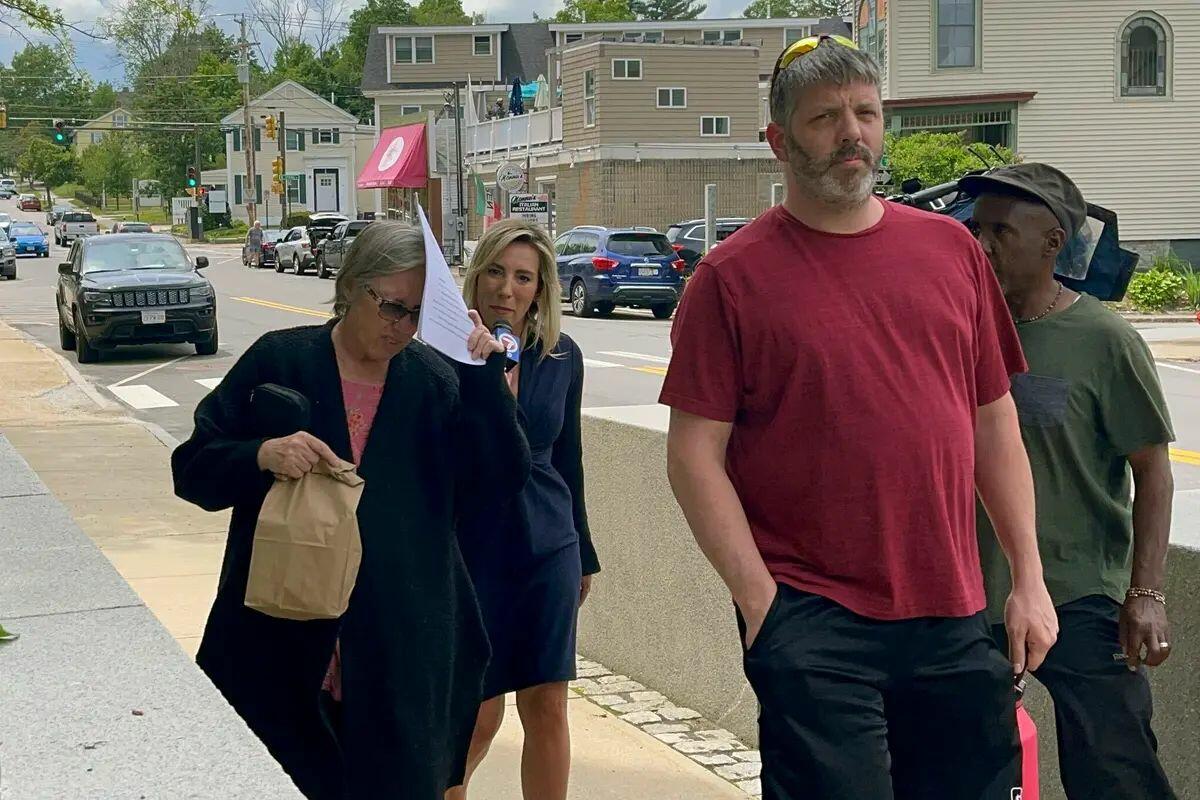
A state court judge in Boston preliminarily approved a class action settlement on Aug. 18 that would resolve the lawsuits filed against the Ivy League institution eight months after Cedric Lodge, the former manager of Harvard Medical School's morgue, was jailed.

Dozens of relatives of individuals whose bodies were donated to Harvard filed lawsuits accusing the school of negligence, contending it turned a blind eye to Lodge's years-long misconduct until he was indicted in 2023.

On Dec. 16, 2025, Lodge, 58, pleaded guilty to charges related to the interstate transportation of stolen goods and was sentenced to eight years in prison.

He admitted to stealing body parts from cadavers donated to Harvard Medical School's Anatomical Gift Program and selling them to buyers across the country.

Morgue Manager Stole Brains, Skin, Bones

Prosecutors said that between 2018 and March 2020, Cedric Lodge stole and trafficked "heads, brains, skin, bones, and other human remains" after the donated bodies had been used for teaching and research.

His wife, Denise Lodge, 65, was also sentenced to 12 months and one day in prison.

Denise Lodge (L) covers her face with a printout of the indictment against her as she walks from the federal courthouse in Concord, N.H., on June 14, 2023. Steven Porter/The Boston Globe via AP
Cedric Lodge, who had worked in Harvard's morgue for almost three decades, smuggled the body parts from the morgue in Boston to his home in Goffstown, New Hampshire, where he and his wife sold them, prosecutors said.

A judge had initially dismissed the class action lawsuit against Harvard, but in October 2025, the Massachusetts Supreme Judicial Court overturned that decision, finding that the plaintiffs had sufficient claims that the institution had failed to act in good faith in handling the bodies.

"Instead of the dignified treatment and disposal of human remains required ... the donors' remains were ghoulishly dismembered and sold for profit under the most horrifying of circumstances," Justice Scott Kafker wrote in the court's opinion at the time. "This horrific and undignified treatment continued for years and involved numerous donors."

'Flagrant Betrayal of Our Values'

Harvard's dean of the faculty of medicine, George Daley, and the dean for medical education at Harvard Medical School, Bernard Chang, said in an Aug. 17 message to the school's community that Lodge's actions took place without the school's knowledge.

Harvard University campus in Cambridge, Mass., on April 22, 2020. Maddie Meyer/Getty Images

"His violations ... were despicable, abhorrent, and a flagrant betrayal of our values as a medical community," they wrote. "These events do not reflect the reverence we hold for the altruistic individuals who selflessly donate their bodies to our Anatomical Gift Program (AGP) to provide essential educational opportunities to medical and dental students, practicing surgeons, and allied health professionals."

Daley and Chang offered their "deep sorrow and empathy" to the families of the donors and said that, in addition to the financial payment, they will provide a statement to the families via a live webinar "confirming that Lodge's criminal acts were morally reprehensible" and inconsistent with the standards Harvard Medical School expects for the treatment of anatomical donors.

John Morgan, whose law firm Morgan & Morgan represented families in the litigation, said, "We hope that this resolution ensures that this never happens to another family ever again."

The remains were sold to, among others, Katrina MacLean, who ran Kat's Creepy Creations, a studio and store in Peabody, Massachusetts, the indictment stated. Payments were often made to Denise Lodge through her PayPal account.

On Aug. 18, MacLean, 47, was jailed for 24 months by Chief U.S. District Judge Matthew W. Brann for interstate transportation of stolen property.

Bill Pan and Reuters contributed to this report.

Tyler Durden Wed, 08/19/2026 - 17:00

Pages