Individual Economists

The Alchemy Of Wealth Taxation

Zero Hedge -

The Alchemy Of Wealth Taxation

Authored by Robert Blumen via The Mises Institute,

“Transmutation” is the process of changing one substance, element, or form into another.

We owe this word to the ancient pursuit of alchemy, which sought to accomplish the artificial production of gold from base metals. While it is now considered a pseudo-science, in our rational age, its aspirations survive in currently popular proposals for taxing billionaires.

The most advanced of these proposals is California Prop 40. Appearing on this fall’s ballot, if passed, would levy a “one time” balance sheet tax of five percent tax on taxpayers with ten or more figures to their name. US Rep. Ro Khanna (D-CA), in “Why I Support a Billionaire Wealth Tax,” likes the idea. He likes it a lot. But, unlike CA-40’s one-time imposition, Khanna’s projects the results for at least ten years:

This [tax] will raise $4.4 trillion over a decade. This is enough to establish a $60,000 salary floor for every public school teacher in America, cap child care at 7 percent of a family’s income, and restore the $1 trillion stripped from Medicaid and the ACA, with a $3,000 check left over for every household under $150,000.

The intention of these plans is to increase access to goods and services for those at the lower end of the income tier, at the expense of the wealthy. The revenue from CA 40, should there be any, is earmarked for,

Medi-Cal and other health coverage programs for low- and moderate-income individuals; health care access, benefits, and services; public education from K-14; and food assistance programs such as CalFresh, CalFAP, CalFood, or California’s Universal Meals Program for school meals.

Billionaires have a lot; working people, not so much. Take from one, give to the other. Make those at the bottom of the pile better off at the expense of those at the top. How hard can this be? As often is the case in economic matters, intended results differ from actual ones.

To determine if these measures achieve their stated goal, we must first ask: “What is the composition of the wealth being taxed?” The point is not just to transfer money. Advocates of these schemes want to increase the consumption of important goods, such as health care and housing. Where, exactly, will they get those things? Billionaires do not have them in large quantities. While the average billionaire might have a few houses, a private jet, a yacht, and some nice cars, their net worth is not a warehouse. Their net worth does not consist of hospitals, MRI machines, or pharmaceuticals.

Rep. Khanna’s arithmetic might be correct, or at least as correct as his assumptions. Where he runs into problems is in thinking that the net worth of billionaires can be transmuted. Stockpiles of unused consumer goods, such as health care, and housing, do not exist in the quantities that Khanna wants to provide. Likewise there do not exist large pools of the types of unemployed skilled labor needed in those fields. The super rich do not have on their payroll thousands of idle doctors, nurses, and teachers. Any trained health care providers whose license is in good order can find work if they wish to do so.

The key point that backers of these proposals miss is that the net worth of the wealthy consists almost entirely of capital goods or assets which are financial claims on capital goods. Capital goods are tools and infrastructure. Most of the durable wealth in the world consists of capital goods. A wealthy society means a society that has accumulated vast amounts of capital goods.

The BEA’s Fixed Assets Accounts reports the value of the US gross capital stock held by businesses, government, and households in 2024 at around $92 trillion. This total includes consumer fixed assets, consisting of residential housing, of $33 trillion. Whether housing is a capital good or a durable consumer good is debated, but, outside of housing almost all long duration wealth consists of capital goods.

Capital goods and labor are the variable factors in the production of consumer goods. A higher standard of living means more consumer goods per capita. This requires a greater concentration of capital goods per unit of labor.

All of the preceding points are true because capital goods are scarce, in the economic sense. Scarcity means that there exists only a finite amount of human and nonhuman resources which the best technical knowledge is capable of using to produce only limited maximum amounts of each economic good.

Factories, oil wells, and pharmaceutical plants are not the things that Khanna wants the tax recipients to have more of. The things he does want, such as medical care, schools and affordable housing, are scarce goods. At any time existing flows of these goods are consumed by someone. Taxing rich people and forcing them to sell assets does not immediately create any more of them.

To be clear on what can and can not happen, imposition of a tax can force rich people to sell some of their capital goods to pay a tax. Government actors can, then, take the monetary proceeds from the sale and use them to buy consumer goods that were already procured. Those consumer goods were procured with labor and other capital goods. It is these consumer goods that the government provides to the poor.

A tax cannot transmute capital goods into consumption goods. The government can only purchase consumer goods that were already produced, with the use of other scarce labor and capital goods.

Many popular criticisms of these taxation schemes circle around the target but fail to make a direct hit because they do not address the fundamental issues of the scarcity and heterogeneity of both capital and consumer goods. These critiques such as:

  • rich people do not keep their entire net worth in cash;

  • billionaires would have to sell off some of their assets to pay the tax;

  • for every seller, there must be a buyer;

  • for positions in the necessary size, there are a limited number of potential buyers

All true, without quite grasping the important part about why they are true. 

If the beneficiaries of the tax receive funds are able to obtain more health care, they will not be displacing billionaires. Billionaires do not have stockpiles of—or consume billions of dollars of—health care. The working-class person who receives the tax benefit will displace the marginal existing consumer. Who is that consumer? That depends on which margin can the consumer be most easily displaced. That margin might be the price. Or it could be waiting time, connections, or the ability to work the system. If California is able to use revenue from this tax to hire a doctor from Missouri, then patients in MO will have one less doctor.

But wait—if there is more money to be spent on those goods won’t the free market economy respond by producing more of them? Yes, but that requires more capital goods and skilled labor. Those things that the rich were forced to sell to pay their “fair share.”

Saving is the source of capital accumulation.

This form of taxation would disincentivize saving in favor of consumption. Over the long term fewer consumption goods will be produced.

Another problem with Khanna’s ten-year projection is to assume a sustainable recurring revenue projection each year.

Did he think that the base net worth that is subject to the tax will regenerate itself each year? One might similarly ask, do capital goods reproduce themselves without savings?

Can the first year’s haul be relied on, as Khanna does, for ten years? Probably not. That view ignores responses that would defeat the goal of the tax.

First, the rich taxpayer might have to sell 8-9 percent of his net worth to pay the capital gains tax and have five percent left. In some years after tax return on a portfolio is nine percent but on average, it’s not. The investor’s base would not recover year after year of nine percent compounded erosion.

Second, Khanna assumes that asset prices would remain unchanged by this tax. Advocates of wealth taxation look at the net worth of billionaires as a fixed number of dollars. This is not so. The monetary value of businesses and assets is variable, not fixed. Each and every asset has a price, which changes from minute to minute in response to market conditions. According to Khanna, the $1 billion marker is only a proof of concept: the eventual tax boundary should be $50 million. As the tax cutoff goes lower, there would be more sellers and fewer potential buyers. If enough people want to, or are forced to sell at the same time, the only adjustment is higher real cash balances and lower asset prices.

Absent transmutation, there is a way for society to have more consumption goods.

This is called “production.”

Production is where labor and capital goods are provided as inputs into a process of manufacturing, moving, or arranging, according to a plan, to yield something useful at the other end.

That is the way—the only way—for everyone, including those in the lower income tiers—to have more of the things that the tax cannot provide.

Tyler Durden Tue, 08/11/2026 - 22:35


No Fourth Amendment In American Airports?

Zero Hedge -

No Fourth Amendment In American Airports?

Authored by M. Walter via AmericanThinker.com,

Do you, as an American citizen, have to hand over your cell phone — along with the access code to open it — upon a (warrantless) demand by a border agent at the airport?

There’s a case grinding through the courts about that right now because one man, a Mr. Sam Tunick, refused.  

Not only did he refuse but he had an app on his phone that triggered its erasure once you keyed in a particular code to open it.  That was the code he gave CBP (Customs and Border Patrol) when they demanded his code to open it.  And then his phone was, indeed, erased right there on the spot, in the hands of the CBP agent.

That’s when CBP got really p***ed off.

According to the reporting on his case, this man was not a criminal.  He was not under suspicion or surveillance for anything, so far as we know. He is not related to Spencer Tunick, an artist who famously creates mass nude photo shoots in public places. He was, in point of fact, a left-wing activist with environmental interests, but, again, without any contact with or prior interest from law enforcement that we know of.

He was just a guy.  Coming home from an international trip (the Dominican Republic.).

You may well be thinking, “A left-wing activist with an erasure code?  Sounds suspicious!”

Let me pause to explain why I don’t think so.

A “right-winger” I know just traveled internationally recently and she traveled with a burner phone to avoid exactly this kind of search in another country.  It was England specifically.  

In England there is no Fourth Amendment and they can search your phone when you land.  They also have no First Amendment and they have terrible censorship laws now.  You can be arrested and jailed for social media posts.  Even some perfectly benign ones, like “Islam is incompatible with Liberty” — that kind of thing.

The Dominican Republic also has no Fourth Amendment and if they simply suspect you have contraband or are engaged in some other illegal activity (so a very wide berth), they have every right to inspect your phone.  Maybe this young man just didn’t want the hassle. Maybe this app was this “left-winger’s” choice instead of a burner, and in the heat of the moment, decided to deploy it once facing our own CPB here in the U.S.

In short, I don’t find it suspicious at all knowing the legal overreach climate we are living in now.  And we certainly can’t be searching American citizens and seizing their devices based on politics alone.  I hope we can all agree on that.

Back to the case:

One attorney, Mike Fox of the Cato Institute characterized Mr. Tunick's situation this way: “This is new, uncharted territory.”

The Supreme Court has never ruled on your Fourth Amendment rights as they specifically relate to your cell phone at American airports/border crossings.  They have ruled on whether or not your phone is searchable in the interior of the United States and the answer is “no” — not without a warrant.

But somehow an American in an American airport on American soil has to surrender his rights to an American customs agent?  What is this sorcery?

Let’s review the Fourth Amendment, in its entirety:

The right of the people to be secure in their persons, houses, papers, and effects, against unreasonable searches and seizures, shall not be violated, and no Warrants shall issue, but upon probable cause, supported by Oath or affirmation, and particularly describing the place to be searched, and the persons or things to be seized.

The Supreme Court has ruled on Fourth Amendment exceptions at border crossings, but not cell phones in particular.  That’s why you have to go through customs and scanners and open your luggage, etc.  We’ve all been doing it forever without a thought.

But your phone ought to be a separate matter entirely, containing as it does, your digital “papers and effects.”  According to the available reporting, there was no “probable cause” to search Mr. Tunick. CPB wasn’t looking for anything specific, which is what a warrant would demand.  They just wanted to go out on a scenic drive, seeing what they could see on his phone.

Hell. No.

The Washington Post just published an op-ed about Mr. Tunick’s case entitled “Your privacy rights don’t disappear at the border,” with the sub-headline, “Congress or the courts need to make clear that a smartphone is not a suitcase.”  It was written by Mike Fox, the attorney mentioned above.

Mr. Fox was also quoted in a CNN article on the case and it sums up his position in both pieces pretty well:

“Obstruction means I’m obstructing some type of investigation, and without any type of warrant or even reasonable suspicion of criminal activity, what investigation am I obstructing?”

The definition of “reasonable” and the deployment of the key code erasure seem to be the real sticking points here, but the larger issue of your cell phone privacy absolutely deserves specific adjudication.

One hopes Mr. Tunick isn’t subjected to a crushing ordeal here, but one does hope that his case makes it to The Supreme Court so we can settle this once and for all.  The other option would be for the Hill to act and pass some legislation making a specific carve out specifying the need for warrants for cell phones, but I’m still choking on the jet fumes from them hurrying out of town for six weeks before they could vote on the Save America Act, so them?  Useful?  On this or any other matter?  That strikes me as a fool’s errand.

There’s no magic fairy dust in the soil at American airports. Your Fourth Amendment rights do not defy gravity there. It’s one thing to paw through my underwear looking for explosives;  I think we can all appreciate the safety concern in that, as absurd as it sounds and even though it’s a pain.  It’s entirely another to thumb through my cell phone just for the heck of it.

Get a warrant.

Tyler Durden Tue, 08/11/2026 - 21:45

Russia Agrees To Repurpose Strategic Military Bases In Post-Assad Syria

Zero Hedge -

Russia Agrees To Repurpose Strategic Military Bases In Post-Assad Syria

Some 20 months after Syria's Bashar al-Assad fled Damascus and went to Moscow, amid jihadist groups taking over the capital city in December of 2024, Russia has finally reached a negotiated settlement over the fate of its Syrian bases with the new Sharaa government.

Russia's Foreign Ministry said Tuesday that a memorandum of understanding over the future of its bases at Tartus and Khmeimim has been set. While some Russian forces will remain at the bases, civilian facilties at these locations will be handed over and operated by the Syrian government and civilian administrators, including Khmeimim airport and the commercial berth at Tartus port.

via Associated Press

The military facilities are expected to be repurposed as joint training sites, where Russian troops will still be based, and the sites will also likely serve as transit hubs for Russian military and logistics operations in Africa. 

It's as yet unclear the degree to which this marks Russia losing its only deep-water naval port on the Mediterranean, at Tartus, but it certainly at least represents a significant downgrade.

The Sharaa government described that the new arrangements represent a "reorganizing of the Russian presence" along Syria's coast and that "this move marks the most significant development since negotiations began approximately a year and a half ago, paving the way for a new phase in Syrian-Russian relations."

Russian forces have long been on their way out of Syria after the Syrian Arab Army under Assad had lost the long-running proxy war. Russian troops had intervened in 2015 in Syria, at Assad's request, and for much of that time had pounded Al-Qaeda held Idlib from the air. 

Ironically it's many of those same jihadists which the Russians were fighting in Idlib which now hold government posts in Damascus.

The Russian Foreign Ministry has acknowledged, "We regard the signing on Aug. 9 of the memorandum between the Russian Federation and the Syrian Arab Republic on the operation of our bases in Khmeimim and Tartus as an important step aimed at further improving bilateral cooperation in the military sphere."

"We believe that reaching this agreement will give further impetus to the development of the full range of relations between our countries, which are based on a long history of friendship and partnership," it added.

Moscow is now having to deal with a completely new reality in the Levant region, and is facing a greatly diminished presence and influence in this post-Syrian war situation. Iran also retreated from Syria, and Hezbollah has completely moved back to its home front in Lebanon.

Tyler Durden Tue, 08/11/2026 - 21:20

Massachusetts Legalizes Abortion Up To Birth As Liberals Cheer

Zero Hedge -

Massachusetts Legalizes Abortion Up To Birth As Liberals Cheer

Authored by Steve Watson via Modernity News,

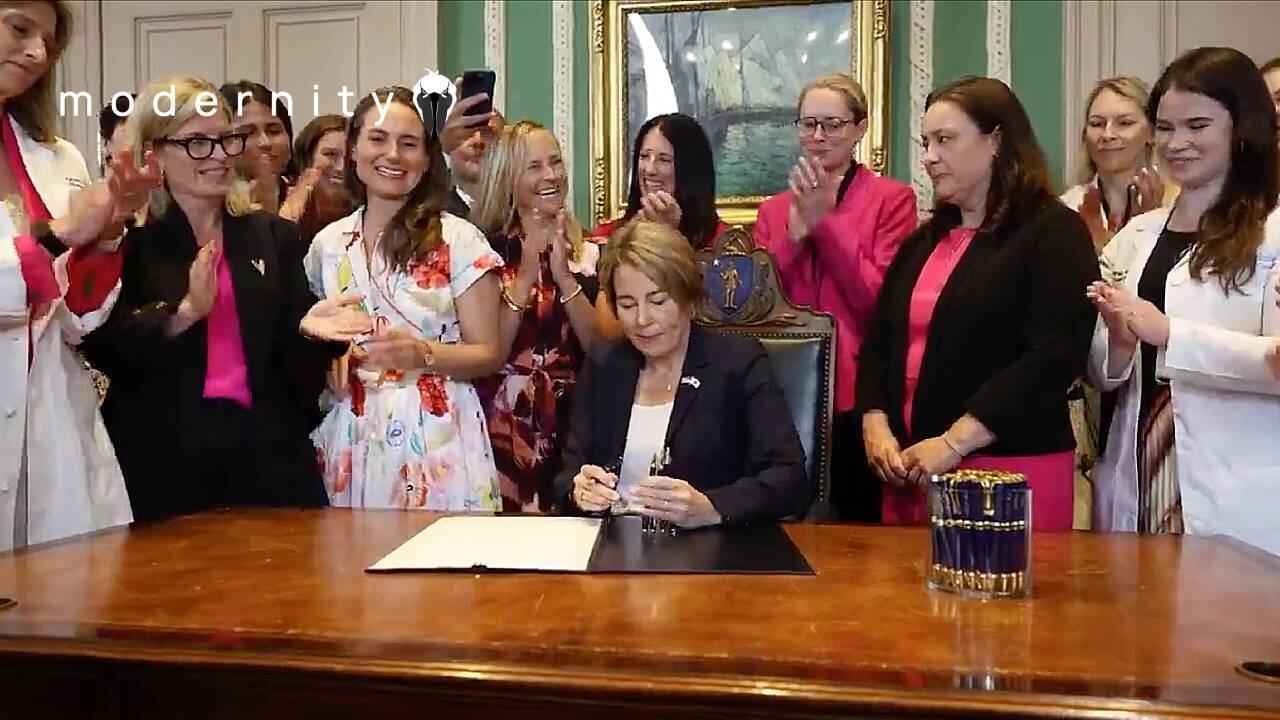
Massachusetts Democratic Governor Maura Healey has signed into law a measure that effectively permits abortion through all nine months of pregnancy, right up to the point of birth. Liberal women packed the room and gleefully cheered as she put pen to paper.

The previous statute restricted abortions after 24 weeks to specific circumstances: preserving the life of the patient, physical or mental health, lethal fetal anomaly, or a grave diagnosis incompatible with sustained life outside the womb without extraordinary intervention. That framework is now gone.

The new law, deceptively titled the "Prioritizing Patient Access to Care Act" (H.5595), states that an abortion may be performed by a physician based solely upon the professional judgment of the physician. No medical review process can override that judgment and the patient's decision.

Healey framed the change around stories of "pain and anguish and heartache and a lot of trauma." She declared: "We're signing this law today so that new patients, people we won't know or won't meet, will be able to get the care that they need in Massachusetts."

She added that health care decisions should be made "between women and families and their doctors, not politicians," and promised abortion would remain "safe... legal, and... accessible here in Massachusetts."

The ceremony featured applause and smiles from advocates, doctors, and lawmakers. Massachusetts now joins Alaska, Colorado, Maryland, Michigan, Minnesota, New Jersey, New Mexico, Oregon, Vermont, and Washington, D.C., as jurisdictions with no statutory gestational limit. The law takes effect in 90 days.

Pro-life leaders did not share the celebratory mood. Carol Tobias, president of National Right to Life, stated: "Governor Healey and the Massachusetts Legislature have erased the final protections for unborn children who can feel pain and who could survive outside the womb."

"At the very stage when premature babies are receiving lifesaving care in neonatal intensive care units, Massachusetts will permit abortionists to end the lives of children of the same age - and even older. That is not compassion, and it is not health care," Tobias further urged.

Myrna Maloney Flynn, president of Massachusetts Citizens for Life, was blunt: the measure "legalized elective abortion up to birth on healthy moms and healthy, pain-capable infants."

She continued that it is "not about protecting the doctor-patient relationship. It is about abortionists normalizing the deaths of fully-developed infants and pressuring vulnerable women to permit their unborn children to die in heinous acts of violence."

These procedures, she noted, rank among the most severe human rights abuses permitted in only a handful of places worldwide.

Rep. Tim Burchett (R-TN) responded simply: "Jesus wept."

This movement fits a pattern of cultural celebration around the destruction of the unborn. Earlier this year a woman in Memphis took abortion pills at a gender-reveal party after learning she was having a girl while friends shouted "kill it."

Washed up Sex and the City actress Cynthia Nixon drew widespread criticism for posing in a red hat altered to read "Make Abortion Great Again," once again providing an example of how weirdo celebrities with dysfunctional lives should not be taken seriously whenever they spout off about how society should function.

Across the Atlantic, the UK House of Lords advanced measures that also effectively open the door to abortion up to birth, despite polling showing only about 1 percent of Britons approve of such extremes and clear majorities favor gestational limits to protect viable life.

The Massachusetts law removes objective statutory guardrails and hands the decision entirely to the attending physician.

Pro-life physicians emphasize that true medical emergencies requiring separation of mother and child are distinct from induced abortion intended to end the life of a viable unborn child.

Late-term procedures often involve dismemberment or induction, with the latter risking live birth if fetal demise is not first induced.

Supporters insist the change merely prevents families from traveling out of state for "complex medical circumstances."

Critics counter that the prior exceptions already covered life-threatening situations and severe anomalies, and that the new open-ended standard invites elective procedures on healthy mothers carrying healthy, pain-capable infants.

Data from the state's own Department of Public Health already showed dozens of abortions at 24 weeks or later in recent years; the removal of limits is expected to increase that number.

Healey and Democratic lawmakers fast-tracked the bill in the final days of the legislative session. It passed the House 119-33 before clearing the Senate. The governor, facing reelection, presented the signing as a defense against what she called attacks on reproductive health care after the Supreme Court returned the issue to the states.

The result is another blue-state outpost where the unborn lose the last remaining legal protections based on gestational age or viability. At the same moment premature infants of identical ages receive aggressive neonatal care, the same state now authorizes ending their lives under the sole criterion of a doctor's professional judgment.

This is the logical endpoint of a movement that treats abortion as both medical necessity and political sacrament.

The cheers at the State House, the "kill it" chants, the novelty hats all point in the same direction: a culture that has decided some human lives are disposable right up to the moment of birth.

Pro-life Americans continue to insist the opposite is true, and that every state still has the power - and the moral obligation - to protect those who cannot speak for themselves.

Your support is crucial in helping us defeat mass censorship. Please consider donating via Locals or check out our unique merch. Follow us on X @ModernityNews.

Tyler Durden Tue, 08/11/2026 - 20:55

Bank Of America: The US Unemployment Rate Is Falling Because Americans Are Too Rich

Zero Hedge -

Bank Of America: The US Unemployment Rate Is Falling Because Americans Are Too Rich

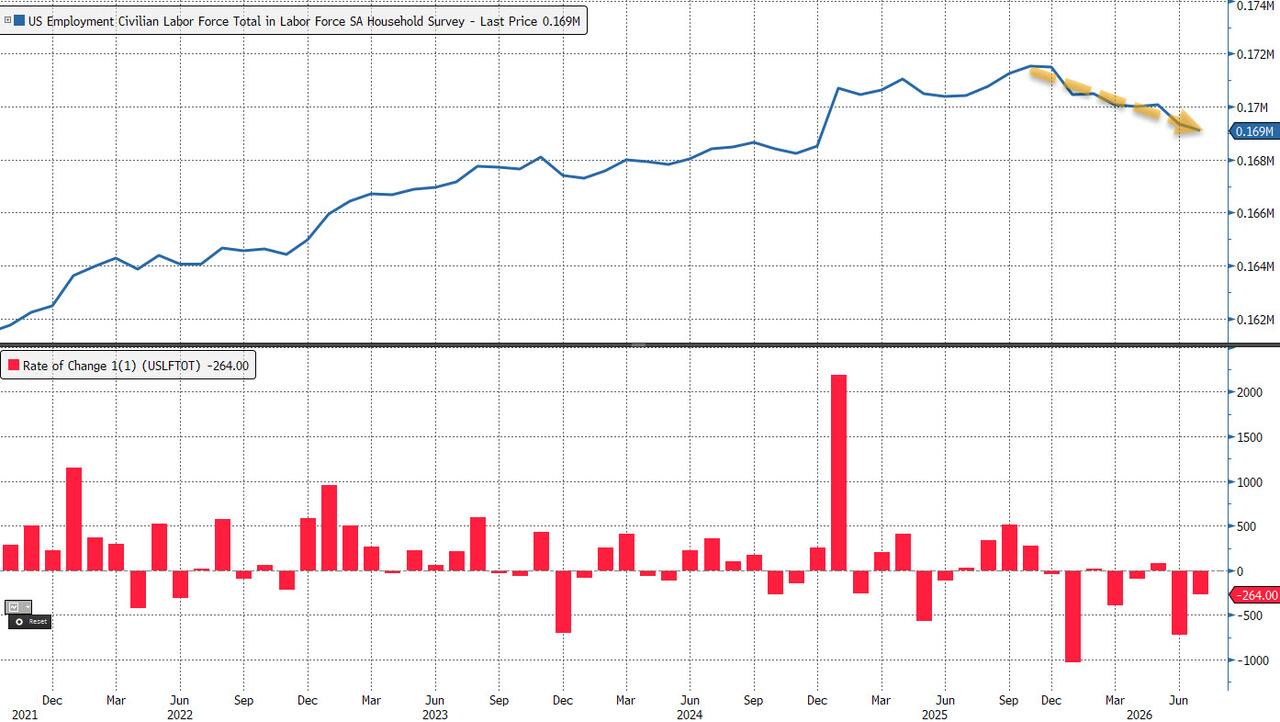
Last Friday's dismal jobs report (where 23K jobs were lost) had a silver lining: the unemployment rate dropped to 4.1%, the lowest since June 2025, dinging expectations that the AI revolution would lead to a spike in unemployment. There was just one problem: unemployment dropped not because more people found a job, but because the labor force shrank by a whopping 264K, and down more than 2 million since the start of the year.

To be sure, the continued shrinkage of the US labor is hardly new and has long been attributed to Trump's anti illegal immigration policies which have led to a substantial trimming of the US labor force. 

However, in a novel spin this morning, Bank of America - seemingly convinced that the US is now enjoying a new Golden Age - published a report titled "A stock-fueled retirement party" in which it makes the modest proposal that the US unemployment rate is shrinking because Americans are simply too rich. 

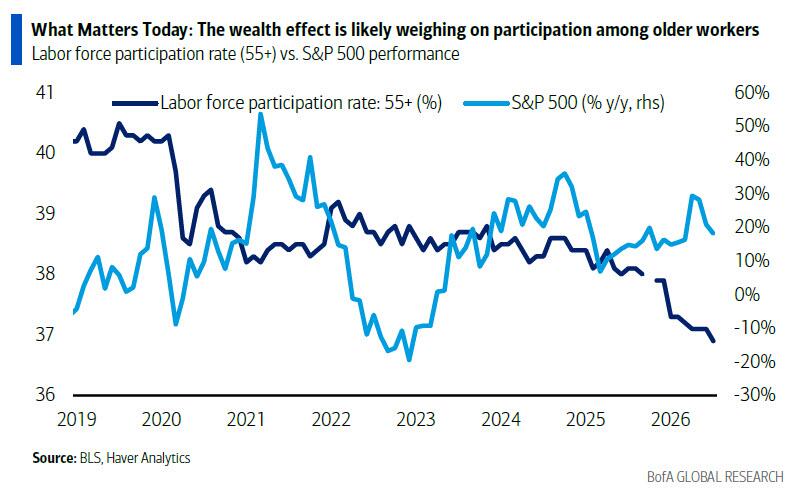
That's right: according to BofA economist Stephen Juneau (full note available here), the labor force participation rate among older (55+) workers never recovered after the pandemic shock. It remained roughly range-bound until the summer of 2024, but has taken another big leg down since then.

Why? Well, to BofA, this is related to the 35%+ increase in the S&P 500 over the last two years. The resulting surge in wealth has likely made retirement an easier choice for many.

More broadly as well, the economist notes that there appears to be a modest negative relationship between equity gains and older workers’ participation.

Is BofA right? We don't know, but if they are it would be ironic that while we wait for the unemployment rate explosion as a result of chatbot agents taking millions of white collar data-heavy jobs, the unemployment rate would actually drop thanks to all those who were long AI stocks. 

Tyler Durden Tue, 08/11/2026 - 20:30

Florida Seeks NY Times Internal Documents Over Errors In Israel-Hamas War Coverage

Zero Hedge -

Florida Seeks NY Times Internal Documents Over Errors In Israel-Hamas War Coverage

Authored by Jill McLaughlin via The Epoch Times,

Florida Attorney General James Uthmeier sought to inspect records from The New York Times on Aug. 10, claiming the newspaper's pattern of admitted mistakes covering the Israel-Hamas war threatens the state's pension fund.

The New York Times building in Manhattan on Feb. 5, 2024. Samira Bouaou/The Epoch Times
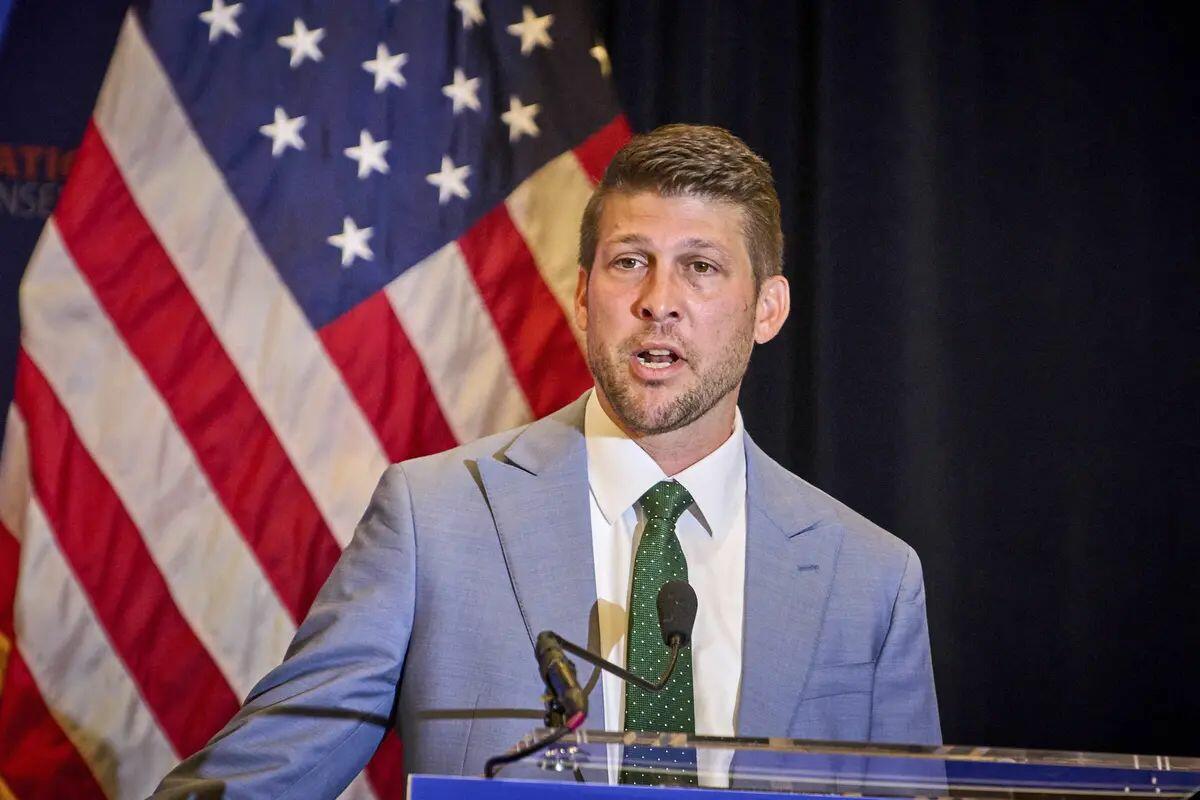
Uthmeier, representing the pension fund and the thousands of shares it holds in company, sent a 28-page letter to The New York Times seeking to scrutinize six years' worth of internal records, board documents, and meeting minutes, dating back to January 2020, and asking the company to prove it was operating smoothly.

"The Times tells investors that its brand and reputation are its most important assets and that if people see its journalism as unreliable or biased, the company can be hurt," Uthmeier said in a video on X. "We want to exercise our rights under New York law to review the company's internal board documents, meeting minutes, reports, and other materials, to see what the directors know.

"The First Amendment protects what a newspaper publishes, but it does not let a public company's board ignore its shareholders," Uthmeier continued.

Uthmeier is a trustee and legal counsel for Florida's State Board of Administration, which oversees the pension fund and its 160,000 shares of stock in The New York Times.

The paper has two weeks to respond or Uthmeier said he would sue them in the New York Supreme Court.

"Shareholders have tools to ensure the Board prevents The Times from becoming a newspaper the public comes to regard as untrustworthy," Uthmeier wrote in the letter.

A downturn in revenue forced the news company to consolidate its editorial staff in 2017 to shift the balance of the newsroom to give them more on-the-ground reporters.

The changes included eliminating an independent editor position, or ombudsman, which received reader complaints and questioned New York Times journalists on how they made decisions.

"Since the New York Times got rid of its independent public editor, it has several times now admitted, only after outside pressure, that published articles did not meet its standards," Uthmeier said. "According to reports, between Oct. 7, 2023 and June 2024, The Times admitted 72 errors in its coverage of the Israel-Hamas war that had to be corrected. Many, if not most, of those errors favored Hamas."

The New York Times received the letter Monday and views it as an intimidation tactic, according to a spokesperson.

"We are aware of the demand letter, which, while positioned as a request under corporate law, is a clear attempt to chill First Amendment-protected journalism. We will respond more fully in due course," Danielle Rhoades Ha, spokesperson for The New York Times, told The Epoch Times.

James Uthmeier speaks at the National Conservatism Conference in Washington on Sept. 3, 2025. Dominic Gwinn/Middle East Images/AFP via Getty Images

Florida's threat of legal action comes two months after President Donald Trump's allegations against the company over coverage of the Iran war. Trump threatened to sue The New York Times in June, accusing the newspaper of publishing "treasonous" coverage that downplayed the impact of the war with Iran.

The New York Times defended its coverage, saying it was presented "fairly, thoroughly and above all, accurately to readers."

The newspaper's board of directors includes Chairman and Publisher A.G. Sulzberger; GoDaddy CEO Amanpal Bhutan; former chief product officer at the online gaming platform Roblox Manuel Bronstein; Beth Brooke, former global vice chair of public policy at Ernst and Young; Rachel Glaser, former chief financial officer at Etsy; Arthur Golden, author of Memoirs of a Geisha and other novels; and Meredith Kopek Levien, CEO of The New York Times.

Also on the board are: Brian McAndrews, former president and CEO of Pandora Media; David Perpich, vice chair of The New York Times; John Rogers, Jr., founder of Ariel Investments; Anuradha Subramanian, chief financial officer of Beast Industries, the parent company founded by YouTube star MrBeast; Margot Golden, freelance graphic designer; and Rebecca Van Dyck, chief marketing officer at Airbnb.

Tyler Durden Tue, 08/11/2026 - 20:05

Mysterious Drone Threat Emerges At America's "Unsinkable Aircraft Carrier," Prompting Curfews

Zero Hedge -

Mysterious Drone Threat Emerges At America's "Unsinkable Aircraft Carrier," Prompting Curfews

One of the most strategically important US military bases outside the continental U.S., often described as an "unsinkable aircraft carrier" in the central Indian Ocean, faces a mysterious drone threat, according to a new report.

TWZ cited the UK Ministry of Defense, which said it was aware of reported drone sightings over the remote US-UK military base but declined to identify the drones.

"We are aware of reported sightings of drones (UAS) over Diego Garcia," the UK Defense Ministry (MoD) told the military blog Monday morning. "We are unable to provide any details about a situation which may affect the security or operation of the joint U.K.-U.S. base on Diego Garcia."

"The U.S. and U.K. Commanding Officers on Diego Garcia consider and implement appropriate measures to ensure the security and safety of the base and the safety of the personnel on the island," MoD added.

TWZ noted that US officials "were less forthcoming" about the drone threat against Diego Garcia.

"As a matter of operational security, we do not discuss specific force protection measures or security procedures at U.S. military installations," an official from U.S. Pacific Command (PACOM) told the outlet on Friday. "We remain vigilant in protecting U.S. personnel and facilities."

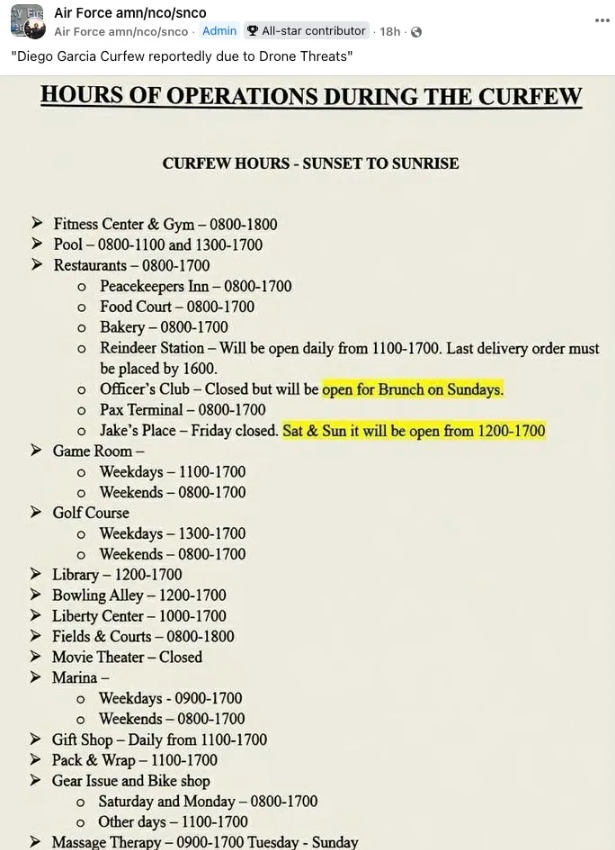
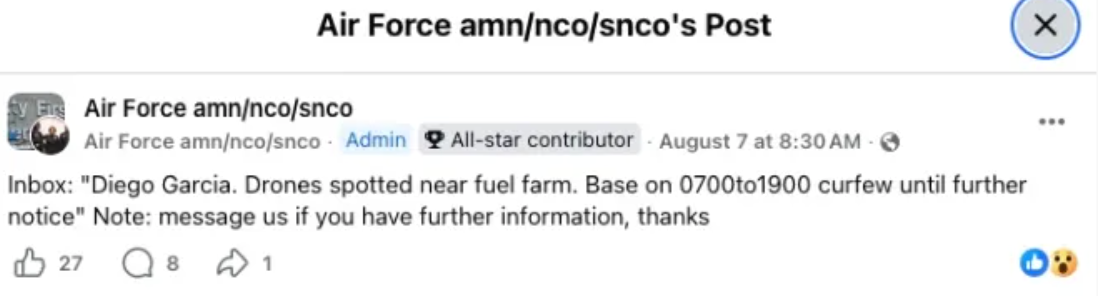
Last Friday, the Air Force amn/nco/snco Facebook page said drones were spotted near the base's fuel tank farm, and a daytime curfew had been imposed. "

"Inbox: Diego Garcia. Drones spotted near fuel farm. Base on 0700 to 1900 curfew until further notice. Note: message us if you have further information, thanks," the Facebook post read.

A post on Sunday by the Air Force amn/nco/snco page, titled "Diego Garcia Curfew Reportedly Due to Drone Threats," displayed curfew times across the base.

The incident highlights the growing drone threat launched from ships, submarines, or uncrewed surface vessels. Officials did not disclose the drone group size.

Here's the classification via Piper Sandler:  

The incident is also a reminder that the drone scare on the US East Coast in December 2024 likely began with a drone or drones launched from a shipping container aboard a cargo ship. Drone threats are emerging outside of modern battlefields, something we've been warning about. 

Also last week, a one-way attack drone was found on the tarmac at Leipzig/Halle Airport, one of Europe's most important freight hubs. 

The drone threat is only going to get worse from here as the federal government is in full race mode to secure high-value assets, abroad and domestically. 

Tyler Durden Tue, 08/11/2026 - 19:40

Looking Back At The Uranium One Scandal

Zero Hedge -

Looking Back At The Uranium One Scandal

Authored by Stu Cvrk via American Greatness,

The Uranium One scandal was a 2010 controversy in which the Obama administration approved the takeover of Uranium One - a Canadian company with significant uranium mining assets in the United States - by Russia's state-owned Rosatom corporation. Critics alleged a pay-to-play scheme, pointing to large donations (roughly $145 million) to the Clinton Foundation from individuals connected to Uranium One and its investors, as well as a $500,000 speaking fee paid to Bill Clinton by a Russian bank involved in the deal.

The conventional wisdom is that no evidence was uncovered of improper influence or criminal wrongdoing by Hillary Clinton or other U.S. officials in the Committee on Foreign Investment in the United States (CFIUS) approval process, though the foreign donations and influence aspects have never been fully resolved.

Could the "conventional wisdom" be wrong (because it was manufactured to hide the reality), and could the truth of those elusive foreign connections involve Iran?

Let us take a deep dive and speculate using facts and logic.

URANIUM ONE ORIGINS AND PURPOSE

Uranium One started as a South African-Canadian mining company. It became a major uranium player after absorbing UrAsia Energy in February 2007. UrAsia's chairman was Frank Giustra, a Canadian mining financier and longtime Bill Clinton associate. Giustra had negotiated Kazakh uranium mining rights beginning in 2005, and in September 2005 he and Bill Clinton traveled to Kazakhstan and dined with President Nazarbayev; UrAsia closed its Kazakh mining deals shortly after. UrAsia's share value rose roughly seventyfold between 2005 and 2007, and Giustra donated $31.3 million to the Clinton Foundation in 2006 - an amount later dwarfed by further pledges once his UrAsia stake was sold into Uranium One two months later.

Rosatom's stated purpose in acquiring Uranium One was straightforward from Moscow's perspective: vertical integration of its state nuclear conglomerate into global uranium supply, part of a broader post-2008 push (noted in leaked State Department cables) to secure uranium sources after Russia felt constrained by import limits elsewhere.

THE CHRONOLOGY

2005-2007: Giustra/UrAsia secure Kazakh uranium rights; UrAsia merges into Uranium One (Feb. 2007); Giustra exits and begins large Clinton Foundation donations.

2009: Rosatom subsidiary ARMZ begins acquiring a stake in Uranium One (first tranche, ~17%).

June 2010: Rosatom announces a deal to acquire majority control. Because Uranium One held U.S. mining assets (Wyoming), the acquisition of Uranium One by Rosatom required review by the Committee on Foreign Investment in the United States because uranium is considered a strategic asset with national security implications.

2010: CFIUS's nine-member agencies unanimously approve the deal; no member raised a formal security objection. The committee approved the proposal, and in 2013 Russia assumed 100 percent ownership, renaming the company Uranium One Holding.

June 29, 2010: Renaissance Capital, a Kremlin-linked bank promoting Uranium One stock, pays Bill Clinton $500,000 for a Moscow speech shortly after the deal's announcement.

2009-2013: As Rosatom's stake grows in stages, Ian Telfer (Uranium One's chairman) makes four donations totaling $2.35 million to the Clinton Foundation through his family foundation - donations the Foundation later admitted it failed to disclose despite a transparency pledge.

2013: Rosatom completes full ownership.

2017-2020: House Republicans open an investigation; DOJ appoints U.S. Attorney John Huber to review the matter (2017); the inquiry never becomes a special counsel probe and winds down by 2020 without public findings.

2023: Special Counsel John Durham's final report did not include Uranium One.

2025-2026: Newly declassified FBI/DOJ records surface via the Senate Judiciary Committee, led by Sen. Charles Grassley (R-IA), reportedly describing internal assessments that there was "significant evidence worth pursuing" on possible criminal activity tied to the Foundation and the sale - reigniting the controversy.

WHO MADE MONEY OFF THE DEAL

Frank Giustra: Sold his UrAsia/Uranium One stake in 2007, three years before the Rosatom deal review. Total lifetime Clinton Foundation giving exceeds $100 million; he sits on the foundation's board. Fact-checkers note he had exited the company well before the CFIUS-reviewed transactions.

Ian Telfer: Remained Uranium One's chairman through the Rosatom acquisitions; donated $2.35 million via his family foundation, undisclosed at the time.

Bill Clinton: $500,000 speaking fee from a Kremlin-linked bank in 2010.

Other Uranium One-connected donors: Nine individuals related to the company donated to the Clinton Foundation, though PolitiFact's review found only Telfer's donations fell clearly within the deal's timeframe. Were the delayed donations merely set up to look like there was no Uranium One connection?

Russian side: Rosatom's U.S. executive Vadim Mikerin was later convicted in a separate racketeering case (kickbacks, bribery, extortion) tied to Rosatom's U.S. nuclear business - a scheme the FBI had informant evidence on as early as 2009, before CFIUS approved the deal.

CFIUS PLAYERS AND POTENTIAL CORRUPTION

The Committee on Foreign Investment in the United States (CFIUS) is a nine-member interagency body (State, Treasury, DOJ, DOD, Commerce, Energy, DHS, USTR, and OSTP), and it does not have unilateral veto power - that rests with the president, and any recommendation goes through consensus review by all nine agencies.

Hillary Clinton did not personally sit on the committee; Assistant Secretary of State Jose Fernandez represented State and has said Clinton was not involved in the matter, with several former State and DOJ officials saying it would be unlikely for her to have more than nominal involvement since these reviews are handled by career civil servants. How plausible are these denials (by Clinton appointees, no less) given what the Clinton Foundation received from Frank Giustra et al?

The corruption allegation ("use of high office to influence the decision") rests almost entirely on inference from timing: donations flowed from Uranium One-linked figures during the review period, and Bill Clinton was paid by a Kremlin-linked bank around the same time. Official investigations conducted by the DoJ and FBI have conveniently found no criminal behavior. Given the manipulation by these investigating agencies in the Russia hoax and later scandals, including former FBI Director James Comey's whitewashing of Hillary Clinton's email server scandal in 2016, how plausible is it that "nothing was found"?

Interestingly, newly surfaced 2025-2026 FBI/DoJ memos are the most significant open question. Reporting by Just the News says they describe an internal assessment that "significant evidence worth pursuing" existed and that the Obama-era DoJ did not pursue it further.

Here is a very interesting quote from those emails, specifically from former US Attorney Cody Hiland, who was involved in the 2018 investigation: "[T]he intelligence summary regarding Uranium One ... fails to account for the dynamic related to possible deliberately false statements that may have been made by U/O officials to CFIUS to induce the authorization to sell U/O to Rosatom (i.e. that Rosatom could not export uranium)."

Even more damning was this quote that implied a pending investigation that may have been quashed: "There are remaining investigative tasks that should be completed before making a final assessment of the U/O [Uranium One] matter.... [including interviewing] the foreign nationals specifically identified by [Redacted] as having made statements concerning the attempts to use the Foundation as a vehicle to influence the Secretary of State."

Bottom line: there is a well-documented appearance of conflict (donations, speaking fees, timing) and documented Russian criminal conduct in the broader nuclear sector, but no investigation to date has yet produced hard evidence of a quid pro quo directly implicating Clinton's CFIUS role. The newly declassified memos may change that picture depending on what they actually show when made public.

WHERE THE URANIUM WENT

There was one documented export, according to The Hill. NRC records show a shipment of yellowcake from the Russian-owned U.S. mines to Canada in 2012 through a third party, with the Obama administration later approving the transfer of a portion of that shipment to Europe. No exports have occurred since.

That 2012 Wyoming to Ontario (Canada) shipment is the one hard data point in the public record. NRC/CNSC incident reports (from a Blind River refinery spill investigation) show the yellowcake drum involved had been shipped from Uranium One's Willow Creek Facility in Wyoming on May 29, 2012, to Cameco's Blind River refinery in Ontario - that's the "third party" as referenced in that report from The Hill. Cameco is Canada's dominant uranium company and operates the world's largest uranium refinery (Blind River) and Canada's only conversion facility (Port Hope).

From there, the normal processing chain is:

  1. Blind River (Ontario) - refines yellowcake into uranium trioxide (UO₃)
  2. Port Hope (Ontario) - converts UO₃ into uranium hexafluoride (UF₆, "hex") for light-water reactor fuel, or uranium dioxide for Canada deuterium uranium (CANDU) reactors
  3. Since Canada has no enrichment capability, the UF₆ is shipped onward - Cameco's own description of its export pattern says its Port Hope hex is transported by truck or ocean freighter to enrichment plants in the United States, Japan, and Europe.

Uranium One's U.S. production (Willow Creek/Christensen Ranch, Wyoming) was sold, like virtually all Western-mined uranium, under confidential long-term supply contracts to nuclear utilities - not sold as raw ore on a spot market to end-users directly (standard industry practice). The most likely commercial destinations are U.S. and allied nuclear utilities (U.S. reactors consume the vast majority of Wyoming ISR production domestically, since ISR-mined material rarely gets exported given the added cost/friction of export licensing).

Once Rosatom owned Uranium One outright (2013), commercial logic would suggest more of that output could be marketed through Rosatom's global trading arm (TENEX-Techsnabexport or Rosatom's international fuel-cycle business) rather than solely through U.S. utility contracts. This is a logical inference from Rosatom's usual global marketing structure, not a documented shipment per se.

IS THERE AN IRANIAN CONNECTION?

So far, there is no documented evidence - in any congressional investigation, NRC export record, or FBI file that has surfaced - that any Uranium One material reached Iran. In fact, the probability that Uranium One-derived material specifically ended up in Iran is low based on the public record - though "low" is not the same as "zero" since neither NRC disclosures (withheld as proprietary) nor downstream tracking of the Canadian/European shipments that Iran has regularly received over the years has been made fully public. The fact that "we don't have a documented final destination" is a real evidentiary gap, not a clean exoneration of anyone.

The most plausible mechanism by which Iran could have received Uranium One product is through commodity fungibility, not smuggling or theft.

Uranium markets don't work like tracked serial-numbered goods. Once yellowcake is refined and converted, it's a fungible commodity - one country's UF6 is chemically indistinguishable from another's. The global trade runs heavily on "swaps" and "book transfers": a producer with material in Location A can contractually deliver to a customer in Location B while someone else's equivalent material physically moves the other direction because it's cheaper than shipping the actual atoms across the world. This is completely standard and legal in the industry.

Given that, the realistic pathway isn't "a truck full of Wyoming yellowcake crosses into Iran." It's something more like this: Rosatom, once owning Uranium One's U.S. production, could have counted that output toward its own global supply obligations - freeing up an equivalent quantity of Russian-origin uranium that Rosatom's fuel arm (TVEL) was already contractually supplying to Iran. That's a real, legal, and well-documented Russia-Iran nuclear relationship, not speculation - TVEL has supplied fuel for Iran's Bushehr power plant for years, openly and under IAEA safeguards, as part of the original construction deal for that reactor.

That is the most logical mechanism by which "Uranium One-linked material" could be economically connected to Iran, as that swap/displacement logic is the most defensible one because it's how the commodity accounting works and nobody has any obligation to disclose it.

CONCLUDING THOUGHTS

There are International Atomic Energy Agency (IAEA) "safeguards" involved in managing Iran's uranium imports. Uranium destined for Iran's declared enrichment facilities (Natanz, Fordow) is subject to material accounting under IAEA safeguards precisely to prevent unaccounted diversion. Significant undeclared quantities moving in would risk detection. That said, were any of these safeguards compromised since Rosatom acquired Uranium One in 2013?

The answer could easily be yes, as Iran has historically restricted or denied IAEA access to certain facilities, particularly those suspected of weapons-related (possible military dimensions) activities. One example is the Parchin military site, which was long restricted with limited, managed access granted only after years of delays and under the 2015 JCPOA framework. Environmental sampling subsequently found man-made uranium particles inconsistent with Iran's explanations. Note: Iran has generally argued that military sites are off-limits or require special authorization, asserting a distinction between civilian and military facilities (a position the IAEA rejects for safeguards purposes).

What does all this mean? Let us connect the dots:

  • Uranium One was sold to Rosatom (Russian-owned).
  • Uranium ore from Uranium One (later Rosatom) could have been transported almost anywhere through "global trade of a fungible commodity."
  • Russia had/has a long-standing nuclear exchange relationship with Iran.
  • Uranium ore from Rosatom could have bypassed the clearly incomplete IAEA safeguards in Iran. The Kremlin would gain significant blackmail leverage over key US decision-makers by facilitating this transfer.
  • The newly discovered Uranium One-related emails being pursued by Sen. Grassley et al. could potentially expose a cover-up by some of the same players involved in the Russia hoax. There are no such things as coincidences.

Note: circling back to the beginning, CFIUS members/State Department personnel involved in the original Uranium One sale would only be culpable if they had contemporaneous knowledge that diversion to a sanctioned/prohibited end-user was likely and approved anyway. There is a long row to hoe before that can be proven, but stranger things have happened lately.

Stu Cvrk retired as a captain after serving 30 years in the U.S. Navy in a variety of active and reserve capacities, with considerable operational experience in the Middle East and the Western Pacific. He is a graduate of the U.S. Naval Academy, where he received a classical liberal education that serves as the key foundation for his geopolitical commentary.

Tyler Durden Tue, 08/11/2026 - 19:15

Woman Who Defrauded USAID-Funded Nonprofit Avoids Prison, Settles Civil Claims For $160,000

Zero Hedge -

Woman Who Defrauded USAID-Funded Nonprofit Avoids Prison, Settles Civil Claims For $160,000

A Maryland woman has agreed to pay the U.S. government $160,000 to resolve civil allegations that she submitted false claims for payment, following her earlier criminal conviction for defrauding a nonprofit that received USAID funding.

Carleena Graham, 59, formerly served as vice president of human resources at World Learning, a nonprofit that received millions of dollars in grants and contracts from both the U.S. Agency for International Development and the State Department. According to the USAID Office of Inspector General, she orchestrated a scheme that drained roughly $425,000 from the organization between about 2016 and mid-2022. Of that total, approximately $272,500 came directly or partially from U.S. government funds.

Graham arranged for goods and services to be delivered to Washington-area nonprofits where she held positions or had relationships, then directed World Learning to pay for them through electronic transfers from its accounts. She falsified vendor invoices to create the appearance that World Learning itself had received the items. She also used the organization's credit cards to cover expenses for those outside entities.

Federal authorities charged her with one count of wire fraud in May 2023. She pleaded guilty and, in March 2024, received a sentence of four years' probation, an order to pay $425,000 in restitution, and a three-year debarment from receiving U.S. government funds. Her plea agreement estimated an advisory sentencing range of 27 to 33 months' imprisonment.

In July 2026 she entered a separate civil settlement with the Department of Justice under the False Claims Act, agreeing to the $160,000 payment. That agreement closes a joint investigation by the USAID and State Department Offices of Inspector General. The government's announcement notes that the claims resolved by the civil settlement are allegations only and that there has been no determination of liability.

Graham's is not the only USAID-linked fraud case to reach resolution. As we reported in June of last year, former USAID contracting officer Roderick Watson and three corporate executives pleaded guilty over a decade-long bribery scheme spanning at least 14 prime contracts worth more than $550 million. Prosecutors said Watson accepted bribes valued at more than $1 million, including cash, laptops, tickets to a suite at an NBA game, a country club wedding, and down payments on two residential mortgages. He faced a maximum of 15 years. The two contractors involved, Apprio and Vistant, admitted criminal liability and entered deferred prosecution agreements. In a separate case, a British national who worked on a USAID-funded power distribution program in Pakistan was extradited after more than two years, pleaded guilty, and was sentenced to time served for a kickback scheme that cost the program almost $100,000.

The settlement lands amid broader scrutiny of USAID's oversight of foreign-aid spending. Inspector general memoranda issued in 2025 flagged weaknesses, including limited visibility into sub-recipients, resistance from some international partners in sharing misconduct information, and incomplete reporting of potential fraud by organizations that received agency funds. World Learning was among the recipients of USAID programming during the period of the scheme.

USAID was formally dissolved on July 1, 2025, with its remaining functions absorbed into the State Department.

Also, the DNC is oddly out of money.


Tyler Durden Tue, 08/11/2026 - 18:50

Homeschool Families Are Pushing For High School Sports Participation

Zero Hedge -

Homeschool Families Are Pushing For High School Sports Participation

Authored by Aaron Gifford via The Epoch Times,

Luke Cecchi watched from the bleachers as his friends and neighbors played varsity sports.

Illustration by The Epoch Times, Courtesy of Sherry Luke Photography, Courtesy of Luke Cecchi, Clemed/CC BY-SA 3.0

The homeschooled student from Cazenovia, New York, wasn't allowed to try out for the local high school soccer and basketball teams under a state law regulating scholastic athletics, even though his family paid thousands of dollars in property taxes to the local school district and supported local recreation sports programs through fees, participation, and volunteer coaching.

New York state has resisted change, despite bipartisan support from lawmakers and the growing number of states allowing homeschooled students access to extracurricular activities at their neighborhood public schools.

"I wanted to play so badly," Cecchi, now a 23-year-old law school student, told The Epoch Times. "It didn't make sense to me."

On his own, Cecchi found a way to train in competitive basketball and eventually made a Division I college team as a walk-on.

Still, he took an unusual, daunting path against incredible odds in America's ultra-competitive scholastic sports landscape.

All told, the vast majority of states either have laws allowing homeschooled students to participate in their local public school sports and extracurricular activities or leave it to individual districts to decide on a case-by-case basis.

But in California, Maryland, New York, Oklahoma, and Virginia, homeschooled students are barred from public school sports by way of legislation, court decisions, or regulations set by organizations that govern interscholastic athletics, according to the Homeschool Legal Defense Association.

A pending state court case in Virginia could set a precedent that opens interscholastic competition to all students, though many families in these exclusive states are content building a league of their own.

Tim Tebow Laws

A decade after Florida passed laws allowing homeschooled students to participate in public school sports, University of Florida quarterback Tim Tebow won the Heisman Trophy as college football's best player and went on to compete in the National Football League.

His parents chose to homeschool him because of their Christian beliefs. He played on a public high school team in the Jacksonville area despite never being enrolled at that school.

The Sunshine State's legislation inspired red and blue states across the nation to follow suit and enact "Tim Tebow" laws.

Some states, such as Alabama, require public schools to make sports available to all nontraditional students. Others, including Georgia, stipulate minimum academic standards and code of conduct provisions. Wisconsin allows it "if space permits."

Nine states and the District of Columbia leave it up to the school district or locality to decide, though New Jersey so far "rarely allows homeschoolers to participate," the Homeschool Legal Defense Association says on its website.

"The majority of states allow it now because of Tim Tebow," Will Estrada, the association's senior legal counsel, told The Epoch Times.

"It was because of legislation, not litigation. We were losing in court everywhere. Judges didn't like to force public schools to do anything."

"All we really need is one case to set precedent."

In Mississippi, where sports and extracurricular participation is currently decided at the district level, the state's House passed its Tim Tebow Act during the 2025-2026 legislative session.

The bill stalled in the Senate Education Committee early this year following opposition by the Parents' Campaign. The citizens group says the measure "incentivizes dropouts, creates an unlevel playing field that favors homeschool over public school students, and inflicts an enormous administrative burden on public school administrators."

Litigation

In Virginia, two parents from the Roanoke area filed a lawsuit after the local public school, as dictated by a governing high school athletic association, refused to allow their ninth-grade son, Samuel Palmer, to join local high school cross-country and track teams. A federal court declined to hear the case, so it's now before a state court.

The complaint filed by the Founding Freedoms Law Center states that Palmer shouldn't be excluded "from an otherwise available government benefit" simply because his parents choose to educate him at home for religious reasons.

Josh Hetzler, the center's executive director and chief counsel, said Palmer had been allowed to run in middle school meets and that the state organization should consider that there are provisions in both high school and college athletics to allow "unattached" runners to compete if they cover their own entry and travel fees and wear apparel that doesn't represent a school.

Moreover, the governing scholastic athletic organization has allowed Christian schools to compete in the same league, as well as students who are fully online and complete all of their coursework at home.

"There's a lot of inconsistencies," he told The Epoch Times.

Alternative Organizations

In Central New York, homeschooled students can join soccer, basketball, or volleyball teams run by the Syracuse Eagles or the Port City Royals community athletic organizations. They compete against each other and small private schools that are also not part of the statewide interscholastic high school sports leagues.

It takes volunteers, fundraising, and sometimes small fees to keep it going. A web search shows there are many groups like these serving homeschool communities in several states.

Nathan Emmons, one of Port City's main volunteers and leaders, said there has been plenty of lobbying and bipartisan support for legislation reversing New York's current regulations, "but we just can't get it over the finish line."

He said the lack of money, facilities, equipment, and trained coaches and referees makes it difficult for his organization to expand to other sports such as track and field, ice hockey, or football. The availability of junior varsity teams and level of competition vary by year, and students who are very serious about their sport also participate in travel-level clubs.

"I don't remember the last time an NCAA recruiter has cared to come to a game," Emmons told The Epoch Times.

Still, he added, this arrangement goes a long way in providing socialization, physical fitness, and lessons about teamwork for students who desire some level of competition without overshadowing their interest in other activities.

"The sports piece is the most challenging for homeschoolers," he said, "but these students still kind of find their way to sports."

Samuel Palmer of Roanoke, Va., leads the pack during a middle school track event. Palmer, a rising high school freshman who is homeschooled, is barred from competing on his local public high school team under current Virginia regulations. His family has filed a lawsuit challenging the rules. Courtesy of Daniel Palmer Tyler Durden Tue, 08/11/2026 - 18:25

Pages