Zero Hedge

The US Is Forcing Others To Take Sides, As Is China

The US Is Forcing Others To Take Sides, As Is China

By Michael Every of Rabobank

The Heat You Feel Isn't Just The Summer Sun

There is a lot of geopolitical heat out there right now; and markets may get burned by it.

The 60-day US-Iran Memorandum of Misunderstanding has lapsed, with Trump and Iran both rejecting any extension while claiming control of Hormuz. In our view, the US is unlikely to restart major military action until after the November midterms. (Note the US just awarded a $23bn contract to Raytheon to accelerate annual Tomahawk missile production to over 1,000 from the current 60 alongside a $59bn Lockheed Martin deal to ramp up Patriot interceptor output from 600 to 2,000.)

Trump’s threat to bomb Oman is public diplomacy matching what Tehran threatens privately to ensure Muscat doesn’t close off the southern Hormuz passage allowing ship-to-ship oil shuttling that, according to the US, is seeing significant flows. The Saudis are now offering to sell oil near Oman; a sign they may be copying the UAE. That doesn’t help with refined products, where the US will announce steps to boost refiners’ throughput: by running at 120% of capacity?

However, as previously argued, relative energy calm incentivises Iran to escalate sooner. Israeli intel claims Tehran has achieved a remarkable recovery in its ballistic missile production by ignoring the needs of the civilian economy; the Wall Street Journal reports Iran is preparing to foment unrest in the Gulf, cut undersea internet cables, further destabilize the Red Sea via the Houthis, and move troops into Kuwait to force the US into a boots-on-the-ground game. Despite US efforts to stabilize Lebanon (by disarming Hezbollah) and Gaza (by disarming Hamas), the above dynamic could destabilize the entire Greater Middle East region.  

Meanwhile, tensions remain high on the Russia-Ukraine front. Speculation is that after the Duma elections on September 18-20, Putin may escalate via mobilization and closing the border; far less likely, a tactical nuclear strike; or a move vs. a Baltic state. The latter would aim to test NATO’s Article 5 resolve within Europe and from the US. This could be coordinated with Iran.

North Korea may also send another 50,000 men to Ukraine. That’s as China-friendly South Korean President Lee is proposing an end to the war with the North, arguably why Trump called to scale back scheduled joint military drills. In reality, that claim was too close to their start to make any difference, but was Trump warning Seoul or helping its bid to restart talks with the North while thinking of Ukraine? We shall see – but simplistic takes of the US ‘walking away from Asia’ are categorically wrong when looking across other news and developments - including Japan revising its national security doctrine after Putin visited the Kuril Islands, which Moscow has held since the end of WW2, to send Tokyo a warning message.

Last week, we had news that the US set ‘ideological loyalty tests’ for NATO members, including asking about stances on Iran. As Bloomberg put it, this “would upend the post-WW2 transatlantic relationship, which was built on US military guarantees that superseded many political disagreements.” Yet NATO’s website states it was created to: “Deter Soviet expansionism”; “Forbid the revival of nationalist militarism”; and “Encourage European political integration.” That is ideology – and Soviet expansionism was global. One can argue the US is -- rudely -- pushing Europe and Canada to look at new ideological threats, globally and towards integrating with it – albeit on its terms.

Matching that, last week saw a US report naming European countries among those helping China to trans-ship goods to avoid US tariffs.

As Canada braces for 50% US tariffs, the geostrategic logic is clear: either a common external tariff vs. China and trans-shipment, or a higher US tariff vs. those who refuse. Likewise, the US is now telling global partners they cannot be part of its critical minerals and chip/AI Pax Silica and also be members of China’s World Artificial Intelligence Cooperation Organization. That’s as the EU’s Mistral has adopted a Chinese AI as the core of its latest model.

As warned for years, the US looks like it’s going to force others to take sides – as will China. That includes US institutions: the Pentagon just ordered 30 US universities to scrutinise their ties with Chinese research partners; and Google just announced it will stop making its Pixel products in China from next year.

For markets, Middle East military escalation is likely to see further spikes in global energy prices; if Russia escalates in tandem, things are worse – potentially vastly more so; and throw uncertainty in Asia into the mix and things are even more volatile. As previously flagged, if the global energy complex were to see a serious crisis, pressure would build for more radical actions than anything the US is likely to announce today on refiners. Geopolitical market fragmentation would be a real risk (i.e., from NAFTA to NAPHTHA) as Bloomberg notes ‘The Americas' Challenge to Middle East Oil Won't Let Up’.

The above backdrop obviously needs massive increases in defense spending and ‘just for me’ vs. ‘just in case’ (forget ‘just in time’) thinking on top of fragmentation risk in goods trade even more evident for tech and defense-adjacent AI. That is zero-sum and inflationary before, for some, it can become more cooperative and deflationary. As one example, copper is in a new supply crunch as the realization sinks in that there isn’t enough of it physically to address the claims being made on it financially.

This is all happening when most economies are already carrying far too high a level of public debt. Against this, US 30-year bond yields today are 5.31%, the highest since July 2007; UK 30-year Gilt yields are 5.84%, the highest since May 1998; German 30-year Bunds are 3.74%, the highest since August 2007;

Japanese 30-year JGBs are at 4.12%, the highest since that maturity was introduced in 1999, and vs. around 0.65% during Covid.

At the same time, the FT reports that private credit is under strain as troubled loans swell to levels last seen in 2007 – just before the Global Financial Crisis; and the Nikkei Asia claims Japan's life insurers' have unrealized bond losses nearing $200bn (or around 4% of GDP) as yields rise.

In the old world order, it would be a matter of time until central banks stepped in to calm things, “because markets.” How can they do so now: with “rate cuts!” that steepen the curve more and an EM-style shift to bills from bonds? Or with rate hikes in an economy that needs to spend much more? Or with yield curve control? Or with rhetoric? Or with prayer?

In our new world disorder, Japan just had to lean on the US to get JPY back down temporarily to help get yields lower; yet it’s slipping again at 159.53 today. If the BOJ were to raises rates to support JPY, could its life insurers suffer even more?

Worse, the way the US helped out Japan saw a hyperbolic FT op-ed arguing the US dollar and US Treasuries are no longer the global reserve FX and reserve assets that we like to think of them being. It may not be true, but if it were, how do we price anything in a suddenly crumbling system?

Once the geopolitical situation is calmer, or has a clear winner, let’s talk again.

Until then, yes, it’s hot out there - and it’s not just the summer sun. Try not to get burned.

Tyler Durden Tue, 08/18/2026 - 11:15

US Issues Rare Condemnation Of Israeli Strikes On Syrian Airbase: 'Unnecessary Escalation'

US Issues Rare Condemnation Of Israeli Strikes On Syrian Airbase: 'Unnecessary Escalation'

A top regional Trump envoy has said the US is "deeply concerned" after major new Israeli airstrikes on Syria overnight, following months of an absence of such attacks, and in the context of the broader Iran conflict.

The Syrian government and US Envoy to Iraq and Syria Tom Barrack said the attacks hit Abu al-Duhur military airfield in Idlib province in northwestern Syria. Barrack blasted it as an unnecessary escalation that threatens regional stability.

Source: Aawsat

Additionally the Syrian Foreign Ministry of the new Sharaa/Jolani government blasted the "unjustified act of aggression" and "flagrant violation of Syria's sovereignty and territorial integrity."

While the Israeli government has not officially owned up to the operation, or provided any details, an unnamed senior Israeli told Fox News that "Highly sensitive intelligence was shared with the United States in advance, at the most senior levels of the various agencies and bodies."

"Al-Sharaa understands that he cannot operate like the previous Syrian regime, which maintained proxy forces. It's possible that he didn’t understand what was going on, or didn't know." Fox added that the official could not provide additional details "due to the highly classified nature of the intelligence."

The statement is odd given its suggestion is that Iran-linked forces were still operating inside Syria (based on the reference to the "previous Syrian regime" and its proxy forces). 

However, Idlib had throughout the entirety of the war been a hotbed of Sunni al-Qaeda linked activity. The post-Assad ruling faction in Damascus previously had the northwest province as its very headquarters, where Jolani got his start commanding Nusra Front which morphed into Hay'at Tahrir al-Sham.

The idea that Iran-linked militias would somehow be operating there 19 months after Assad's exit in December 2024 is strange and unlikely.

But ultimately it remains unclear why Israel conducted the strikes, and what the precise high level target may have been.

Amb. Barrack added to his statement: "The United States continues to believe that restraint and engagement offer the more constructive course. We encourage all parties to prioritize logical discourse over further military incidents."

Secondary explosions reported and filmed at the airbase location...

Things in Syria have been mostly quiet of late; however, there's still a sporadic conflict in the south, where Israeli troops occupy territory significantly beyond even the Golan Heights.

At the same time, Israel is sure to be alarmed by a fresh statement out of Syria's foreign ministry saying it aims to keep nuclear material that was already in the country in its custody, subject to IAEA monitoring and guarantees.

Tyler Durden Tue, 08/18/2026 - 10:55

Meta Faces Unprecedented Legal Reckoning Over Youth Mental Health As Massive Multistate Trial Begins

Meta Faces Unprecedented Legal Reckoning Over Youth Mental Health As Massive Multistate Trial Begins

Meta Platforms is facing a critical juncture in its battle over youth online safety. Just weeks after suffering a massive legal defeat in New Mexico, the parent company of Facebook and Instagram is now defending itself in a California federal court against a bipartisan coalition of 29 states. The states say Meta deliberately designed its platforms to addict children and harvested their data in violation of federal law.

The California Showdown

A sweeping multistate trial opens Tuesday in Oakland, California, overseen by U.S. District Judge Yvonne Gonzalez Rogers. Attorneys for Colorado, California, New Jersey and Kentucky - leading a bipartisan group of 29 states - will deliver opening statements. Those four states' claims about addictive design and deceptive marketing are what this trial tests, while all 29 states are involved over data-harvesting claims. 

Interestingly - the eight-person jury hearing the case won't actually decide it. Rogers empaneled it in a purely advisory capacity, which is rare. The jurors will answer specific questions she selects, and she is free to disregard their findings entirely when she issues her ruling after the trial concludes in October, Reuters reports.

The states argue that features like infinite scroll were purposely engineered to keep young users hooked, that Meta misled the public about the safety of its platforms for adolescents, and that the company improperly collected and monetized children's personal data in violation of federal law.

The financial exposure is the largest of any case Meta has faced. The company has warned that maximum statutory penalties could theoretically reach $1.4 trillion, while the attorneys general have indicated they may seek around $200 billion.

A Reuters/Ipsos poll released last week found that 85 percent of Americans believe social media can be addictive for children.

Beyond money, the coalition wants nationwide structural changes: age restrictions, deletion of algorithms and AI models built with children's data, elimination of infinite scroll and notifications, strict time limits for young users, and an algorithm retuned to prioritize well-being over engagement. Meta CEO Mark Zuckerberg and Instagram head Adam Mosseri are both expected to testify, alongside former employees and outside experts.

What Happened In New Mexico

The multistate trial arrives on the heels of a devastating legal blow in New Mexico. On Aug. 6, State Judge Bryan Biedscheid ruled that Meta had created a public nuisance and ordered the company to pay $567 million into a youth mental health fund, allocating $420 million to treatment, $90 million to screening and assessment, $33 million to prevention and awareness, and $15 million to referrals and care coordination over five years. The award followed a $375 million penalty a New Mexico jury imposed in March for violations of the state's Unfair Practices Act.

The award fell well short of New Mexico's request. The state had sought $1 billion toward a $3.7 billion plan to expand children's mental health services.

"The Court finds that the weight of the evidence presented demonstrates that Meta's platforms are a cause of and substantial contributing factor to the youth mental health crisis in New Mexico."

Biedscheid compared the platforms to a polluting factory, writing that the harms "do not stay contained" but migrate "to the real world" and burden families, schools, hospitals and law enforcement.

The order, a win for New Mexico Attorney General Raul Torrez, also imposes five years of operational changes: monthly limits on teen use of Facebook and Instagram, restrictions on notifications, tighter controls on adult contact with minors, safeguards for AI chatbots, and enhanced review of child sexual abuse reports. Meta must file written progress reports twice a year. The template is now sitting in front of the 29-state coalition.

Meta's Defense

Meta plans to appeal the New Mexico ruling and maintains that the attorneys general in the California trial are chasing an "outlandish payout" without proof of actual harm. "We remain confident in our record of protecting teens online and will continue to defend ourselves against claims that misrepresent the facts," the company said after the New Mexico decision.

The company argues it has invested heavily in creating a safe environment for teens, employing child safety experts and deploying technology to root out predators and harmful content. Company spokespeople have characterized the state lawsuits as an attempt to penalize Meta for industry-wide problems, such as the complexities of age verification.

The litigation traces back to 2021, when whistleblower Frances Haugen testified before the U.S. Senate and provided internal documents indicating Meta knew its platforms could harm young users but prioritized engagement over safety.

Meta is not alone. Alongside Snap, TikTok parent ByteDance and YouTube parent Alphabet, it faces more than 3,000 federal lawsuits consolidated before Rogers and another 3,300 pending in Los Angeles state court. Eight states, including Tennessee and Arkansas, opted out of the federal case and filed in their own courts. Tennessee's trial is already underway.

Meta has told investors that legal and regulatory blowback over youth safety "could significantly impact our business and financial results."

Tyler Durden Tue, 08/18/2026 - 10:40

Nvidia Confirms It Will Back Massive 4.25GW SoftBank Data Center In Ohio For $105 Billion

Nvidia Confirms It Will Back Massive 4.25GW SoftBank Data Center In Ohio For $105 Billion

Nvidia has confirmed reports that it is financially backing SoftBank's massive data center at the Portsmouth Site in Pike County, Ohio, with up to $105 billion in financing, a securities filing revealed on Monday.

The project, led by SB Energy, is set to be fully leased to OpenAI. The facility could grow to 10GW, making it the world's largest data center, but Nvidia will initially support the first 4.25GW, DataCenterDynamics reported.

In a LinkedIn post, Nvidia CEO and founder Jensen Huang confirmed that his company would partner with SB Energy to help secure land, power, and shell (LPS) capacity at the Department of Energy (DOE) site. 

The GPU giant will provide a $105bn backstop for the project, helping lower debt costs, similar to previous SPV project financings and reusing the structure popularized by Meta in late 2025 with its Project Beignet off balance sheet structure to fund its massive Hyperion data center . It had initially planned to support as much as $250bn, but faced investor pushback over the extent of the risk.

Nvidia will also invest $1.5bn in SB Energy, down from a reported $3bn. The SoftBank subsidiary, which is preparing for an IPO, is set to build 10GW of new power generation, including 9.2GW of natural gas generation, to power the facility. This will provide up to 8GW of total IT load.

SB Energy and SoftBank also plan to invest at least $4.2bn in new regional grid infrastructure through a partnership with AEP Ohio they say is designed to protect ratepayers.

"Nvidia is supporting the LPS infrastructure at Ports-Pike for approximately 4GW over a 20-year term, securing a site on which Nvidia compute will be exclusively deployed," Huang said.

"Our support is limited to defined portions of lease and power payments, along with a specified residual-value commitment — not the full cost of the site or all of the tenant’s obligations. The guarantee will become effective in phases as data centers are placed in service between 2028 and 2030. As OpenAI makes lease payments and capacity comes online, Nvidia's remaining exposure declines."

Huang said that most companies will secure LPS independently, and then buy Nvidia gear, but that leading AI labs are "growing faster than their balance sheets and long-term credit profiles can support.

Ports-Pike will not only exclusively feature Nvidia GPUs, but also the company's full-stack DSX AI factory platform, including CPUs, networking, and infrastructure software. Over 20 years, it is expected to feature multiple generations of Nvidia gear.

"Each generation of Nvidia AI factory systems deployed at Ports-Pike could represent approximately 1.5 million Nvidia GPUs, or approximately $150 billion to $200 billion in Nvidia revenue," he said.

The company may yet decide to secure the remaining capacity of 3.75GW at the site.

Huang claimed that the deal was not an example of circular financing, an accusation the company has increasingly faced as it has funneled its profits back into the AI companies that buy its hardware.

"Nvidia uses its scale and long-term visibility to secure Ports-Pike to host Nvidia compute," he said. "This is the same discipline we apply to supply-chain management: we secure critical inputs when we have visibility into customer demand and when doing so enables long-term productive capacity."

Tyler Durden Tue, 08/18/2026 - 10:25

US Pending Home Sales Plunge Back Near Record Lows In July

US Pending Home Sales Plunge Back Near Record Lows In July

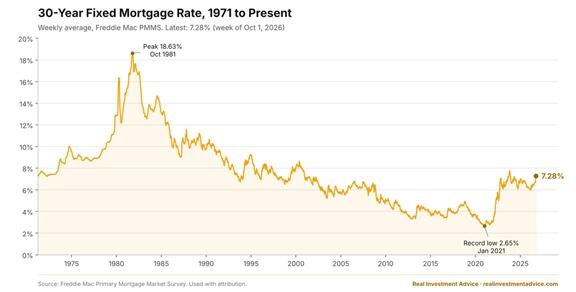
Following another disappointment in existing home sales in July, weak homebuilder sentiment, and plunging housing starts, pending home sales tumbled for the second month in a row in July (-2.3% MoM vs 0.0% exp - below thew worst forecast), dragging sales down 2.5% YoY - the biggest annual drop since April 2025...

This decline matches the second-worst reading in data back to 2001...

“The highest mortgage rates of the year hit right in the middle of summer, and that’s pulling back contract signings,” NAR Chief Economist Lawrence Yun said in a statement.

Home prices are at record highs so houses for sale are sitting on the market longer, and fewer buyers are bidding above the asking price than a year ago, though there are large local market variations.”

All four major US regions experienced a decline in demand during the month.

An index of pending sales in the South, the nation’s biggest home-selling region, decreased 2.2% to the lowest level since January 2025. Pending sales dropped 4.7% in the West.

As a reminder, because houses typically go under contract a month or two before they’re sold, the pending home sales data tend to be a leading indicator of closings that are captured in the monthly previously owned home sales reports.

Translation - this is terrible news building on an already ugly situation in the US housing market.

Tyler Durden Tue, 08/18/2026 - 10:13

Home Depot Earnings Offer Glimmer Of Hope As Small Projects Offset Renovation Downturn

Home Depot Earnings Offer Glimmer Of Hope As Small Projects Offset Renovation Downturn

Home Depot reported stronger-than-expected second-quarter sales and profit as homeowners spent money on smaller do-it-yourself projects, giving the home-improvement retailer enough confidence to reaffirm its full-year outlook.

The frozen housing market, combined with elevated borrowing costs, has deterred homeowners from financing larger renovations, such as replacing exterior windows and doors or installing a new deck, and has also pressured Home Depot shares over the past year and a half.

However, second-quarter demand showed signs of resilience in smaller projects, including ceiling fan replacements, landscaping, gardening, and electrical upgrades.

"They are engaged in smaller projects, but we haven't yet seen that combination of factors that unlocks larger projects," CFO Richard McPhail said in an interview.

Comparable sales increased 1.7% in the quarter, beating the Bloomberg consensus estimate for a 0.94% gain. Revenue rose 5.7% to $47.86 billion, while adjusted earnings of $4.92 a share topped the $4.73 consensus estimate.

Here's a snapshot of 2Q earnings:

  • Comparable sales +1.7%, estimate +0.94% (Bloomberg Consensus)
  • US comparable sales +1.3%, estimate +0.85%
  • Net sales $47.86 billion, +5.7% y/y, estimate $47.33 billion
  • Adjusted EPS $4.92 vs. $4.68 y/y, estimate $4.73
  • EPS $4.79 vs. $4.58 y/y
  • Average ticket sales $92.50, +2.8% y/y, estimate $91.70
  • Merchandise inventories $26.85 billion, estimate $26.29 billion
  • Total location count 2,364, estimate 2,365
  • SG&A expense $8.42 billion, +8.5% y/y, estimate $8.17 billion

Home Depot maintained its forecast for annual revenue growth of 2.5% to 4.5%, with comparable sales ranging from unchanged to 2% higher. The company said tariff refunds should help offset rising fuel costs.

Barclays analyst Seth Sigman told clients, "HD reported better 2Q26 results, with broad-based demand driving better sales, while EPS was well managed and benefited from tariff refunds. The sales improvement should be the key takeaway as trends continue to gradually improve despite limited progress on the housing front."

Home Depot shares are up a little more than 2% in premarket trading. Shares are flat on the year and about 21% below their 2024 peak.

DA Davidson analyst Michael Baker wrote earlier today that the earnings results "doesn't mean we're out of the woods yet with respect to home-related spending, particularly as rates continue to move back up." He noted, "But it does show that the worst of the cycle downtrend is likely behind us."

Tyler Durden Tue, 08/18/2026 - 10:05

Trump Drops Map Of Hormuz As "New US Territory" Amid No Talks, Declares Strait "Open & Operating"; UAE Under Missile Alert

Trump Drops Map Of Hormuz As "New US Territory" Amid No Talks, Declares Strait "Open & Operating"; UAE Under Missile Alert Summary
  • No talks: Trump confirms US-Iran negotiations are off.
  • Hormuz attack: Tanker hit, injuring a crew member.
  • Houthis escalate: Attacks shut Yemen’s Mokha port.
  • Diplomacy stalled: Qatar says not mediating until Oman-Hormuz deal finalized.
  • Iran hardens: Tehran says it maintains an offensive posture.
//--> //--> Strait of Hormuz traffic returns to normal by September 30?
Yes 9% · No 92%
View full market & trade on Polymarket

*  *  *

UAE Under Missile Alert

While initial details and the precise nature of the threat remain unclear, the UAE has said it detected a missile threat targeting the country. "UAE air defense systems detected a missile threat targeting the county," the National Emergency Crisis and Disaster Management Authority said in a post on X. This has included Dubai residents receiving a UAE missile threat alert.

The country has not actually been targeted much by Iran throughout the war. The UAE has in follow-up said the situation is currently "safe" after the missile threat. Air-defenses detected two inbound:

UAE Defense Ministry said it detected two ballistic missiles launched from Iran, one missile fell outside territorial waters, second fell inside.

Trump Confirms 'No Talks' - Says Hormuz 'Open & Operating'; Oil Slides

President Trump issued a new Truth Social post, within hours after posting a map depicting the Strait of Hormuz as a 'new US territory'. He affirmed there are currently no talks or conversations happening with the Iranians - nor is there so much as anything scheduled. However, he claimed the strait is "open and operating" - with water minds having been "removed or detonated".

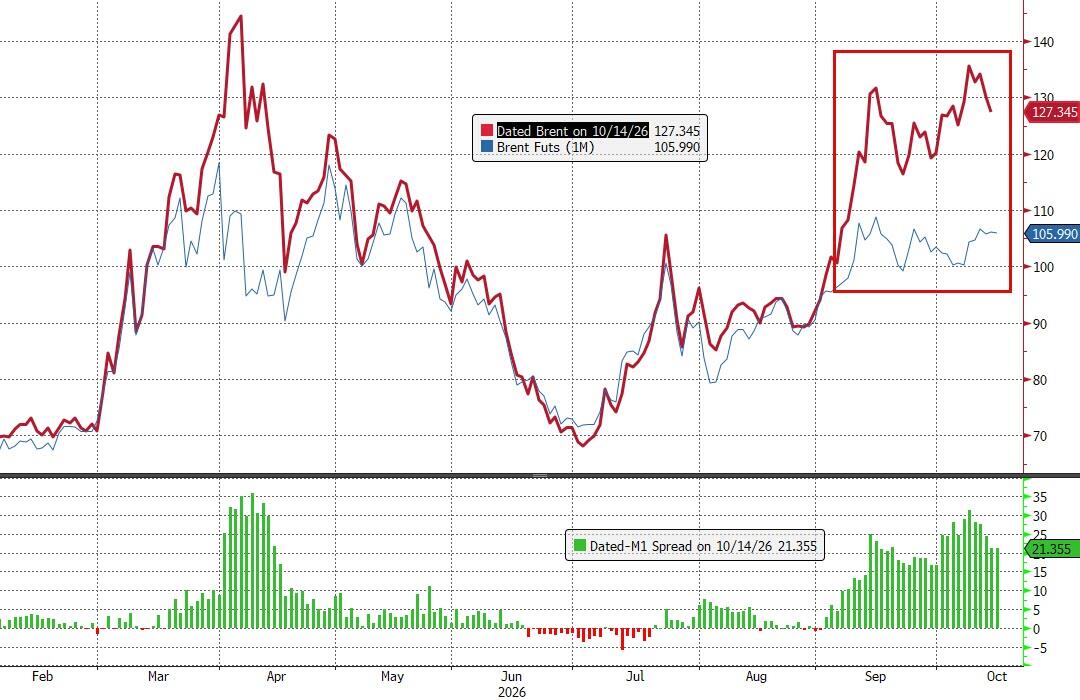
Perhaps as intended, oil reacted to the claim of an 'open' and supposedly mine-free Strait of Hormuz, sliding on the statement...

Iranian Attack on Outbound Tanker in Hormuz

Yet another attack has occurred in the Strait of Hormuz, this time on a foreign tanker on an outbound transit route, which Iran and Oman claim to directly oversee and administer according to the terms of the Oman deal for managing the strait which is still being finalized.

UK Maritime Trade Operations says Tuesday that the unknown projectile caused engine-room damage and a crew casualty, with the remaining crew being rescued and assisted by the Omani Coast Guard.

Such attacks which mark enforcement of Iran's protocol and claim of control over the vital energy transit waterway have been steady, though not rapid, over the last several weeks. Oil prices have been on the rise this week, also as it continues to be clear that Washington and Tehran are digging in with their competing maximum demands.

Houthis Escalate in Red Sea

Hormuz isn't the only chokepoint still witnessing active conflict. Waters off Yemen and the Red Sea also continue to heat up, with the Iranian-allied Houthi rebels still escalating.

According to The Wall Street Journal on Tuesday, the group is "shutting down operations at a strategic seaport and pushing closer to the Bab al-Mandeb Strait, an important global shipping chokepoint."

The report cites Yemeni authorities to describe, "The militant group’s recent missile and drone attacks forced the closure of the port of Mokha, a key logistics hub for civilian shipping and for anti-Houthi forces operating along the coast."

According to more on the significance:

"This is the most significant escalation in quite a few years, maybe since 2020," said Adam Baron, a Yemen expert and fellow with New America, a policy institute in Washington.

Baron called the port of Mokha the key logistics hub for anti-Houthi forces on the Red Sea. The Houthis control mountainous terrain inland from the Bab al-Mandeb but not the coast along the crucial waterway, which is held by opposing forces. 

No Movement on Talks until After Oman Deal Signed: Qatar

On the question of finding a path toward broader US-Iran peace, there's still no movements on talks. Qatar is even openly saying that its direct mediation efforts won't resume until the Oman deal is finalized - which critics have complained gives Iran de facto control of operations in the Strait of Hormuz.

"Qatar’s Foreign Ministry spokesman Majed al-Ansari says during a news conference that countries mediating between Iran and the US are waiting for Iran and Oman to announce an expected agreement on transit through the Strait of Hormuz, before pushing Washington and Tehran to resume negotiations aimed at ending their war," Al Jazeera reports.

President Trump's latest rhetoric and social media activity is not going to help the cause of peace, or the two sides getting back to the negotiating table. After verbalizing Monday that the US should declare the Hormuz Strait a US territory, he posted the following to Truth Social on Tuesday:

All of this comes on the heels of the 60-day diplomatic window set by the MoU inked in June has expired. Tehran said it was already effectively dead anyway, and thus "irrelevant" - blaming Washington for having violated its terms on multiple occasions.

Rough Road to November

Trump is meanwhile ultimately sticking to the following as an ultimate goal of the Iran conflict: "The number one Goal is, and always will be, that Iran cannot have, in any way, shape, or form, a Nuclear Weapon. Thank you for your attention to this matter! President DONALD J. TRUMP," he earlier stated on Truth Social.

The path to midterm elections in November continues to be a rough one for the US administration, and the pain is likely to continue for at least the time being...

Not only has Iran not backed down, but its military is newly claiming to take an "offensive" posture and has reshuffled its command accordingly. If there are new tit-for-tat attacks, Tehran is in essence saying the next salvo will go bigger.

Tyler Durden Tue, 08/18/2026 - 09:55

Women Flee Ceuta After 15 Rapes Recorded Since Migrant Invasion

Women Flee Ceuta After 15 Rapes Recorded Since Migrant Invasion

Via Remix News,

The Spanish Civil Guard has now confirmed there have been 15 rapes in Ceuta since the mass migrant invasion at the end of July, which has continued to shake Europe. In response, women are now reportedly fleeing the city in greater numbers as sexual violence spreads and scenes from the city portray a government unable to contain the growing chaos on the beaches and streets.

The latest rape reportedly occurred on Friday night on Lisboa Street, where three migrant brothers reportedly sexually assaulted a 10-year-old girl. An investigation is ongoing regarding the incident. Remix News reported last week that five underage Moroccan girls had reportedly been raped in Ceuta since July 30, along with one underage boy. Since then, the number has risen to 15, according to the Spanish newspaper El Mundo.

Women in Ceuta are now reportedly looking for an exit. Two sisters, Yoli and María José, say they have left the city until the crisis ends due to fear for themselves and their daughters.

"What we are going through is very hard and it is very hard to hear journalists justify this Government, justify everything. We can't take it anymore, we feel humiliated, trampled. I have had to take my daughters out of their house because the Government does nothing, because Mr. Pedro Sánchez is on vacation in La Mareta. Nobody cares about us," said Yoli to Spanish television network Cuatro.

There have now been dozens of videos of women, both young and old, expressing their fears over the crisis. One asked, "Why do I have to leave my city, the city where my mother gave birth to me, where I was raised, and where I want to raise my children? What we are living through is very extreme."

"I need someone to walk me to my front door at 29 years old. I never thought I would have to live through this situation we're facing - never."

Another woman said she woke up to find a Moroccan migrant in his underwear in her bed after he climbed up multiple stories to slip into her room through the balcony window early in the morning.

The sexual assault of the 10-year-old girl has also shocked residents, with one local woman saying she was now afraid to let her children go outside.

The Civil Guard has already identified approximately 1,800 minors, who have all been issued an identification bracelet. Sources cited by El Mundo indicated that these minors are simply released back to the streets since they cannot be returned to Morocco.

Beyond the threat of rape and sexual assault, daily life has also come to a halt in many respects. Many areas of the beach remain occupied by thousands of migrants, while health services speak of a catastrophe due to the influx of patients, many carrying and transmitting diseases like tuberculosis.

The government has tried to present a picture of calm but an announcement that tents would start being erected for the migrants has fueled fears that many of the migrants could be in the area for some time to come. Meanwhile, 1,500 agents of the Civil Guard and the National Police, along with military personnel, continue to operate in the area.

Police sources have also pointed out deficiencies in border controls, among them problems with air conditioning and identification systems.

During controls, Spanish police have also detained an immigrant with history of terrorism and other crimes, who also had an arrest warrant from Interpol. The detainee remains in Ceuta while the procedures for his extradition are completed. The case raises fears that during the chaos, migrants with terrorist motives may have made their way to European territory.

Read more here...

Tyler Durden Tue, 08/18/2026 - 09:50

Agricultural Commodity Prices Break Out As JPMorgan's Food Crisis Warning Gets Louder

Agricultural Commodity Prices Break Out As JPMorgan's Food Crisis Warning Gets Louder

JPMorgan analyst Nora Szentivanyi's warning last week that the next global food crisis could begin as early as next year has been a major wake-up call for some, adding to the growing voices on institutional desks warning that food inflation is poised to re-accelerate. 

Remaining extra watchful about agricultural prices, Bloomberg reported earlier that US corn futures moved higher after preliminary results from the Pro Farmer Crop Tour indicated weaker-than-expected yields in parts of critical growing belts across the Midwest.

Corn yield estimates were about 3% below last year in Ohio and 14% lower in South Dakota. Soybean pod counts also declined, while severe storms and flooding in Indiana and Ohio added to concerns about further crop damage."

The crop tour has somewhat buoyed markets so far, considering the expected lower yields and unfavorable weather,” said Eliza Redfern, Senior Manager Industry Insights for Bendigo Bank Agribusiness.

Chicago corn futures are approaching their 2026 highs, while wheat futures are closing in on levels last seen in 2023.

Meanwhile, and perhaps most alarming, the broader agricultural complex is confirming the move in soft commodities. The Bloomberg Agriculture Spot Index rose to about 406, its highest level since early 2023 and roughly 27% above its 2024 low.

The benchmark remains below the extreme peaks reached during the 2008-10 Arab Spring crisis and 2021-22 food crises, but its accelerating upside momentum suggests inflationary pressure is building across the broader food complex.

The latest moves provide further evidence that Szentivanyi's global food-crisis scenario may become a higher-probability outcome in 2027.

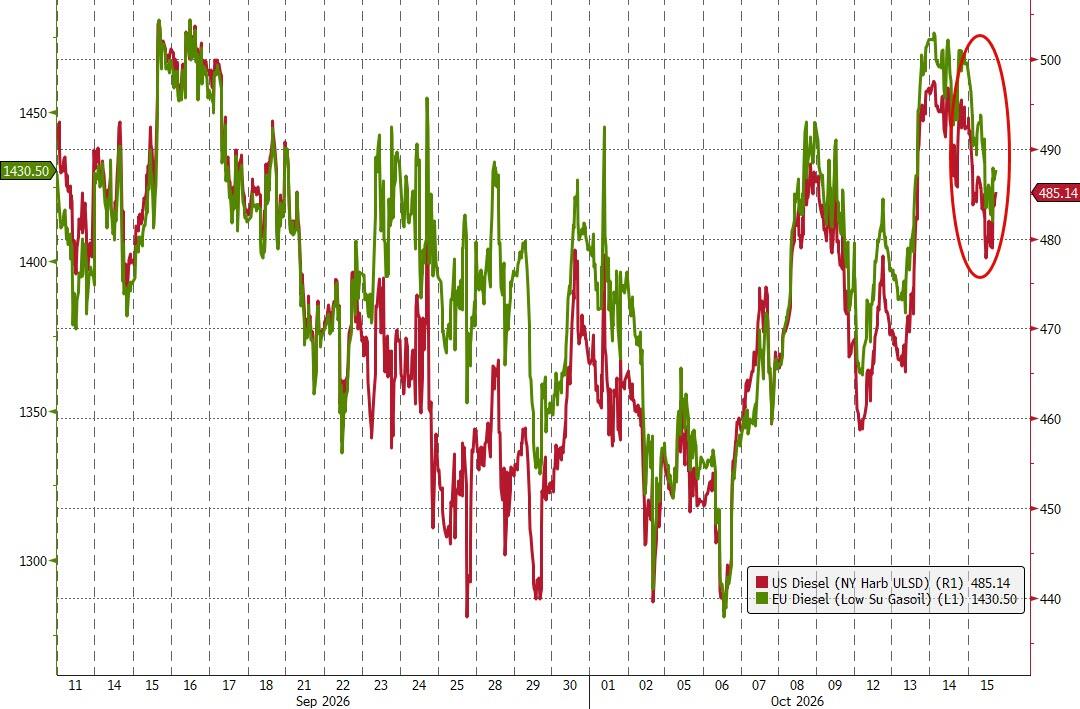
Meanwhile, the diesel crack spread is blowing out, a key indication of a "perfect storm" brewing in the refined products market that will certainly add to inflationary forces in the food complex. 

Tyler Durden Tue, 08/18/2026 - 09:20

Buy-Now-Pay-Later Klarna Crashes As Outlook Cut Exposes Consumer Growth Cracks

Buy-Now-Pay-Later Klarna Crashes As Outlook Cut Exposes Consumer Growth Cracks

Klarna, the Swedish fintech firm best known for its buy now, pay later services, crashed in premarket trading in New York after it lowered its full-year revenue and gross merchandise value forecasts following a second-quarter active-user miss, overshadowing stronger-than-expected earnings.

The buy-now, pay-later firm now expects 2026 revenue of $4.08 billion to $4.16 billion, down from a previous forecast exceeding $4.34 billion. Gross merchandise value is projected to be $149 billion to $151 billion, compared with earlier guidance of above $155 billion.

Third-quarter revenue is expected to range from $940 million to $980 million, well below the $1.11 billion consensus estimate. The company forecast gross merchandise value of $35 billion to $36 billion, versus expectations of $39.26 billion.

Second-quarter revenue was a bright spot, rising 27% to $1.04 billion and beating estimates, while gross merchandise value reached $36.6 billion. Earnings were 1 cent per share, compared with an expected 6 cent loss. But active users totaled 120 million for the quarter, missing the 122 million estimate.

Klarna cited about $600 million of currency headwinds and a more cautious view of Germany, its largest market by volume. The company left its US outlook unchanged, with US gross merchandise value rising 27% during the quarter.

Klarna noted that "the U.S. remains Klarna's fastest-growing large region."

Klarna also said CFO Niclas Neglén will step down in early 2027 after six years in the role.

Nordea analyst Thomas Nilsson provided clients with his first take on the earnings:

Klarna Group plc – Buy/USD 30: Strong Q2 overshadowed by FY26 guidance cut

Klarna delivered a strong Q2 with accelerating growth and improving profitability. GMV rose 18% y/y to USD 36.6bn, revenue increased 27% to USD 1.04bn, and transaction margin dollars grew 42% to USD 446m. Adjusted operating income increased to USD 91m, 100% above Visible Alpha consensus, corresponding to a margin of 9%.

The main negative was guidance. FY26 GMV guidance was cut to USD 149-151bn from >USD 155bn, mainly due to FX headwinds and softer volumes in Europe, particularly Germany. Klarna now expects FY26 adjusted operating income of USD 280-300m, compared with previous guidance of >USD 299m. Conclusion: A strong Q2 report that is overshadowed by the GMV guidance cut. Q3 adjusted operating income guidance is only USD 5-15m due to heavy investments ahead of the peak season. With FY26 guidance lowered by ~7% at the midpoint, we expect negative revisions to consensus estimates in the high single digits. In light of this, we view a negative share price reaction of a similar or greater magnitude as warranted today.

Klarna shares are down 18.5% in premarket trading.

The most staggering figure from Klarna's earnings report is that more than 120 million consumers now use its payment network for everyday purchases, ranging from groceries and gasoline to airline tickets.

Management identified the US as its fastest-growing market, but that bright spot carries a darker macro warning: increasingly stretched US consumers are turning to short-term financing to cover routine expenses.

Tyler Durden Tue, 08/18/2026 - 08:50

US Housing Starts Plummet In July, Near COVID Lows

US Housing Starts Plummet In July, Near COVID Lows

After Housing Starts exploded higher in June (driven by a massive rebound in multi-family units), July was expected to see a reflexive decline of 5.9% MoM...

...things were considerably worse, with US Housing Starts plunging 12.4% MoM (the third major monthly drop in four months)...

On the other hand, the more forward-looking Building Permits (preliminary for July) rose 5.0% MoM (well above the 0.6% MoM expected), after two months in a row of declines.

On a SAAR basis, Starts at back near post-COVID lows while Permits are holding in a four year range...

Under the hood, both Single-Family and Multi-Family movements were stroinger for Permits abut weaker for Starts (after multi-family starts soared last month)...

This shouldn't be a total surprise after yesterday's decline in builder sentiment (confidence among US homebuilders dropped for a second month to the lowest level of the year, dragged lower by elevated borrowing costs and higher material and land prices).

It seems recent rises in the mortgage rate (and inventories already at over-stuffed levels, given the slowness of sales) has finally dented the homebuilders' self-satisfying confidence... and the lack of affordability leaves the American Dream fading into Renter Nation...

Tyler Durden Tue, 08/18/2026 - 08:42

If Other Countries Give Fewer Shots, Why Can't We Ask Why?

If Other Countries Give Fewer Shots, Why Can't We Ask Why?

Authored by Jack Hellner via AmericanThinker.com,

By age 18, a child in the United States can receive roughly 30 to 75 total vaccine doses if they follow standard schedules and get annual flu shots. Fewer shots are needed because vaccines are combined.

By comparison, in Germany, the Robert Koch Institute (via the Standing Committee on Vaccination, STIKO) recommends routine protection against about 12 to 15 infectious diseases for children. Because Germany relies heavily on multi-component combination shots (like the 6-in-1 hexavalent vaccine), children receive roughly 11 to 14 actual physical injections.

Elsewhere in Europe, in England, children receive around 20 to 25 individual vaccine doses from birth to age 14, delivered via roughly 14 to 16 actual needle injections.

Similarly, under Japan’s routine immunization program, children receive around 20 to 22 individual injection shots.

And in Spain, children receive around 15 to 18 individual injection shots from birth through adolescence under the official public health system.

These comparisons raise some obvious questions.

Doesn’t it look like children in the United States get more shots today, and there would be a valid reason to recommend fewer?

Do children in countries with fewer shots have worse health results?

Do other countries ignore science when they have fewer shots?

Wouldn’t it be nice if the media were curious instead of just repeating talking points to trash President Donald Trump?

And vaccines aren’t the only area of health care where such questions should be asked.

Obamacare is one of the worst and most costly bills ever passed, yet the media and other Democrats still falsely claim that it makes health care more affordable.

If Democrats just wanted to cover the poor and those at high risk, they would have just expanded Medicaid and high-risk pools instead of destroying the whole system.

They never wanted affordable care. They wanted government-controlled care.

Tyler Durden Tue, 08/18/2026 - 05:00

"Generates A Number Of Risks": UBS Warns German NatGas Storage Levels Alarmingly Below Seasonal Norms

"Generates A Number Of Risks": UBS Warns German NatGas Storage Levels Alarmingly Below Seasonal Norms

Following up on our "Winter Is Coming: Europe Faces Twin Diesel And NatGas Crunch" note earlier this month, which focused on Europe as a whole, UBS analysts focused on Germany's natural gas inventories Monday morning and warned that levels are alarmingly low for this time of year, raising the risk of elevated prices and a renewed supply crunch if the Northern Hemisphere experiences a severe winter.

Simon Penn, a London-based UBS macro strategist, wrote earlier today that Germany's NatGas storage is just 48% full, compared with 65% a year ago and 75% during the 2022 energy crisis. 

We would go a step further: inventories are now at their lowest level for this time of year in 17 years.

Penn added more color:

Economist Felix Huefner sees Germany hitting 65% in November, compared to the government target of 80% and the EU's target of 90%. This generates a number of risks. 

A surge in demand and hence gas prices if Germany attempts to achieve its targets; increased pressure on Germany's fiscal position if the government needs to use Trading Hub Europe (THE) to replenish stocks; pressures elsewhere in Europe as German demand crowds out other national buyers; Germany's regasification facilities are limited which means even if it can find LNG supply, it can't necessarily convert that to stored gas. Hence, a gas shortage could ensue late winter anyway

The ECB estimates that a 10% increase in wholesale gas prices adds 0.6pp to Eurozone headline inflation. In addition, all that is likely to place downward pressure on German GDP, which is already threatened by the consequences of a near-dry Rhine river. There is now a mere 10cm of navigable depth at the Kaub pinch point - in February it was 400cm and a year ago 200cm. Cargo barges are down to 10-20% of capacity to stay afloat.

Circling back to our Aug. 7 "Winter Is Coming" note, we warned that it is not just a global diesel crunch keeping Goldman's Samantha Dart up at night. NatGas is another mounting concern.

Continued disruption through the Strait of Hormuz, compounded by historically low Rhine River levels, is slowing Europe's effort to rebuild NatGas stockpiles. That risk is now materializing in the inventory data.

Here is where Europe stands in terms of NatGas storage:

At this point, Europeans had better hope that a strong El Niño would produce relatively mild weather. Otherwise, the continent could face a cold and extremely expensive winter.

Tyler Durden Tue, 08/18/2026 - 02:45

Europe's Looming Existential Crisis

Europe's Looming Existential Crisis

Authored by Kenneth Timmerman via American Greatness,

Americans pay little attention to Europe, other than to sneer at the Euro-elites and bemoan the fecklessness of European leaders.

I am guilty of both sins. Mea culpa.

But I am also aware of the coming existential crisis facing Europe as a whole and the European Union quite specifically.

It comes in several flavors, and all of them are bitter.

First is the shock and embarrassment posed by the influx of 72,000 North African Muslim wannabe migrants into Ceuta, one of two tiny Spanish enclaves in Morocco, just miles away from the Spanish mainland near Gibraltar.

The inability—or unwillingness—of the Spanish authorities to repulse them has provoked a Europe-wide reaction, prompting Italy’s center-right prime minister, Giorgia Meloni, to impose passport controls on visitors from Spain for the first time since the Schengen accords of 1995 created a “borderless” European space.

Spain retaliated last week, imposing controls of its own on visitors from Italy.

This week Meloni teamed up with her center-left Danish counterpart, Mette Frederiksen, to jointly condemn uncontrolled migration.

“We are both proud of Europe’s Christian cultural heritage and want to protect it,” they said on Monday. “We expect those who come to our countries and choose to make Europe their home to respect our values and not seek to impose ways of life on us that we do not share.”

Meloni drafted a letter to European Commission President Ursula von der Leyen condemning lax EU immigration policies, which was joined by Frederiksen and 21 EU leaders.

Immigration has been a long-simmering issue since German Chancellor Angela Merkel opened the floodgates to hundreds of thousands of Syrian “refugees” in 2015. The Ceuta stampede is just the latest chapter.

Fabrice Leggeri, a Frenchman who was executive director of the EU Border and Coast Guard Agency from 2015 to 2022, fought tooth and nail to standardize EU immigration procedures and to transform his bureaucratic backwater into a real law enforcement agency.

He was stymied by the European Commissioner in charge of Home Affairs, Ylva Johansson of Sweden. “Don’t worry,” she said. “You don’t need guns and uniforms because migrants come in search of love. Europe is an aging continent, so whether you like it or not, it is your job to welcome migrants.”

Next comes EU enlargement.

Standing at the gates to join the EU’s 27 member states are tiny Montenegro and Albania. Then comes Iceland, should its citizens approve a resumption of EU membership talks in an upcoming referendum.

While only Albania, which is predominantly Muslim, is controversial, their accession could open the door to membership talks with Ukraine and Serbia.

Ukraine would require a peace deal with Russia, which would be less likely should Ukraine be rewarded with EU membership. Serbia, a Russian ally and gateway to the Russian economy, poses its own problems.

And finally, there is the whole question of democracy and freedom.

EU citizens rail incessantly over the often ridiculous regulations enacted by the unelected bureaucrats of the European Commission that affect their daily lives.

Many of these are motivated by Europe’s powerful “Green” parties and lobbyists. Others stem from the left-wing, anti-capitalist, anti-farmer bias of the Eurocrats.

One case in point: the reintroduction of wolves onto agricultural lands where the predators had been eradicated generations ago. Today, the wolf packs are protected as endangered species even as they devastate sheep herds from Sweden to southern Italy.

I know farmers who brave the authorities and secretly hunt down wolves endangering their livelihoods. They operate as a veritable underground resistance movement, communicating using coded texts, always watchful of the police.

It’s a running joke that a young Swedish girl could get gang-raped by Syrian immigrants, and the police wouldn’t lift a finger. But if a farmer got caught killing a wolf, they would exhaust every investigative and prosecutorial resource to put him away for years.

European Commission President Ursula von der Leyen is certainly aware of the dissenters among the European Parliament, mainly from the populist or center-right parties.

But instead of accommodating them, she is attempting to reinforce the powers of the unelected Commission by doing away with the existing rule of unanimity when it comes to foreign policy decisions.

For years, Hungarian leader Viktor Orbán vetoed European Commission policies that invariably criticized Israel, supported the Palestinians, or criticized the United States.

His election loss only emboldened Ms. von der Leyen, who frequently clashed with Orbán personally and in public.

Now she wants to allow a simple majority of member states to approve foreign policy dictates, a shift that would essentially create the “tyranny of the majority” America’s founders warned about 250 years ago.

Former Belgian Prime Minister and European Council President Charles Michel is scathing in his criticism of von der Leyen. “Today, the Commission is trying to take control. That’s not in line with the [EU] treaty,” he told a Belgian magazine in April. “There is super authoritarian governance.”

Much but not all of those new powers came during the COVID years and in response to the war in Ukraine. But the anti-democratic gene runs deep among the Eurocrats.

Former Czech President and Prime Minister Václav Klaus lived through decades of Soviet Communism imposed on his country after World War II. Already in 2009, he was warning about the lack of democratic institutions within the EU.

“The present decision-making system of the European Union is different from a classic parliamentary democracy, tested and proven by history… Here, only one single alternative is being promoted, and those who dare think about a different option are labelled as enemies of European integration.

“Not so long ago, in our part of Europe we lived in a political system that permitted no alternatives and therefore also no parliamentary opposition. It was through this experience that we learned the bitter lesson that with no opposition, there is no freedom. That is why political alternatives must exist.”

Europe and the EU are at a crossroads.

Down one road, Europe will become increasingly authoritarian and increasingly centralized, while its founding cultures will be increasingly marginalized and demeaned in favor of Muslim immigration and multiculturalism. These were the faults that led to Brexit, Britain’s withdrawal from the EU.

Down another road, Europe will return to its roots, celebrate its diverse cultures and its Christian and Jewish heritage, and honor the wishes of its member states and their people.

Count me skeptical, but I don’t see that democratic alternative on the horizon, at least not yet.

Tyler Durden Tue, 08/18/2026 - 02:00

What's Behind Trump's Unexpected Favor To Kim Jong Un?

What's Behind Trump's Unexpected Favor To Kim Jong Un?

Authored by Andrew Korybko,

He might be flirting with a radical policy recalibration even if he soon changes his mind...

Trump unexpectedly announced that the US will “substantially reduce” its participation in the annual Ulchi Freedom Shield large-scale joint military drills with South Korea that he was apparently unaware of till just recently and which began this week. He described his decision as being “Based on my very good relationship with Kim Jong Un” and aimed at not “send[ing] a signal that is totally inappropriate and hostile”. He also complained about its costs and South Korea’s refusal to help the US fight Iran.

Trump’s favor to Kim was unexpected because he mentioned North Korea alongside Russia, China, and Iran as “US adversaries” just last month who have the ability to manipulate US elections. His Under Secretary of War Elbridge Colby was also in Southeast Asia in early August, where he was replicating the NATO 3.0 concept through what can be called AUKUS+. While it’s mainly aimed at containing China, fearmongering about North Korea could raise its appeal among some South Koreans and Japanese.

On that topic, those two states are US mutual defense allies, and they share similar threat perceptions of China and North Korea. They’re also rapidly militarizing, with South Korea planning to build its first nuclear submarine with American assistance and Japan considering abandoning its Three Non-Nuclear Principles, both of which have heightened regional tensions to the US’ divide-and-rule benefit. The same goes for the latest Russian-Japanese tensions over the Southern Kurils in which the US backs Japan.

It was therefore completely unexpected that Trump would do Kim a favor as significant as “substantially reducing” the US’ participation in its annual large-scale joint military drills with South Korea since this goes against all of the abovementioned policies. While only he can account for his reasons, and it’s possible that he simply felt like it and there’s nothing deeper, it can’t be ruled out that he has some plan in mind. His South Korean counterpart’s recent call to resume talks with the North could provide a hint.

Trump might thus be considering the resumption of his own talks with Kim, whether bilaterally like during his first term and/or somehow connected with his “Board of Peace” initiative, the motivation of which could be a blend of personal and geostrategic calculations. As regards the first, he might want to cement his legacy as a “president of peace” like he’s previously described himself as while also distracting from the political-military debacle of the Third Gulf War that he initiated earlier this year.

On the geostrategic front, Trump might fear that Russia, North Korea, and China could strengthen their military-security ties to the point of a de facto alliance in the face of the challenge that AUKUS+ poses to them all, which could risk World War III by miscalculation if North Korea carries out more nuclear and/or missile tests amidst worsening regional tensions. Essentially, the speculative resumption of Trump-Kim talks could therefore be for escalation-control purposes, though only if they’re successful.

It’s admittedly premature to analyze anything beyond what was already mentioned in this piece, and even that which was written is reasonable conjecture, but it’s nevertheless notable that Trump unexpectedly did such a significant favor for Kim in spite of the rising regional tensions that the US is responsible for. After all, this single move goes against all of the US’ policies in Northeast Asia, so it’s not far-fetched that he might be flirting with a radical policy recalibration even if he soon changes his mind.

Tyler Durden Mon, 08/17/2026 - 23:50

Deep Capture: The Administrative State's Intellectual Origins

Deep Capture: The Administrative State's Intellectual Origins

Authored by Sofia Karstens via Brownstone Institute,

Woodrow Wilson holds a distinction no other American president has: he earned a Ph.D., completing his doctorate in political science and history at Johns Hopkins University in 1886. That same year, he wrote an essay called "The Study of Administration," later published in the inaugural volume of Political Science Quarterly. Historians widely credit this essay as the founding document of public administration as a formal academic field, and Wilson himself as the father of that discipline.

Wilson's central argument was that government should be split into two separate domains: politics, where elected officials set broad goals and policy direction, and administration, a technical, expert-driven sphere that should be run with "large powers and unhampered discretion" and insulated from day-to-day political interference.

Wilson suggested that government ought to be removed from the political process...in other words: "Democracy is too important to be left to voters." He explicitly encouraged American reformers to study European administrative models - including Prussia's - for lessons in efficiency, arguing that the US had fallen behind other nations in developing a science of government administration.

Later scholars have debated how far Wilson actually intended this separation to go, and some interpret his argument as calling for administrators to be almost entirely removed from political accountability. His essay laid the intellectual groundwork for what would become the modern professional civil service - insulated from patronage and run by career administrators rather than political appointees or elected officials.

The Frankfurt School's American Exile

Nearly 50 years later, a very different intellectual tradition found refuge in the same city that Wilson's ideas would eventually help administer. Max Horkheimer became director of the Institute for Social Research in Frankfurt, Germany in 1930, leading a group of thinkers who developed what became known as Critical Theory. Its core members included Theodor Adorno, Herbert Marcuse, Erich Fromm, and Leo Lowenthal. Critical Theory is a philosophical framework that analyzes power structures and social inequalities.

Developed by the Frankfurt School in the 1930s and 1940s, it shifted Marxism from a strict economic focus to a critique of culture, media, and modern society. Critical Theory was a different way of looking at philosophy; where philosophy was a search for truth - trying to explain phenomena and things that were not easily proven by science (ethics for example) - Critical Theory shifted to look at philosophy specifically through the lens of Marxism. It became no longer a search for truth but a means of propagandizing, which some would argue was a betrayal of philosophy.

When the Nazis seized power in 1933, Horkheimer was forced to relocate the group first to Geneva and then to New York, where it formed a loose affiliation with Columbia University in 1934-35. Horkheimer's actual scholarly project - laid out in works like Dialectic of Enlightenment and Eclipse of Reason - described how instrumental reason, mass culture, and authoritarianism are able to take hold in modern societies.

It was also between 1933 and 1937 that several regulatory agencies were established that would come to form the backbone of the modern Administrative State.

Port Huron and the Old/New Left Split

By the early 1960s, the American left was largely defined by an older tradition: labor unions, industrial organizing, and class-based politics rooted in the fights of the 1930s and '40s. In June 1962, a group of Socialist Organization representatives, student activists, organized labor unions, civil rights leaders, and foreign observers gathered in Port Huron, Michigan, and produced a document that would come to mark a generational break from that tradition.

Students for a Democratic Society had grown out of the Student League for Industrial Democracy, the youth wing of an older Socialist educational group called the League for Industrial Democracy, which itself traced back to the Intercollegiate Socialist Society founded in 1905. In early 1960, that student branch renamed itself Students for a Democratic Society.

The manifesto produced at Port Huron was drafted primarily by Tom Hayden, a University of Michigan student and former editor of the Michigan Daily, working from ideas that blended the sociology of Columbia's C. Wright Mills and Walter Reuther with the direct-action tactics of the Student Nonviolent Coordinating Committee. The week-long meeting brought together groups who wrote, debated, and voted on a 60-page document. Notably, it took place at a United Auto Workers retreat, with the UAW under Reuther's leadership covering a range of the convention's costs. Inside circles among Reuther's contemporaries referred to it as "The Long Journey."

The statement opened with a line that became its signature: "We are people of this generation, bred in at least modest comfort, housed now in universities, looking uncomfortably to the world we inherit." Its authors argued that two forces had shaken them out of complacency - the civil rights struggle against racial bigotry in the South, and the threat of nuclear war under the Cold War's shadow.

Where the Old Left had organized around labor and class struggle, Port Huron's New Left shifted the terrain. It called for a "participatory democracy" in which ordinary people - not just union leaders or party bosses - would have a direct hand in the decisions shaping their lives, workplaces, schools, and government. It criticized both American Cold War policy and Soviet communism, explicitly opposing the Soviet system's suppression of organized dissent. And because the statement judged the civil rights, peace, and student movements too poor and marginalized to drive change on their own, and organized labor too quiet, it looked instead to universities - which it saw as institutions open to people of nearly any viewpoint who could be recruited as "useful innocents" (often mistranslated as "useful idiots") to carry the water - as the engine of a new movement. Media, unions, high schools, and elementary schools were to follow.

The Port Huron Statement went on to shape the framing of Great Society-era politics, the anti-Vietnam War movement, and the broader counterculture that carried into the early 1970s. Historians and participants alike have described it as the founding document of the New Left and a turning point.

The Modern Left's Long March

The strategic logic for how a university-centered movement might expand its influence beyond campus came from Germany. West German student movement leader Rudi Dutschke, nicknamed "Red Rudi," coined the phrase "der Lange Marsch Durch die Institutionen" (the long march through the institutions), borrowing the "long march" imagery from Mao's Chinese Communist Red Army march of 1934-35. The idea was that instead of pursuing a frontal revolutionary confrontation with the state, radicals should embed themselves inside existing institutions and overtake them from within over time. The name (and indeed his nickname) was a deliberate echo of the Chinese Communist Party.

Herbert Marcuse (The Frankfurt School) explicitly endorsed the approach of pursuing radical change not through revolution but by working patiently inside the institutions of government and civil society until they were captured and transformed from within. Writing to Dutschke in 1971 he intoned: "Your notion of the 'long march through the institutions' is the only effective way" forward for the movement. Marcuse became an enthusiastic backer of the strategy, and summarized Dutschke's strategy in his 1972 book Counterrevolution and Revolt as "working against the established institutions while working within them."

He described infiltrating while learning their actual skills and functions rather than simply obstructing them; by "not simply 'boring from within' but by 'doing the job'...learning how to program and read computers, how to teach at all levels of education, how to use the mass media, how to organize production, how to recognize and eschew planned obsolescence.

Writing nearly three decades later, cultural critic Roger Kimball invoked this same Marcusean formulation to explain how the radicalism of the 1960s ultimately achieved its aims not through revolution but through patient institutional capture - "by insinuation and infiltration rather than by confrontation" (The Long March: How the Cultural Revolution of the 1960s Changed America). The result, as later commentators (The Successful Long March Through the Institutions, The American Vision) have characterized it, was a transformation accomplished without open conflict: "Not a shot was fired. No one was forced into concentration camps. Millions of parents willingly sent their children into public schools and universities systems..." that had, by then, been reshaped from within. Effectively replacing "bloody revolutions from without" with institutional capture from within.

Dutschke's thinking is often linked to the earlier work of Antonio Gramsci, the imprisoned Italian Marxist theorist who argued that revolution in developed Western societies wouldn't come from a single decisive uprising but from a slow "war of position" - a patient campaign to win cultural and institutional influence over time. While there's no direct evidence Dutschke had read Gramsci when he coined the term, notably, his diaries and biography reference other influences, including Georg Lukacs, Che Guevara, and Mao Zedong.

Khrushchev famously said "We will bury you," which he later clarified to mean that communism would trounce capitalism. The Long March Through the Institutions is reminiscent of the Marxist/Communist concept of the "Vanguard State" as the "bridge" between a Capitalist state and a Socialist/Communist state.

Marcus Raskin and the Institute for Policy Studies

One American figure who embodied this institution-building, infiltrating strategy was Marcus Raskin. Born in Milwaukee in 1934 to Russian immigrant parents, Raskin studied at the University of Chicago, where he earned his law degree in 1957. During his time at Chicago, Raskin studied under Rexford Tugwell, who was a Columbia economist and a key member of Franklin Roosevelt's "Brain Trust."

It was Tugwell who had suggested that it would be necessary to collect money (from the American people) to begin the process of creating an Administrative State.

In 1933, President Franklin Roosevelt issued Executive Order 6102, requiring most Americans to surrender their gold coins, bullion, and certificates to the Federal Reserve in exchange for paper dollars, citing that private gold hoarding was worsening the Depression. The following year, the Gold Reserve Act of 1934 revalued gold from $20.67 to $35 an ounce - a roughly 69 percent devaluation of the dollar against gold - which meant the government profited handsomely on the gold it had just collected at the lower price. Tugwell was among the New Deal's most influential architects of expanded federal planning, helping design agencies like the Agricultural Adjustment Administration and the Resettlement Administration. The devaluation, paired with an expanded money supply, gave Washington greater fiscal room to fund Administrative State projects.

After Chicago under Tugwell, Raskin went on to work as legislative counsel for several Congressmen in the late 1950s, then joined the Kennedy administration's National Security Council in 1961 as an aide to McGeorge Bundy. He resigned in 1962, citing his opposition to the Cuban Missile Crisis response. In 1963, alongside fellow Kennedy-administration alumnus Richard Barnet, Raskin co-founded the Institute for Policy Studies (IPS) in Washington, D.C. - widely described as the first independent progressive think tank, built explicitly on the idea that the systemic change they wanted couldn't be achieved from inside government, and would instead have to come through social movements and infiltrating institutions.

IPS was closely tied to the New Left from the start. Historian Brian Mueller has written that IPS "epitomized the ideals of the New Left, especially those found in the 1962 Port Huron Statement" and, in fact, a 1962 prospectus Raskin wrote for IPS contained ideas strikingly similar to Port Huron's. Fellow IPS founder Arthur Waskow joined SDS in 1963, and both men wrote for the New Left magazine Ramparts.

IPS drew sustained scrutiny throughout the Cold War for its foreign-policy positions. The House Committee on Internal Security and later conservative critics documented Raskin and Barnet's contacts with North Vietnamese communist officials during the Vietnam War, Raskin's board membership at Ramparts (which the same committee called "pro-Hanoi, pro-Castro") and, later, in the 1980s, IPS-organized conferences with Soviet officials that a bipartisan group of roughly 80 members of Congress warned could be used for Soviet intelligence purposes.

Carter, Ink, and the Reshaping of Federal Administration

The administrative machinery Wilson had theorized decades earlier took its modern shape under President Carter. By 1977, Carter had concluded that the federal civil service system needed its first comprehensive overhaul since the Pendleton Act of 1883. The opportunity came in the aftermath of Watergate and amid broader public distrust of government institutions. In March 1978, he sent Congress his reform proposal; after 13 days of hearings and testimony from more than 200 witnesses, Congress passed the Civil Service Reform Act, and Carter signed it into law that October - just over seven months after it was introduced.

The Act abolished the US Civil Service Commission and split its functions among three new agencies: the Office of Personnel Management (OPM), which handles federal personnel policy; the Merit Systems Protection Board (MSPB), which adjudicates federal employee appeals; and the Federal Labor Relations Authority (FLRA), which oversees federal labor-management relations.

The reform's chief architect and implementer was Dwight Ink, a career federal executive who had served in every presidential administration since Eisenhower. Ink had already built a formidable reputation of cutting through red tape and quickly executing major government overhauls, earning him the nickname "Mr. Implementation." Ink himself later wrote that he couldn't recall any other government-wide management reform as broad as the 1978 act being enacted so quickly. The transformation was praised by Marcus Raskin's intellectual incubator, IPS, which has documented ties to the American Communist Party and drove DNC capture between 1972 and 1978.

That same year, Carter signed a second landmark law. The Inspector General Act of 1978 established 12 statutory offices of Inspector General across major federal departments and agencies, giving each the authority to audit internal agency documents, investigate fraud, and report findings both to their agency heads and directly to Congress every six months. By 1988 additional IGs had been added for smaller independent agencies, and there are now 73 statutory Inspectors General across the federal government. By systematically replacing public servants with IGs and positions functioning as commissars who decide investigative targets, including the US elections commission, the landscape for a coup became fertile.

Marching Along

CIGIE, created in 2008, was established by the Inspector General Reform Act by merging two earlier coordinating bodies: the President's Council on Integrity and Efficiency (PCIE) and the Executive Council on Integrity and Efficiency (ECIE). Those two predecessor councils themselves went back to 1992, created by executive order under President George H.W. Bush. Between the original 1978 IG Act and the 2008 creation of the unified CIGIE structure are three decades of Long March institutional groundwork.

CIGIE functions as a coordinating and standard-setting body for the IG community - running training, setting audit and investigation standards, and housing an Integrity Committee that investigates allegations against IGs themselves. Its voting members include not just the Inspectors General of individual agencies, but also representatives from the CIA, the Office of the Director of National Intelligence, the FBI, the Office of Government Ethics, and the Office of Special Counsel - a genuinely broad cross-section of oversight and intelligence-adjacent offices sitting on one council, which could be described as a "control layer."

The IG Act has continued to evolve since 1978: notably, the 2022 Securing Inspector General Independence Act added new protections against politically motivated IG removals, requiring the President to give Congress 30 days' notice and a substantive, case-specific rationale before removing an Inspector General.

CIGIE today represents a sui generis entity where one office effectively oversees software integrity across 3,143 counties. This structure echos Woodrow Wilson's administrative state-framed government as "too important to be left to the voters," relying on a political-technocratic elite and completes the Marxist Commissar model.

The GAP

In 1977 the Institute for Policy Studies formed the Government Accountability Program (GAP). On its surface it looked like a place for whistleblowers to find shelter, especially after the Pentagon Papers, and indeed many whistleblowers from the intelligence community and national defense program gravitated there. Critics suggest, however, that it was actually used as a honeypot to entice, contain, and control the whistleblowers, even as it collaborated and often even worked directly with the US Office of Special Counsel (OSC).

The Office of the Whistleblower Ombudsman was created in January 2019, as part of the House rules package adopted at the start of the 116th Congress (when Democrats took control of the House). It established, within the House of Representatives, a mandate to develop practices for House offices receiving confidential information from whistleblowers about government wrongdoing - including setting up reporting systems, maintaining confidentiality, and training staff.

It sat without a director for about a year. Then in February 2020, shortly after the conclusion of Trump's first impeachment trial (which had been sparked by a whistleblower complaint), Speaker Nancy Pelosi announced that she had appointed Shanna Devine as the inaugural director of the office. Devine had previously worked at GAP.

Critics questioned whether someone from an advocacy group could serve a "nonpartisan" role, citing concerns that the position could function as a filter protecting officials from exposure, and worrying whether this infrastructure meant this office could effectively legally spy on everyone - including Congress.

GAP also had a prominent role in advocating for the office's creation. Samantha Feinstein, GAP's senior legal and international analyst, testified before Congress to request the creation of the Ombudsman Office, which meant GAP was influencing policy from the outside as well.

The Modern Left's Electoral Rise

Decades after Port Huron, the left flank that it and IPS helped seed has grown into an electoral force. The Democratic Socialists of America was formed in 1982 through the merger of two left-wing organizations: the Democratic Socialist Organizing Committee, founded in 1973 by socialist Michael Harrington, and the New American Movement. For decades it remained small and aging - its median member age was 68 in 2013.

That changed after 2016. Bernie Sanders' presidential campaign highlighted disaffection with mainstream Democratic politics and helped consolidate a younger left wing, and DSA's median member age dropped to 33 by 2017. One commentator described the shift as transforming the group from a "musty debate club for retired social democrats into an electoral powerhouse of young, ecumenical radicals."

Electoral wins followed quickly. In 2017, fifteen DSA members won local and state offices, including Lee Carter's election to the Virginia House of Delegates. The breakthrough came in 2018, when DSA member Alexandria Ocasio-Cortez defeated incumbent Congressman Joe Crowley in a primary upset in New York's 14th District, becoming a national figure. She and Rashida Tlaib became the first two DSA members elected to Congress that year.

The organization's footprint in elected office has continued to grow, with Ashik Siddique, a research analyst at one IPS program (National Priorities Project) who is also separately, and much more significantly, the current national co-chair of the DSA. That means that a sitting IPS staffer simultaneously holds DSA's top elected position.

Notable DSA-linked officials now include Ocasio-Cortez, Tlaib, and New York City Mayor Zohran Mamdani, elected in 2025. By 2025, more than 250 DSA members held elected office across 40 states, with 90% of them elected after 2019. As of mid-2026, DSA has grown to more than 120,000 members and now plays an influential role within the Democratic Party, and the group and its local chapters have endorsed 150 candidates this year, claiming 38 wins so far.

The group draws sharp fire from opponents. President Trump has characterized Mamdani and other DSA-backed candidates as "communist," exposing their links to adversaries like the CCP - though DSA describes itself as aiming for "democratic socialism."

Expert Colonel Tim Shindelar describes The New Left's methodical inching into the Modern Left as "The Final Mile." The Old Left (Marxism, 1908-1962; 54 years) was about class struggle and establishment of unions. The New Left (Social Justice, 1962-1982; 20 years), focused on issues like abortion, capital punishment, civil rights, environmentalism, feminism, gay rights and gender roles, and immigration. The Modern Left (Final Mile, 1982-present; 44 years) has evolved into policies like the Green New Deal, making higher education free, social ownership of the American economy (placing governors on true free market capitalism), national defense reduction, a Democratic Party shift into the progressive far left, along with pro-Palestinian and anti-Zionist causes.

The Media and The Last Mile

This shift to administrative power effectively renders elected officials powerless. Just because someone is elected to office doesn't mean they have any real power; the administrative state will allow elected officials (even executive ones) to ride in the back but they cannot drive the car.

Which means that voters are at the kids table, because it doesn't matter who the elected official is if the power lies with the Administrative State...thus embodying and defining Wilson's vision of keeping politics out of government because democracy is too important to be left to voters. The politics in which we all engage is merely a rubber match, and is unconnected to the outcome; the real match is occurring in a different stadium entirely.

Much of this neutralization and marginalization of the actual people (voters), while maintaining the illusion that it is neither by validating the scrimmage to its participants, traces to mid-20th-century globalist planning (1952-1956), building on Wassily Leontief's 1953 work aimed at phasing American labor to China while addressing excess human labor and galvanizing wealth concentration among a technocratic elite. Individual self-interest via game theory was expected to align populations toward what we now describe as the Singularity, but Marx's framework did not anticipate AI collapsing labor demand to zero - accelerating the need for focused population control programs. But there would be no buy-in unless a different diorama was presented.

The 1928 book Propaganda was written by the nephew of Sigmund Freud, Edward Bernays (1891-1995). Bernays was the son of Freud's sister and also related through his mother, who was Freud's sister. His father was also the brother of Freud's wife Martha.

Bernays is often called the "father of public relations" and Propaganda argued that manipulating public opinion is a necessary part of a functioning democracy. It drew heavily on his uncle's psychoanalytic theories to explain how to influence mass behavior through unconscious desires rather than rational argument.

George Orwell didn't invent the world of 1984 out of thin air - he drew it directly from Stalinist Russia, where erasing and reshaping history was institutionalized state policy. Not long after Stalin consolidated control, images of Leon Trotsky, the driving force behind the 1905 and 1917 revolutions, started vanishing from public life. In their place came grand, fictionalized depictions of Stalin standing shoulder to shoulder with Lenin as co-architects of the Bolshevik uprising, while Trotsky, despite having founded the Red Army himself, was written out entirely. These doctored scenes became fixtures of Soviet propaganda, plastered across office walls, towering billboards, museum halls, and postage stamps.

The effect on public memory was profound. Younger citizens absorbed the fabrication as historical fact, while older ones who had lived through the actual events found their genuine recollections gradually blurring with the state's preferred narrative - a strange kind of political false memory syndrome. People who reconciled what they actually remembered with that which the government insisted they believe developed what Orwell described as "doublethink." Those who refused - old revolutionaries who knew firsthand - were branded traitors, class enemies, or fascist sympathizers; they faced arrest, torture, forced public confessions, and execution.

With total command over media and law enforcement, it is possible to rewrite the collective memory of an entire population if you have one generation in which to accomplish it. With fully infiltrated and captured institutions it is possible to take control over an entire country without firing a shot if you have two. We are in the final mile, and the ghost in the machine has a government ID.

Sofia Karstens is an activist in California who worked closely with publisher Tony Lyons and Robert F. Kennedy Jr on several projects, including Kennedy's best-selling book: The Real Anthony Fauci. She collaborates with several organizations in the legal, legislative, medical science, and literary spaces and she is co-founder of Free Now Foundation, a non-profit preserving medical freedom and children's health.

Tyler Durden Mon, 08/17/2026 - 20:55

Peter Thiel Makes $76 Million Bet On Argentina's Top Shale Exporter Amid Milei Reforms

Peter Thiel Makes $76 Million Bet On Argentina's Top Shale Exporter Amid Milei Reforms

Vista Energy SAB's American depositary receipts are up 5% Monday on news that Peter Thiel's hedge fund disclosed a $76 million stake in Argentina's largest oil exporter.

Thiel Macro LLC reported owning almost 1.2 million shares of Vista at the end of the second quarter, valued at about $76 million. This was the fund's second-largest disclosed holding after Amazon.

Thiel, the co-founder of Palantir and PayPal, has deepened his ties to Argentina. He recently bought a home in Buenos Aires and met President Javier Milei in April, fueling speculation about increased investment in the country, which is undergoing a radical shift from failed socialism toward free-market capitalism.

Vista Energy is a Mexico-incorporated independent producer focused almost entirely on Argentina's Vaca Muerta shale formation. Latest data show that the formation's combined oil and natural gas output has surpassed 1 million barrels a day.

Bloomberg noted:

Under Milei, Argentina has removed controls on oil prices and exports, and regained access to global financial markets, jump-starting growth in its Vaca Muerta shale patch in Patagonia, where combined crude and natural gas production has already surpassed 1 million barrels a day. The boom is starting to transform Argentina's economy.

Since Milei was sworn in on December 10, 2023, taking the oath of office in Buenos Aires, Vista ADRs have risen 139%.

Bloomberg data show that Theil now ranks as the 15th-largest shareholder. 

Milei's economic reforms are aimed at attracting foreign investment, particularly in the country's natural resources, including oil, rare-earth minerals, and lithium.

Tyler Durden Mon, 08/17/2026 - 20:30

Iran War Pushes Middle Eastern Airlines Towards $4.3BN Loss In 2026

Iran War Pushes Middle Eastern Airlines Towards $4.3BN Loss In 2026

Via Middle East Eye

As the US and Israel launched air strikes on Iran on February 28 2026, Iran struck back near US military installations in the Gulf, including in Qatar and the UAE. Several international airports were hit by Iranian strikes, including Dubai, the world's busiest for international passengers, as well as Abu Dhabi, Kuwait and Bahrain

The UAE, Qatar, Bahrain and Kuwait closed their airspaces due to safety concerns, gradually reopening them a week later as hostilities lessened. The war has had long-lasting consequences for regional aviation: falling passenger and cargo demand, fewer private jet flights, and global repercussions from high jet fuel prices

via AFP

The International Air Transport Association's (IATA) June outlook estimated that airlines operating from the Middle East will see a $7.2bn net profit in 2025 become a $4.3bn net loss in 2026.

Most major regional carriers have resumed operations, including Emirates, Etihad and Qatar Airways, but not at full capacity. Emirates CEO Tim Clark told the Financial Times in June his planes were flying at three-quarters capacity

Conversely, most European and Asian airlines' flights in the region remain suspended. Air France expects to resume in late August and Lufthansa in September, while British Airways, Cathay Pacific and Singapore Airlines are all targeting late October. 

Air Canada is not planning to resume before mid-January 2027, and many others have not announced a restart date at all. Regional airspaces have reopened, but are still facing intermittent closures and disruptions

The EU Aviation Safety Agency’s most recent bulletin advises operators to "avoid the airspace of Bahrain, Kuwait, Qatar, the UAE and part of the Gulf of Oman until 31 August 2026".

The result is limited choice for travelers. For a one-week round trip between the UAE and London in September, the only options are Emirates to Dubai, Etihad to Abu Dhabi, or Air Arabia to Sharjah, while to fly between Doha and Tokyo on those same dates, only Qatar Airways is available.

Business under threat

Gulf airlines organize their activity around a hub-and-spoke model concentrating traffic at a central base and operating flights worldwide from there. Passengers connect onward from the main hub, offering connections that are otherwise unavailable or sometimes cheaper fares than direct flights. 

This model has long relied on the Gulf’s strategic position between Europe and Asia, forming what analysts describe as a "bridge" between the two continents. But the war has put this model at risk.

Naveed Kapadia, an aviation lecturer at Buckinghamshire New University, told Middle East Eye that while competition for airlines such as Qatar Airways and Emirates is “greatly reduced”, allowing them to “capture market share and maintain stronger fares”, they remain “connecting carriers whose economics depend on moving large volumes of passengers efficiently through Dubai and Doha”.

Kapadia said IATA’s June data showed Middle Eastern passenger demand fell 13.9 percent year-on-year, while direct traffic between Europe and Asia rose 11 percent, already revealing a strain on the Gulf carrier’s model.

This leads to cost increases across the board. “Where flights must use longer or less efficient routings, airlines face higher fuel burn, longer crew duty periods and reduced aircraft utilisation,” Kapadia said. The extra fuel many now carry in case of disruption also directly limits “passenger or cargo payload that can be carried”.

The hub-and-spoke model leaves airlines susceptible to disruption, as aircraft and crews can be stranded far away, causing cascading delays and cancellations across the entire schedule.

Emirates innovates  

Emirates has been innovating to win back the customers it had before the war, as many are hesitant to book flights connecting through Dubai in case hostilities resume.

One measure is an unprecedented travel insurance policy, offering comprehensive coverage even in case of conflict-related cancellation. Until now, most travel insurance voided cover in the event of war-related disruption, leaving passengers to absorb the costs themselves. 

The policy aims to prevent passengers from being stranded, with Emirates offering to fly them home on other airlines if needed. CEO Tim Clark told the Financial Times the aim was to guarantee “we would get you back irrespective [of whether it's] on Emirates or not”.

Dubai has also been trying to reboost tourism more broadly, offering complimentary packages for visitors invited by Emirati nationals and free hotel stays for long connecting flights.

Cargo demand lags 

Cargo carriers have also been impacted by regional disruptions. Kapadia said Middle East cargo demand grew roughly a third slower than the rest of the industry’s, at 5.6 percent year on year, behind the global rate of 8.5 percent.

Citing IATA figures, Kapadia said traffic between Europe and the Middle East remained 41.1 percent below the previous year, while Asia-Middle East traffic was down 4.1 percent.

He added that while “disruption to maritime traffic through the Strait of Hormuz is creating demand for faster alternatives, particularly for urgent, high-value and time-sensitive shipments”, this was not a "straightforward windfall" for Gulf-based cargo airlines.

Middle Eastern carriers such as Qatar Airways Cargo and Emirates SkyCargo account for around 13 percent of global air cargo traffic.  “The more important question,” he said, “is whether they can convert short-term urgency into sustained and profitable cargo flows.”

Private jets staying  

Similar disruptions have also been observed in the private jet sector. Nick Koscinski, an aviation analyst at WINGX, told Middle East Eye that as of 10 August, overall private jet traffic originating in Gulf countries was down 46.5 percent since the war began. 

“The vast majority of flights stayed within the Middle East region,” he said, though volumes there are “still down considerably”. Europe remains the second most common destination from Gulf origins, but Gulf-to-Europe flights are down 41.0 percent.

Koscinski said Qatar Executive, one of the top Gulf-based private jet operators, had been more resilient than UAE or Saudi Arabia-based competitors.  Total flights are down 6.7 percent since the war began, against 28.7 percent for a comparable UAE-based operator and 39.0 percent for a Saudi one. 

Koscinski said operators “likely have some ability to pass increased operating costs, like fuel spikes, through to the consumer via surcharges”, but lags in repricing and “softer demand overall” mean they will still take a financial hit.

Fuel costs squeeze margins

Jet fuel prices fell 20 percent in June as Gulf oil flows temporarily improved, Kapadia said, but remained “45.8% higher than a year earlier”. IATA forecasts the 2026 jet fuel price average will run 70 percent above 2025 levels.

Kapadia expects “Gulf airfares to remain elevated and volatile rather than rise uniformly” because “airlines will try to recover higher fuel and disruption costs through fares to some extent, but they cannot pass on every additional cost without weakening demand, particularly among price-sensitive leisure travellers.”

Low-cost carriers around the world have been particularly vulnerable to the jump in fuel cost: US-based Spirit Airlines ceased operations on 2 May 2026, while Air Baltic and Wizz Air face growing bankruptcy risk and are forced to restructure operations. 

McKinsey report found that around 70 percent of jet fuel surcharges are passed directly to consumers, with airline margins recovering only briefly when fuel prices fall. It said the economic pressure will force airlines to retire older aircraft, cut less-booked routes, and further trim overhead costs.

Not every carrier is equally impacted. Israel’s national airline, El Al, has recently reported record profits, more than double the previous year.

Many passengers have criticized the “outrageous” fares, as the continued flight suspension by international carriers leaves the airline in a near-monopoly.

Harsha Jaison, an aviation consultant at ICF, told Middle East Eye the conflict has set a precedent that will probably outlast it. “Airport investment deals, geopolitical risk is increasingly being reflected in downside scenarios, valuation assumptions and risk premiums,” she said.

Tyler Durden Mon, 08/17/2026 - 20:05

Record Ground Beef Prices May Finally Be Breaking Consumer Demand

Record Ground Beef Prices May Finally Be Breaking Consumer Demand

Last week's retail sales report provided fresh evidence that the K-shaped economy is buckling, with national average gasoline prices still printing above $4 a gallon and discretionary spending weakening. Consumer stress is now surfacing in the grocery aisle: as beef prices hover near record highs, Americans are beginning to trade down to cheaper proteins.

Bloomberg cites new data from Chicago-based market research company Circana, showing that beef sales volumes declined .3% during the 13 weeks through mid-July. Volumes had risen about 5% during the same period in each of the previous two years. The decline is notable because it occurred during the peak grilling season around Memorial Day and July Fourth.

Source: Bloomberg

Data from the United States Department of Agriculture (USDA) show that the national average price of ground beef in the supermarket is hovering just below $7 per pound, a record high, as a prolonged cattle shortage shows no signs of abating anytime soon.

The Trump administration has focused on easing elevated beef prices through increased imports, but any meaningful relief will take years. The US cattle herd remains near its lowest level in more than five decades, while imported animals must be raised for months before entering the food supply.

Bank of America analysts recently cited Oklahoma State University agricultural economist Derrell Peel, who warned that the US cattle cycle is unlikely to improve anytime soon and that beef prices are poised to remain elevated through at least next year.

Read:

We noted in late July that one of the most overlooked affordable proteins is pork, which averaged $4.81 per pound in mid-June, compared with $7.95 per pound for ground beef, while pork chops cost roughly one-third as much as beef steak, according to Bloomberg, citing NielsenIQ data.

"Consumers are stretched," Chris DuBois, an executive vice president at data-analytics firm Circana, told Bloomberg. "It's not always just about the price of food, there's the price of life that hits, so that puts some of the pressure on total volume in the store."

Last week (view report), retail sales in July were a big disappointment, with discretionary categories seeing spending pullbacks. Notably, lower-income spending held up well, while higher-income spending cooled modestly.

With that said, demand destruction levels for beef may finally be hitting, which is a promising sign of early rebalancing. However, consumers will not be thrilled, as they will have to trade down to cheaper proteins such as chicken and pork.

Tyler Durden Mon, 08/17/2026 - 19:40

Charges Against Palisades Fire Arson Suspect Revised

Charges Against Palisades Fire Arson Suspect Revised

City News Service via The Epoch Times,

LOS ANGELES - The man accused of setting a blaze that grew into the deadly Palisades Fire, the most destructive fire in Los Angeles history, is facing one less criminal charge, with federal prosecutors obtaining a revised indictment in the case.

Jonathan Rinderknecht, 29, is posed after his arrest on charges that he intentionally ignited the Pacific Palisades fire in Los Angeles, before his first court appearance in Orlando, Fla., on Oct. 8, 2025. Department of Justice/Handout via Reuters
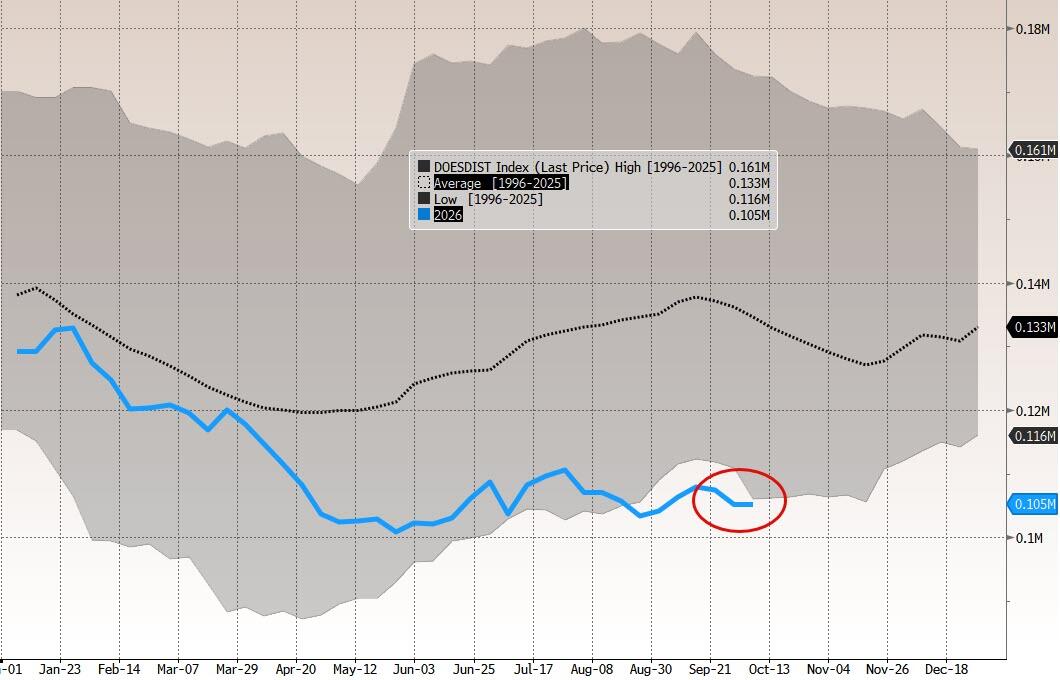
In June, a federal court jury deadlocked 10-2 in favor of acquitting Jonathan Rinderknecht on three arson-related charges stemming from the 2025 firestorm, which prosecutors say began on New Year's Day as the Lachman Fire, which smoldered for a week before Santa Ana winds re-ignited it into the Palisades Fire. In light of the deadlock, a judge declared a mistrial, but prosecutors vowed to retry the case.

The Palisades Fire killed 12 people, burned 23,448 acres, cost billions in damage and insurance claims, and ruined much of the exclusive Pacific Palisades community, destroying about 6,800 structures.

Rinderknecht was originally charged with three federal arson counts: destruction of property by means of fire, arson affecting property used in interstate commerce, and timber set afire. On Aug. 13, however, prosecutors filed a superseding indictment with only two charges - destruction of property by means of fire and arson affecting property used in interstate commerce.

In the new indictment, the first charge refers only to Rinderknecht's alleged setting of the Lachman Fire, rather than the Lachman and Palisades fires.

Rinderknecht is due in court for a status conference this week, with a re-trial tentatively set for October.

First Assistant U.S. Attorney Bill Essayli insisted after the mistrial was declared in June that prosecutors would eventually win a conviction.

"The evidence is strong that Jonathan Rinderknecht is responsible for igniting the fire on January 1, 2025, which eventually became the Palisades Fire," Essayli wrote on X. "We fully intend to retry this case before a new jury and obtain guilty verdicts on all charged counts."

Defense attorney Steven Haney told reporters outside court, however, that his client is innocent, and a retrial won't give prosecutors a better result. He said prosecutors "failed miserably" in their efforts to prove their case.

"If they want to re-try it again, we can re-try it again," Haney said. "If Bill Essayli wants to cheerlead from the sidelines, maybe he should come in and try the case himself next time."

He said a re-trial would likely end up with Rinderknecht being acquitted.

"Ten-to-two is an overwhelming message from the jury that the government failed and did not have enough evidence to prove their case," Haney said.

Rinderknecht remains in federal custody pending the new trial.

During the 10-day trial earlier this year, the jury heard evidence that the deadly Palisades Fire was a "holdover" fire - a continuation of the Lachman Fire that began early in the morning on New Year's Day 2025. Although firefighters quickly suppressed the Lachman Fire - named for a street near the Skull Rock Trailhead - the fire continued to smolder and burn underground within the root structure of dense vegetation.

On Jan. 7, 2025, heavy winds caused the underground fire to re-surface and spread above ground in what became known as the Palisades Fire, which caused widespread damage in Pacific Palisades and Malibu.

Prosecutors used witness statements, video surveillance, cell phone data, and analysis of fire dynamics and patterns at the scene to try to show Rinderknecht intentionally set the Lachman Fire and then lied about it to investigators. The evidence was largely circumstantial.

Haney argued that no hard evidence tied his client to arson, and the Lachman and Palisades fires were two separate events. The first fire was likely caused by errant New Year's Eve fireworks, he told jurors, and the second blaze could've been arson.

According to Haney, Rinderknecht was on the trail near the Hidden Buddha clearing where the Lachman Fire was thought to have started, but the part-time Uber driver did nothing more than call 911 to report it.

Haney insisted the Lachman Fire "could've started before Jonathan even arrived [on the scene]. Nobody knows for sure when it started. Everyone is guessing. A man's on trial and nobody knows when the fire started."

Prosecutors told jurors Rinderknecht, driven by anger, loneliness and a thirst for revenge against the wealthy, used a grill lighter to ignite hilltop vegetation around midnight on Dec. 31, 2024 at a remote, deserted area adjacent to the Pacific Palisades' Summit neighborhood. That fire ultimately exploded into the deadly conflagration that wiped out much of the upscale community six days later.

Tyler Durden Mon, 08/17/2026 - 19:15

Pages